
Katyayani's strength on Shashthi, and why it was never the same as rage


Mahishasuramardini , Bhadrakali , Chandika. Devotees use all three names for Katyayani , whom Shardiya Navratri honours on Friday, 16 October 2026, the day of Shashthi tithi, the sixth lunar day. These names are not merely ornaments on a crown. Each points to a central truth: she is the force that rises when demons and negative forces threaten the world.
Her origins are told in two main narratives, and both carry the same message. Whether she answers a sage’s prayer or emerges from the collective power of the gods, her arrival marks the moment when disorder is challenged. Unrest is not accepted as normal. It is confronted, resisted, and overcome.
The Sage Who Asked for a DaughterIn one Puranic account, Sage Katyayan prayed for the Goddess to be born as his daughter. She appeared before him and went on to destroy the demons, including Mahishasura. The name Katyayani, associated with Katyayan, is linked to this story. Puranic texts differ in their details, so this should be understood as one telling among several.
There is something quietly radical about this account. A prayer becomes a relationship, and that relationship becomes strength in action—a power directed against what causes harm.
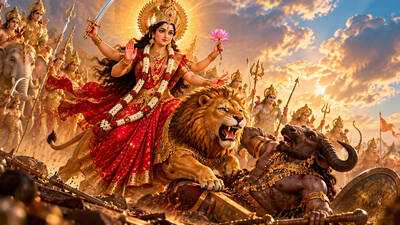
What Did the Gods Do Before She Appeared?According to the Markandeya Purana, when Mahishasura spread disorder throughout the worlds, the troubled gods gathered and pooled their energy. From this concentrated power, the Goddess emerged to slay him.
Durga Puja celebrates this victory. In Bengal, Sharad Shashthi is traditionally associated with Bodhon, the ritual awakening or invocation of the Goddess. However, some observances may fall on different dates according to regional almanacs and local traditions, so check your neighbourhood puja committee’s schedule.
Consider the sequence of events: the gods gather, their energy is pooled, and only then does the Goddess act. Victory is not born of panic but of concentrated power. This is where many Navratri teachings depart from the idea that strength is simply another form of anger.
Viewed through this devotional interpretation, rather than as a direct scriptural quotation, her strength lies in making the right decision at the right time, standing against injustice, and using power with wisdom and restraint.
A Sword, a Lotus, and Two Open HandsThe gopis, the cowherd women of Vrindavan, prayed to Katyayani for Krishna to become their husband. The Bhagavata Purana places their vrata, or religious observance, in the winter month of Margashirsha, not in Ashvin.
Many interpret the prayer for Krishna as a husband symbolically: as a longing for a partner embodying Krishna’s qualities of divinity, love, and virtue. In this reading, devotion seeks not merely a person but a particular quality of life and love.
Katyayani’s iconography carries a similar message. She is depicted with four hands. One holds the sword Chandrahas, while another holds a lotus. The remaining two display the Abhaya Mudra, the gesture that dispels fear, and the Varada Mudra, the gesture that grants boons. She rides a lion, often referred to as Shardula.
As you light the lamp, remember what each symbol represents: fear dispelled, blessings bestowed, and negative forces overcome.
The sword and the lotus travel on the same lion, at the same pace.
Her origins are told in two main narratives, and both carry the same message. Whether she answers a sage’s prayer or emerges from the collective power of the gods, her arrival marks the moment when disorder is challenged. Unrest is not accepted as normal. It is confronted, resisted, and overcome.
The Sage Who Asked for a DaughterIn one Puranic account, Sage Katyayan prayed for the Goddess to be born as his daughter. She appeared before him and went on to destroy the demons, including Mahishasura. The name Katyayani, associated with Katyayan, is linked to this story. Puranic texts differ in their details, so this should be understood as one telling among several.
There is something quietly radical about this account. A prayer becomes a relationship, and that relationship becomes strength in action—a power directed against what causes harm.
What Did the Gods Do Before She Appeared?According to the Markandeya Purana, when Mahishasura spread disorder throughout the worlds, the troubled gods gathered and pooled their energy. From this concentrated power, the Goddess emerged to slay him.
Durga Puja celebrates this victory. In Bengal, Sharad Shashthi is traditionally associated with Bodhon, the ritual awakening or invocation of the Goddess. However, some observances may fall on different dates according to regional almanacs and local traditions, so check your neighbourhood puja committee’s schedule.
Consider the sequence of events: the gods gather, their energy is pooled, and only then does the Goddess act. Victory is not born of panic but of concentrated power. This is where many Navratri teachings depart from the idea that strength is simply another form of anger.
Viewed through this devotional interpretation, rather than as a direct scriptural quotation, her strength lies in making the right decision at the right time, standing against injustice, and using power with wisdom and restraint.
A Sword, a Lotus, and Two Open HandsThe gopis, the cowherd women of Vrindavan, prayed to Katyayani for Krishna to become their husband. The Bhagavata Purana places their vrata, or religious observance, in the winter month of Margashirsha, not in Ashvin.
Many interpret the prayer for Krishna as a husband symbolically: as a longing for a partner embodying Krishna’s qualities of divinity, love, and virtue. In this reading, devotion seeks not merely a person but a particular quality of life and love.
Katyayani’s iconography carries a similar message. She is depicted with four hands. One holds the sword Chandrahas, while another holds a lotus. The remaining two display the Abhaya Mudra, the gesture that dispels fear, and the Varada Mudra, the gesture that grants boons. She rides a lion, often referred to as Shardula.
As you light the lamp, remember what each symbol represents: fear dispelled, blessings bestowed, and negative forces overcome.
The sword and the lotus travel on the same lion, at the same pace.
Next Story