
Maa Siddhidatri and Maha Navami 2026: When thought becomes power


Siddhi is so often translated as “supernatural power” that most readers stop there. Maa Siddhidatri , worshipped on Navami during Sharad (Shardiya) Navratri 2026, invites a more grounded interpretation.
What the texts say about the giver of the SiddhisPuranic lists describe her as the possessor and bestower of the eight Siddhis, including Anima (the ability to become minute), Mahima (the ability to become vast), and Garima (the ability to become immensely heavy).
This changes how you stand before her. You are not asking a minor force for a small favour. You are approaching the source that holds the keys.
Yet Siddhi is not merely a display of power. It is a state—the awakening of an inner capacity that was always there. As many spiritual teachers explain, the greatest Siddhi is mastery over your own mind, purity in your actions, the honest fulfilment of your responsibilities, and the ability to remain on the path of dharma even when circumstances become difficult.
Nothing left to chaseFollow the nine forms of the Goddess in sequence, and a pattern emerges:
She is associated with extraordinary and extrasensory powers, as well as the subconscious mind and superconsciousness. When outcomes begin to follow your thinking without excessive effort, that is one way to understand her presence.
The principle is ancient: what you think, you become. The mind stops being a noisy room and becomes a lamp.
For those who work with ideas, including inventors and designers, her worship is considered especially helpful. After all, genuine innovation cannot always be forced. It emerges naturally, like a lotus opening when the sun is ready.
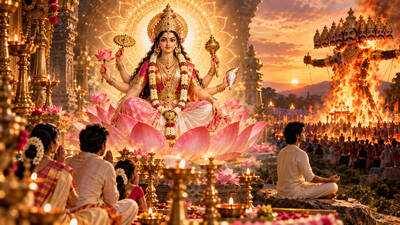
A seat on the lotus, and no vehicleShe needs no mount and goes nowhere. She sits on a lotus, calm and complete, holding a lotus, a chakra (discus), a mace, and a conch.
When nothing needs chasing, you sit. When nothing needs proving, you bloom.
Why she grants no boon on the last dayOn this day, she neither grants boons nor offers protection because she has turned inward. The powers we worship throughout Navratri are understood to be internal, and the Mother is not so much departing as merging with the devotee.
The question changes from “What will I receive today?” to “What have I become?”
She is also associated with Ardhanarishvara, the half-Shiva, half-Parvati form—a reminder that every being carries both masculine and feminine energies. Softness and leadership belong together. Maintain that balance, keep your thoughts clear, and allow inner Siddhi to emerge without forcing it.
The ravana you cannot see on the fieldNavami falls on Tuesday, 20 October 2026, and ends around 12:50 PM in Delhi. Check your local Panchang (Hindu almanac) for the exact timings.
Dashami follows, and Dussehra (Vijayadashami) is celebrated that day in Delhi and much of North India. According to Bengali almanacs, Bijoya Dashami and Sindoor Khela fall on Wednesday, 21 October, as do certain observances in other regional calendars.
Dussehra celebrates the victory of dharma over adharma, and light over darkness. But the festival is about more than an effigy catching fire.
As the outer Ravana burns, ask yourself: Who is the Ravana within you?
It might be ego, anger, greed, jealousy, negative thinking, or a fear that has kept you from moving forward. Choose one. As the flames rise, quietly promise yourself that you will begin to let it go.
What the texts say about the giver of the SiddhisPuranic lists describe her as the possessor and bestower of the eight Siddhis, including Anima (the ability to become minute), Mahima (the ability to become vast), and Garima (the ability to become immensely heavy).
This changes how you stand before her. You are not asking a minor force for a small favour. You are approaching the source that holds the keys.
Yet Siddhi is not merely a display of power. It is a state—the awakening of an inner capacity that was always there. As many spiritual teachers explain, the greatest Siddhi is mastery over your own mind, purity in your actions, the honest fulfilment of your responsibilities, and the ability to remain on the path of dharma even when circumstances become difficult.
Nothing left to chaseFollow the nine forms of the Goddess in sequence, and a pattern emerges:
- Shailputri gives stability.
- Brahmacharini turns that stability into practice.
- Chandraghanta, Katyayani, and Kalaratri bring courage and the ability to face fear.
- Mahagauri purifies.
- Siddhidatri completes the sequence with Siddhi.
She is associated with extraordinary and extrasensory powers, as well as the subconscious mind and superconsciousness. When outcomes begin to follow your thinking without excessive effort, that is one way to understand her presence.
The principle is ancient: what you think, you become. The mind stops being a noisy room and becomes a lamp.
For those who work with ideas, including inventors and designers, her worship is considered especially helpful. After all, genuine innovation cannot always be forced. It emerges naturally, like a lotus opening when the sun is ready.
A seat on the lotus, and no vehicleShe needs no mount and goes nowhere. She sits on a lotus, calm and complete, holding a lotus, a chakra (discus), a mace, and a conch.
When nothing needs chasing, you sit. When nothing needs proving, you bloom.
Why she grants no boon on the last dayOn this day, she neither grants boons nor offers protection because she has turned inward. The powers we worship throughout Navratri are understood to be internal, and the Mother is not so much departing as merging with the devotee.
The question changes from “What will I receive today?” to “What have I become?”
She is also associated with Ardhanarishvara, the half-Shiva, half-Parvati form—a reminder that every being carries both masculine and feminine energies. Softness and leadership belong together. Maintain that balance, keep your thoughts clear, and allow inner Siddhi to emerge without forcing it.
The ravana you cannot see on the fieldNavami falls on Tuesday, 20 October 2026, and ends around 12:50 PM in Delhi. Check your local Panchang (Hindu almanac) for the exact timings.
Dashami follows, and Dussehra (Vijayadashami) is celebrated that day in Delhi and much of North India. According to Bengali almanacs, Bijoya Dashami and Sindoor Khela fall on Wednesday, 21 October, as do certain observances in other regional calendars.
Dussehra celebrates the victory of dharma over adharma, and light over darkness. But the festival is about more than an effigy catching fire.
As the outer Ravana burns, ask yourself: Who is the Ravana within you?
It might be ego, anger, greed, jealousy, negative thinking, or a fear that has kept you from moving forward. Choose one. As the flames rise, quietly promise yourself that you will begin to let it go.
Next Story