
Pitru Paksha in Varanasi: Important Ghats for Shraddha and Pind Daan

Pitru Paksha 2026 will begin on 27 September and end on 10 October with Sarva Pitru Amavasya. September 26 is observed as Purnima Shraddha, which comes immediately before the main Pratipada to Amavasya Pitru Paksha sequence. This distinction is why some calendars mention September 26 when discussing the wider Shraddha period.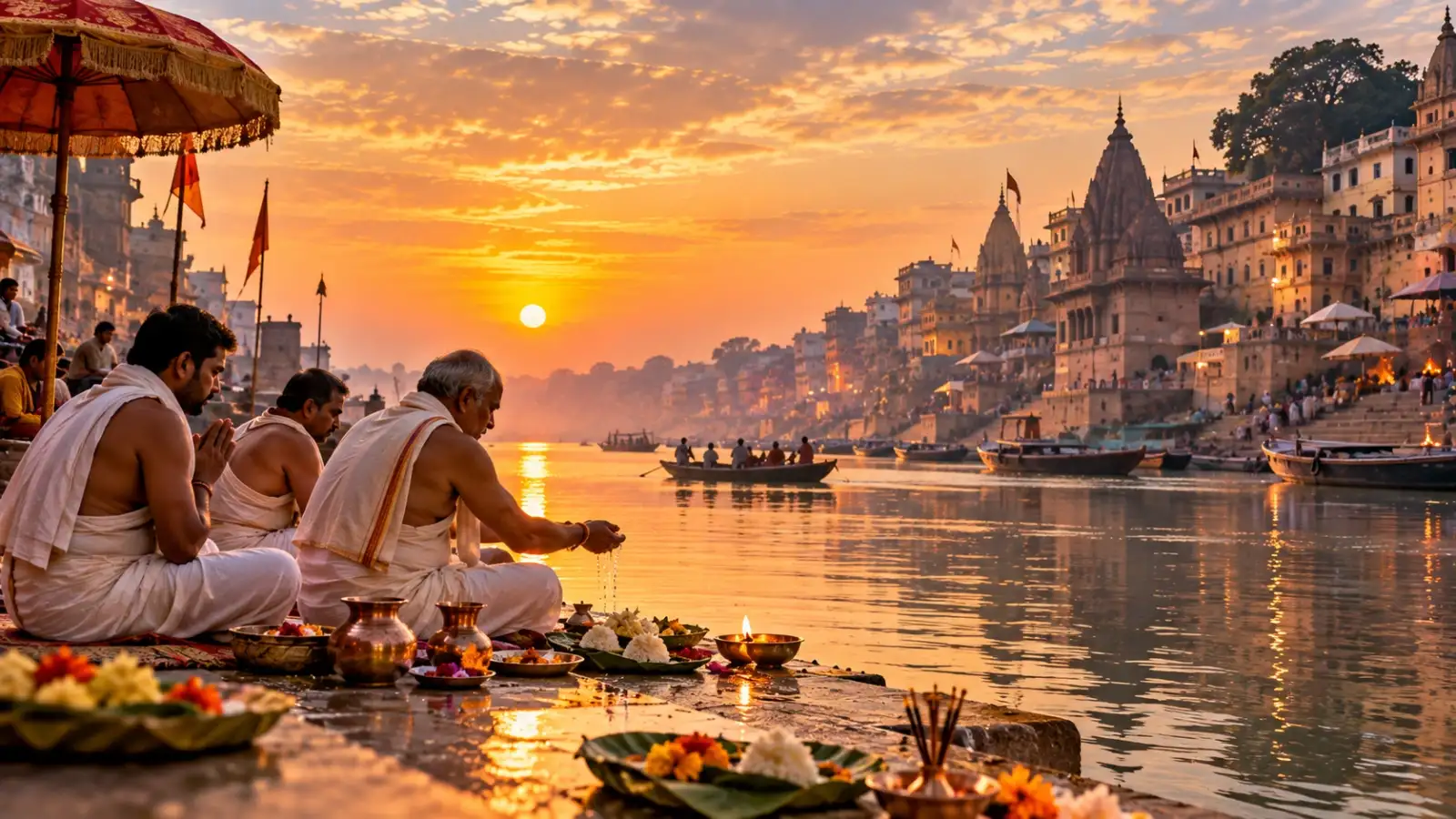
During Pitru Paksha, Hindu families traditionally remember departed ancestors through rituals such as Shraddha, Tarpan and Pind Daan. Varanasi, also known as Kashi, holds an important place in this tradition because of its sacred association with the Ganga, numerous ghats and centuries old pilgrimage practices.
The city has dozens of ghats along the Ganga, but they do not all have the same religious purpose. Some are particularly associated with ancestral rituals , while others are better known for bathing, temple visits, cremation rites or daily religious ceremonies. Families visiting Varanasi during Pitru Paksha should therefore understand the significance of the particular ghat where their ritual is being performed.
Located just south of Dashashwamedh Ghat, Prayag Ghat is named after Prayag, the important pilgrimage city now known as Prayagraj. Its name reflects the wider religious association between sacred river locations and Hindu pilgrimage traditions.
During Pitru Paksha, families may come here with priests to perform Pind Daan, Tarpan and other rites according to their customs. The ritual is generally centred on remembering departed family members and making prescribed offerings.
Because the purpose of such a visit is religious rather than recreational, visitors should avoid treating an ongoing ceremony as a tourist spectacle. The ghat is a living place of worship where families come for deeply personal observances.
The name Panchganga refers to the traditional belief that five sacred rivers meet at this location. While the Ganga is physically visible, the other rivers are part of the religious and scriptural traditions associated with the site.
The ghat has also been associated with saints, scholars and different spiritual traditions throughout its history. During Pitru Paksha, its connection with ancestral rituals gives it particular relevance to families observing Shraddha.
The comparatively peaceful atmosphere of Panchganga Ghat can also make it suitable for quiet prayer and remembrance. Visitors should follow the instructions of the priest conducting the ceremony because the exact ritual sequence can differ according to family and regional traditions.
The ghat was built in the late 16th century under Raja Man Singh of Amer and occupies a relatively quieter section of the Varanasi riverfront. Its association with the sacred Lake Mansarovar adds another layer to its religious significance.
For families visiting during Pitru Paksha, the ghat can form part of a wider ancestral pilgrimage in Kashi. Rituals are generally performed under the guidance of priests familiar with local practices and the family's requirements.
The setting also makes Mansarovar Ghat different from some of the city's busier riverfront locations. Families seeking a more focused environment for prayer may find its atmosphere appropriate, although the suitability of a particular ghat depends on the ritual being performed.
The ghat also has a broader religious role during the daytime. Devotees come here for bathing, prayers and various religious rituals, including ancestral observances. Its importance means that it can become particularly busy during major festivals and religious periods.
For visitors arriving during Pitru Paksha, Dashashwamedh can form part of a wider pilgrimage itinerary. However, families performing specific Pind Daan or Shraddha ceremonies should confirm the appropriate location with their priest rather than assuming that every ritual is performed at the city's most famous ghat.
Its proximity to Kashi Vishwanath Temple also allows pilgrims to combine different aspects of a traditional Kashi visit, subject to current temple and local arrangements.
The ghat is not primarily identified with Pind Daan in the same way as Prayag Ghat, but it remains part of Varanasi's broader sacred riverfront. Visitors observing Pitru Paksha may come here for prayer, bathing and personal remembrance as part of their pilgrimage.
Assi Ghat can also provide a different atmosphere from the crowded central ghats. Early morning visits offer an opportunity to observe religious life along the Ganga before the riverfront becomes busier.
Families should nevertheless distinguish between general prayers and specific ancestral ceremonies. When a formal Shraddha or Pind Daan is required, the appropriate ghat and ritual procedure should be confirmed beforehand.
The ghat should therefore be approached with particular sensitivity. Families come here for cremation ceremonies, which are private and deeply emotional religious occasions. Visitors should never interfere with these rituals or photograph grieving families without permission.
Manikarnika's importance does help explain Varanasi's wider association with death, liberation and ancestral traditions. However, it should not be assumed that every Pitru Paksha Pind Daan ceremony takes place at Manikarnika.
The district administration notes that Varanasi has 88 ghats, with most used for bathing and religious ceremonies and two serving specifically as cremation sites.
Tarpan is another important practice associated with ancestral observances. It generally involves offering water while remembering the ancestors. Shraddha is a broader set of rites and offerings performed to honour departed family members.
The exact procedure can differ according to regional customs, family traditions and the specific ritual being performed. Families should therefore avoid assuming that a procedure followed by one group will necessarily be identical for another.
During Pitru Paksha, these rituals are traditionally connected with the remembrance of ancestors and the fulfilment of family religious obligations.
The riverfront provides a setting for bathing, prayer, offerings and various religious ceremonies. During Pitru Paksha, the ghats can become places where families gather to remember ancestors and perform traditional rites.
Beliefs concerning the spiritual benefits of these rituals belong to the religious traditions in which they are practised. They should therefore be understood as matters of faith rather than as independently verifiable claims.
For families, however, the ritual can carry significant emotional and cultural importance. The act of travelling to Kashi, sitting beside the Ganga and performing ceremonies for departed relatives can form an important part of their ancestral traditions.
This is particularly important because Shraddha dates follow the Hindu lunar calendar rather than simply the Gregorian calendar. During Pitru Paksha 2026, different Shraddha observances fall on specific lunar tithis between September 27 and October 10. Sarva Pitru Amavasya falls on October 10.
Visitors should also clarify the complete cost of the ceremony and the services included before beginning the ritual. This can help families avoid confusion when arranging priests, ritual materials, transport or accommodation.
Since Varanasi can become considerably busier during major religious periods, advance planning for accommodation and local transport is also sensible.
Visitors should avoid photographing private rituals without permission and should not interrupt priests or families performing ceremonies. The same applies to cremation areas, where sensitivity and distance are particularly important.
It is also important to avoid throwing plastic, synthetic materials or other waste into the Ganga. Families performing offerings should follow local guidance on environmentally responsible disposal of ritual materials.
For families observing Pitru Paksha in 2026, the main period begins on 27 September and concludes on 10 October, with Sarva Pitru Amavasya marking the final day. September 26 is observed separately as Purnima Shraddha, which explains the different start dates sometimes seen in calendars.
A visit to Varanasi during this period is therefore less about sightseeing and more about remembrance, family tradition and religious observance. The ghats along the Ganga provide the setting, while the rituals allow families to honour ancestors according to their own customs.
During Pitru Paksha, Hindu families traditionally remember departed ancestors through rituals such as Shraddha, Tarpan and Pind Daan. Varanasi, also known as Kashi, holds an important place in this tradition because of its sacred association with the Ganga, numerous ghats and centuries old pilgrimage practices.
The city has dozens of ghats along the Ganga, but they do not all have the same religious purpose. Some are particularly associated with ancestral rituals , while others are better known for bathing, temple visits, cremation rites or daily religious ceremonies. Families visiting Varanasi during Pitru Paksha should therefore understand the significance of the particular ghat where their ritual is being performed.
Prayag Ghat
Prayag Ghat is one of the most relevant places in Varanasi for families performing ancestral rituals. The official Kashi portal specifically identifies the ghat as a sacred location for Pind Daan and ancestral rites.Located just south of Dashashwamedh Ghat, Prayag Ghat is named after Prayag, the important pilgrimage city now known as Prayagraj. Its name reflects the wider religious association between sacred river locations and Hindu pilgrimage traditions.
During Pitru Paksha, families may come here with priests to perform Pind Daan, Tarpan and other rites according to their customs. The ritual is generally centred on remembering departed family members and making prescribed offerings.
Because the purpose of such a visit is religious rather than recreational, visitors should avoid treating an ongoing ceremony as a tourist spectacle. The ghat is a living place of worship where families come for deeply personal observances.
Panchganga Ghat
Panchganga Ghat is one of Varanasi's most sacred riverfront locations and has a long association with religious practices. The Kashi official portal states that devotees come here to perform Tarpan and Shraddh rituals for their ancestors.The name Panchganga refers to the traditional belief that five sacred rivers meet at this location. While the Ganga is physically visible, the other rivers are part of the religious and scriptural traditions associated with the site.
The ghat has also been associated with saints, scholars and different spiritual traditions throughout its history. During Pitru Paksha, its connection with ancestral rituals gives it particular relevance to families observing Shraddha.
The comparatively peaceful atmosphere of Panchganga Ghat can also make it suitable for quiet prayer and remembrance. Visitors should follow the instructions of the priest conducting the ceremony because the exact ritual sequence can differ according to family and regional traditions.
Mansarovar Ghat
Mansarovar Ghat is another location in Varanasi associated with ancestral rituals. The official Kashi portal notes that the ghat is used for ancestral rites and quiet prayer. It is also connected with a traditional belief surrounding a Mansarovar pond located near the ghat.The ghat was built in the late 16th century under Raja Man Singh of Amer and occupies a relatively quieter section of the Varanasi riverfront. Its association with the sacred Lake Mansarovar adds another layer to its religious significance.
For families visiting during Pitru Paksha, the ghat can form part of a wider ancestral pilgrimage in Kashi. Rituals are generally performed under the guidance of priests familiar with local practices and the family's requirements.
The setting also makes Mansarovar Ghat different from some of the city's busier riverfront locations. Families seeking a more focused environment for prayer may find its atmosphere appropriate, although the suitability of a particular ghat depends on the ritual being performed.
Dashashwamedh Ghat
Dashashwamedh Ghat is one of the most prominent ghats in Varanasi and is particularly famous for the evening Ganga Aarti. Located close to the Kashi Vishwanath Temple, it is one of the busiest parts of the city's riverfront.The ghat also has a broader religious role during the daytime. Devotees come here for bathing, prayers and various religious rituals, including ancestral observances. Its importance means that it can become particularly busy during major festivals and religious periods.
For visitors arriving during Pitru Paksha, Dashashwamedh can form part of a wider pilgrimage itinerary. However, families performing specific Pind Daan or Shraddha ceremonies should confirm the appropriate location with their priest rather than assuming that every ritual is performed at the city's most famous ghat.
Its proximity to Kashi Vishwanath Temple also allows pilgrims to combine different aspects of a traditional Kashi visit, subject to current temple and local arrangements.
Assi Ghat
Assi Ghat lies towards the southern end of Varanasi's main riverfront and is among the city's best known ghats. The area is associated with morning prayers, religious ceremonies and the daily Subah-e-Banaras programme.The ghat is not primarily identified with Pind Daan in the same way as Prayag Ghat, but it remains part of Varanasi's broader sacred riverfront. Visitors observing Pitru Paksha may come here for prayer, bathing and personal remembrance as part of their pilgrimage.
Assi Ghat can also provide a different atmosphere from the crowded central ghats. Early morning visits offer an opportunity to observe religious life along the Ganga before the riverfront becomes busier.
Families should nevertheless distinguish between general prayers and specific ancestral ceremonies. When a formal Shraddha or Pind Daan is required, the appropriate ghat and ritual procedure should be confirmed beforehand.
Manikarnika Ghat
Manikarnika Ghat has a very different significance from the ghats primarily associated with ancestral offerings. It is one of Varanasi's principal cremation grounds and occupies a central position in the city's religious traditions surrounding death and cremation.The ghat should therefore be approached with particular sensitivity. Families come here for cremation ceremonies, which are private and deeply emotional religious occasions. Visitors should never interfere with these rituals or photograph grieving families without permission.
Manikarnika's importance does help explain Varanasi's wider association with death, liberation and ancestral traditions. However, it should not be assumed that every Pitru Paksha Pind Daan ceremony takes place at Manikarnika.
The district administration notes that Varanasi has 88 ghats, with most used for bathing and religious ceremonies and two serving specifically as cremation sites.
What Is Pind Daan During Pitru Paksha?
Pind Daan is a traditional Hindu ancestral ritual in which symbolic offerings known as pindas are made in remembrance of departed family members. The ceremony is generally performed under the guidance of a priest, who explains the required materials, prayers and sequence of offerings.Tarpan is another important practice associated with ancestral observances. It generally involves offering water while remembering the ancestors. Shraddha is a broader set of rites and offerings performed to honour departed family members.
The exact procedure can differ according to regional customs, family traditions and the specific ritual being performed. Families should therefore avoid assuming that a procedure followed by one group will necessarily be identical for another.
During Pitru Paksha, these rituals are traditionally connected with the remembrance of ancestors and the fulfilment of family religious obligations.
Why Is the Ganga Important for Ancestral Rituals?
The Ganga has a central place in Hindu religious traditions, and Varanasi's location along the river is one of the main reasons the city has remained an important pilgrimage centre.The riverfront provides a setting for bathing, prayer, offerings and various religious ceremonies. During Pitru Paksha, the ghats can become places where families gather to remember ancestors and perform traditional rites.
Beliefs concerning the spiritual benefits of these rituals belong to the religious traditions in which they are practised. They should therefore be understood as matters of faith rather than as independently verifiable claims.
For families, however, the ritual can carry significant emotional and cultural importance. The act of travelling to Kashi, sitting beside the Ganga and performing ceremonies for departed relatives can form an important part of their ancestral traditions.
How Families Can Prepare for Pitru Paksha in Varanasi
Families planning to perform Pind Daan or Shraddha in Varanasi should ideally arrange the ceremony before arriving. A knowledgeable priest can explain which ghat is appropriate, what materials are required and which tithi applies to the ancestor being remembered.This is particularly important because Shraddha dates follow the Hindu lunar calendar rather than simply the Gregorian calendar. During Pitru Paksha 2026, different Shraddha observances fall on specific lunar tithis between September 27 and October 10. Sarva Pitru Amavasya falls on October 10.
Visitors should also clarify the complete cost of the ceremony and the services included before beginning the ritual. This can help families avoid confusion when arranging priests, ritual materials, transport or accommodation.
Since Varanasi can become considerably busier during major religious periods, advance planning for accommodation and local transport is also sensible.
Respect the Ghats During Ancestral Rituals
Varanasi's ghats are not simply tourist attractions. They are active religious spaces where people pray, perform ceremonies, mourn relatives and follow longstanding traditions.Visitors should avoid photographing private rituals without permission and should not interrupt priests or families performing ceremonies. The same applies to cremation areas, where sensitivity and distance are particularly important.
It is also important to avoid throwing plastic, synthetic materials or other waste into the Ganga. Families performing offerings should follow local guidance on environmentally responsible disposal of ritual materials.
Varanasi During Pitru Paksha
Pitru Paksha gives Varanasi's already active religious landscape another layer of significance. From Prayag Ghat and Panchganga Ghat to Mansarovar Ghat and the better known Dashashwamedh and Assi ghats, different parts of the riverfront play different roles in the city's spiritual life. The official Kashi portal specifically records ancestral rituals at Prayag, Panchganga and Mansarovar ghats.For families observing Pitru Paksha in 2026, the main period begins on 27 September and concludes on 10 October, with Sarva Pitru Amavasya marking the final day. September 26 is observed separately as Purnima Shraddha, which explains the different start dates sometimes seen in calendars.
A visit to Varanasi during this period is therefore less about sightseeing and more about remembrance, family tradition and religious observance. The ghats along the Ganga provide the setting, while the rituals allow families to honour ancestors according to their own customs.
Next Story