
What to wear and chant for Kaalratri on Sharad Navratri 2026: Colours, mantras and remedies


Open this year’s Navratri colour charts, and Saturday, 17 October, shows grey, while Sunday, 18 October, shows purple in most lists. A few lists give pink or peacock green for the 18th. Kaalratri worship spans both days, as Saptami is present at sunrise on each. The timings mentioned here are for Delhi, so check your local panchang, the Hindu almanac.
Grey, purple, or black: Reconciling the coloursThe traditional colours associated with Kaalratri are black and blue, while red is associated with the third day and yellow with the fifth. This shift marks a more intense focus, intended to cultivate deeper inner strength. Grey, which sits close to black, works well on 17 October, while dark blue is a suitable choice on either morning. Purple on 18 October is a convention followed by some modern colour charts, so follow your family’s customs or your priest’s guidance if they differ.
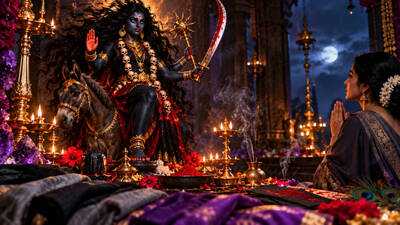
In astrological tradition, Kaalratri is associated with Saturn, and Saturday falls on her day this year. According to popular astrological belief, her worship is said to help alleviate Saturn-related difficulties and benefit those working in Saturn-associated industries, such as iron, petroleum, leather, and labour supply. When Saturn weighs heavily on life, people may feel delayed, tested, or burdened. Her worship is regarded as a source of refuge during such periods.
In certain yoga and Tantra traditions, she is associated with the Sahasrara Chakra, the crown centre. Practitioners following these traditions may incorporate Om, or Aum, into their chanting, while others can follow their usual methods of worship.
Mantras to chant for mother Kaalratri
एकवेणी जपाकर्णपूरा नग्ना खरास्थिता। लम्बोष्ठी कर्णिकार्णी तैलाभ्यक्त शरीरिणी॥
वामपादोल्लसल्लोहलताकण्टकभूषणा। वर्धनमूर्धध्वजा कृष्णा कालरात्रिर्भयनकरी॥
The verse describes her as having a single braid and wearing red flowers as ear ornaments. She rides a donkey and appears in a fierce, unclothed form. Her lips are prominent, her body is anointed with oil, and she wears iron ornaments adorned with thorn-like projections. She is dark-complexioned and carries a flag above her head. She is known as Kaalratri, the fearsome Goddess who dispels fear.
Remedies for nights of pressureWorship her when you feel defeated on all sides, when time seems to be running out, or when a problem appears insurmountable. She is described in devotional traditions as an ultimate refuge in such moments. Her worship is also associated with those in politics who genuinely fight for the people rather than resorting to immoral means.
For overcoming enmity: One traditional ritual involves writing an enemy’s name on black paper with red ink, or on red paper with black ink. The paper is then folded and placed before the worshipper. The practice involves sitting through the night after sunset, reciting her seed mantras, and burning the paper before sunrise. According to this belief, the ritual is intended to end hostility or distance the adversary from one’s life.
For lawsuits and court cases: Another traditional practice involves sitting in prayer at night during Navratri and reciting the Ratri Sukta, the night hymn from the Vedic tradition, until morning, seeking divine support in legal battles. For particularly challenging cases, Baglamukhi Devi Sadhana, a focused ritual practice, performed by AstroDevam is also recommended by its proponents. Night-time sadhana is best undertaken under the guidance of a qualified guru.
Whichever shade you choose, lay out your clothes tonight.
Grey, purple, or black: Reconciling the coloursThe traditional colours associated with Kaalratri are black and blue, while red is associated with the third day and yellow with the fifth. This shift marks a more intense focus, intended to cultivate deeper inner strength. Grey, which sits close to black, works well on 17 October, while dark blue is a suitable choice on either morning. Purple on 18 October is a convention followed by some modern colour charts, so follow your family’s customs or your priest’s guidance if they differ.
In astrological tradition, Kaalratri is associated with Saturn, and Saturday falls on her day this year. According to popular astrological belief, her worship is said to help alleviate Saturn-related difficulties and benefit those working in Saturn-associated industries, such as iron, petroleum, leather, and labour supply. When Saturn weighs heavily on life, people may feel delayed, tested, or burdened. Her worship is regarded as a source of refuge during such periods.
In certain yoga and Tantra traditions, she is associated with the Sahasrara Chakra, the crown centre. Practitioners following these traditions may incorporate Om, or Aum, into their chanting, while others can follow their usual methods of worship.
Mantras to chant for mother Kaalratri
- Beej Mantra: ॐ क्लीं ह्रीं महाकालरात्र्यै नमः॥This means, “I bow to Mother Kaalratri, who destroys fear and ignorance.”
- Mool Mantra: ॐ देवी कालरात्र्यै नमः॥This means, “O Goddess Kaalratri, I offer my salutations to you.” It is direct and devotional.
- Stuti Mantra: या देवी सर्वभूतेषु कालरात्रि रूपेण संस्थिता। नमस्तस्यै नमस्तस्यै नमस्तस्यै नमो नमः॥This means, “Salutations again and again to the Goddess who resides in all beings in the form of Kaalratri.” The repetition is central to the prayer.
एकवेणी जपाकर्णपूरा नग्ना खरास्थिता। लम्बोष्ठी कर्णिकार्णी तैलाभ्यक्त शरीरिणी॥
वामपादोल्लसल्लोहलताकण्टकभूषणा। वर्धनमूर्धध्वजा कृष्णा कालरात्रिर्भयनकरी॥
The verse describes her as having a single braid and wearing red flowers as ear ornaments. She rides a donkey and appears in a fierce, unclothed form. Her lips are prominent, her body is anointed with oil, and she wears iron ornaments adorned with thorn-like projections. She is dark-complexioned and carries a flag above her head. She is known as Kaalratri, the fearsome Goddess who dispels fear.
Remedies for nights of pressureWorship her when you feel defeated on all sides, when time seems to be running out, or when a problem appears insurmountable. She is described in devotional traditions as an ultimate refuge in such moments. Her worship is also associated with those in politics who genuinely fight for the people rather than resorting to immoral means.
For overcoming enmity: One traditional ritual involves writing an enemy’s name on black paper with red ink, or on red paper with black ink. The paper is then folded and placed before the worshipper. The practice involves sitting through the night after sunset, reciting her seed mantras, and burning the paper before sunrise. According to this belief, the ritual is intended to end hostility or distance the adversary from one’s life.
For lawsuits and court cases: Another traditional practice involves sitting in prayer at night during Navratri and reciting the Ratri Sukta, the night hymn from the Vedic tradition, until morning, seeking divine support in legal battles. For particularly challenging cases, Baglamukhi Devi Sadhana, a focused ritual practice, performed by AstroDevam is also recommended by its proponents. Night-time sadhana is best undertaken under the guidance of a qualified guru.
Whichever shade you choose, lay out your clothes tonight.
Next Story