
'Chess is equal if both sides play well': Javokhir Sindarov after 4th draw; Gukesh says 'a lot of more games to come'


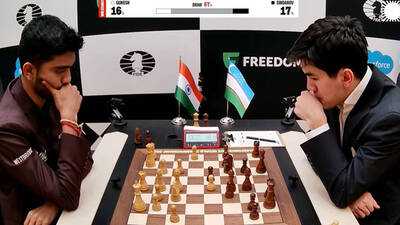
D Gukesh and Javokhir Sindarov tried to bruise each other, sans the violence, within the vast gamut of the Petroff opening . But the Indian and the challenger from Uzbekistan were alert enough and took their fourth game to safer territory in Geneva, Switzerland, on Saturday.
The game was drawn in less than four hours, with Gukesh needing perpetual checks for three-fold repetition in 34 moves in queen and four pawns each endgame. Sindarov had a passer on the b-file but it did not matter. There are 10 more games remaining, with the 14-game level at 2-2 and Sindarov playing with white pieces on Sunday.
Asked about four successive draws, Sindarov said, “Chess is equal if both sides play well, always a draw. It was a tricky game but the draw is a normal result. Gukesh got the position that was easier to play with white.”
Gukesh was happy that he could play the prepared Qb1 (ninth move) which was refuted well. “A lot of more games to come,” he said.
At around 20-odd moves, the players had half an hour each to make the time control. Despite Sindarov giving some chances for Gukesh to press, the liquidation was reached with both rooks and dark-coloured bishops exchanged.
The champion, with white, was expected to ask sterner questions of the 20-year-old on Saturday. And he did that through a bishop move as early as on the fifth turn. Sindarov took 17 minutes to respond with Ne6.
Though Gukesh had a decent advantage on the clock, it disappeared as Sindarov came up with two highly-effective answers with Nxc3 and Qc8 on successive moves, without falling for traps and sharper tactics.
Gukesh’s body language turned from positive (after playing an interesting 9.Qb1 and ahead by 25 minutes with a possibility of a knight jump) to cautious. It was no surprise that he burned his time advantage for the pawn-push on the a-file on the 11th turn. Earlier, if Gukesh’s 5.Be2 (played only once by untitled players in 2020 with white winning) narrowed the position to the very rarely played opening line, Sindarov’s reply made it a completely new position since no game could be found in the competitive database.
Commentator and GM Anish Giri was not in favour of Sindarov’s pawn-push to a6 and felt that taking Gukesh out of the book in a desperate fashion was not advisable. Gukesh had opted for the queen-pawn opening and London System with white in the second game. As expected, he changed to the king-pawn opening on Saturday.
It was a symmetrical variation in the Steinitz Attack with Sindarov having some recent good memories from it. He had beaten China’s Yangyi Yu in the fourth round of last year’s Goa World Cup, through which he had qualified for the Candidates. Gukesh had beaten Nijat Abasov on his way to clinching the 2024 Candidates tournament.
Five-time world champion V Anand told Chess.com before the fourth game: “Playing fast in the opening is a show of confidence. But even if your opponent does that, you must play at your pace. If you have decided to think at a particular time, take your time regardless of the opponent’s speed of moves. The way to do it is to ignore it (opponent’s speed) and do it in a way as if the opp doesn't exist. ”
The game was drawn in less than four hours, with Gukesh needing perpetual checks for three-fold repetition in 34 moves in queen and four pawns each endgame. Sindarov had a passer on the b-file but it did not matter. There are 10 more games remaining, with the 14-game level at 2-2 and Sindarov playing with white pieces on Sunday.
From Viswanathan Anand to 100 Grandmasters: How India Changed the Chessboard
Asked about four successive draws, Sindarov said, “Chess is equal if both sides play well, always a draw. It was a tricky game but the draw is a normal result. Gukesh got the position that was easier to play with white.”
Gukesh was happy that he could play the prepared Qb1 (ninth move) which was refuted well. “A lot of more games to come,” he said.
At around 20-odd moves, the players had half an hour each to make the time control. Despite Sindarov giving some chances for Gukesh to press, the liquidation was reached with both rooks and dark-coloured bishops exchanged.
The champion, with white, was expected to ask sterner questions of the 20-year-old on Saturday. And he did that through a bishop move as early as on the fifth turn. Sindarov took 17 minutes to respond with Ne6.
Though Gukesh had a decent advantage on the clock, it disappeared as Sindarov came up with two highly-effective answers with Nxc3 and Qc8 on successive moves, without falling for traps and sharper tactics.
Gukesh’s body language turned from positive (after playing an interesting 9.Qb1 and ahead by 25 minutes with a possibility of a knight jump) to cautious. It was no surprise that he burned his time advantage for the pawn-push on the a-file on the 11th turn. Earlier, if Gukesh’s 5.Be2 (played only once by untitled players in 2020 with white winning) narrowed the position to the very rarely played opening line, Sindarov’s reply made it a completely new position since no game could be found in the competitive database.
Commentator and GM Anish Giri was not in favour of Sindarov’s pawn-push to a6 and felt that taking Gukesh out of the book in a desperate fashion was not advisable. Gukesh had opted for the queen-pawn opening and London System with white in the second game. As expected, he changed to the king-pawn opening on Saturday.
It was a symmetrical variation in the Steinitz Attack with Sindarov having some recent good memories from it. He had beaten China’s Yangyi Yu in the fourth round of last year’s Goa World Cup, through which he had qualified for the Candidates. Gukesh had beaten Nijat Abasov on his way to clinching the 2024 Candidates tournament.
Five-time world champion V Anand told Chess.com before the fourth game: “Playing fast in the opening is a show of confidence. But even if your opponent does that, you must play at your pace. If you have decided to think at a particular time, take your time regardless of the opponent’s speed of moves. The way to do it is to ignore it (opponent’s speed) and do it in a way as if the opp doesn't exist. ”
Next Story