
7 Cricket Fielding Positions with Odd Names and Where They Come From

Cricket's fielding positions have been confusing outsiders for over two centuries, and even dedicated fans often use the names without knowing what they mean. The geometry of the field explains some of them, old English usage explains others, and a few survive simply because cricketers are conservative about language once something sticks.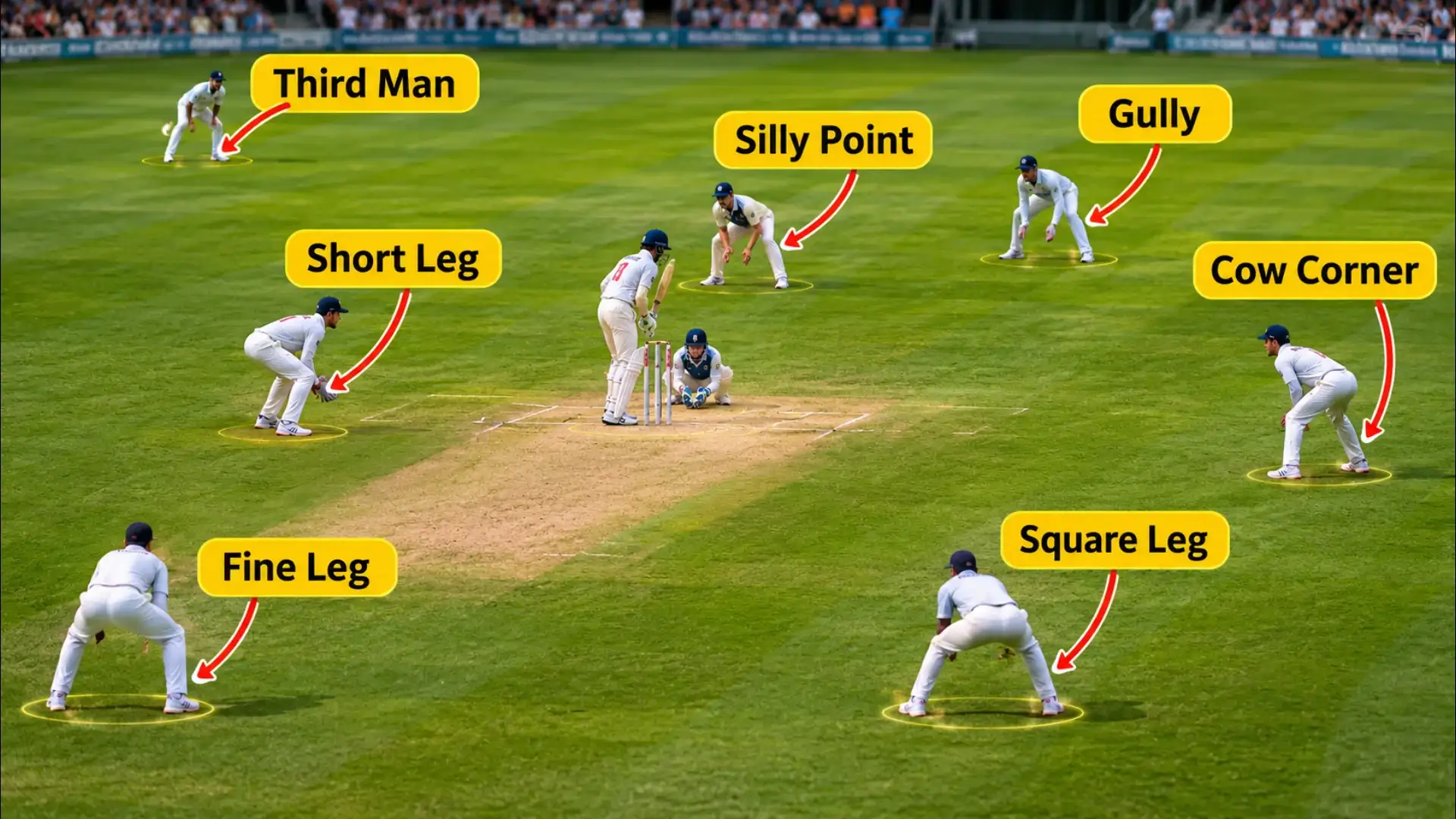
Cricket's fielding map is really a vocabulary lesson in how the game developed: some terms from the physical geometry of the pitch, some from the landscape of old English village grounds, some from the way the ball moves off the bat. The names sound arbitrary until you know what each one is pointing at, and then they are almost logical.
Silly Mid-On and Silly Mid-Off
Silly does not mean foolish in the way the word is used today. In older English, silly carried the meaning of helpless or exposed, from the Old English sælig, meaning blessed or vulnerable, depending on the era. A fielder placed at silly mid-on stands close enough to the batsman that a hard shot could reach him before he reacts. The position is genuinely dangerous, which is why the name stuck. Mid-on and mid-off refer to the two sides of the pitch relative to the bowler's end: on is the leg side, off is the off side. Silly simply marks how close in the fielder is standing.Gully
Gully sits in the gap between point and the slips, a narrow channel of space on the off side. The name comes directly from the word for a narrow passage or ravine, a gully in landscape terms is a channel cut by water, tight and defined on both sides. The fielding position occupies exactly that kind of gap: a specific corridor where edges and deflections travel. The name is among the most descriptive in the game, once you see the channel it guards.Fine Leg and Square Leg
These two share a word, leg, and are distinguished by angle. Leg in cricket always refers to the leg side, the side of the field the batsman's legs face when in a standard stance. Fine and square describe the angle relative to the batting crease. Square means at a right angle to the pitch, directly beside the batsman. Fine means at a shallow angle, closer to behind the wicket than beside it. The same geometry applies on the off side: there is a square point and a fine point, though the leg-side versions are more often named in commentary because leg-side shots are more varied in angle. Fine leg sits deep and backward; a fielder there is watching for glances and edges that travel at a thin angle off the bat.Slip
Slip is one of the oldest positions in the game and the name comes from how the ball gets there. An edge off the bat slips away, the ball slips off the outside edge and travels behind the batsman on the off side. The fielder placed to catch those slips was called the slip fielder, and the position became slip. First slip, second slip, and third slip mark how far from the wicketkeeper each stands. The name predates much of modern cricket's vocabulary and appears in written records from the eighteenth century.Cow Corner
Cow corner is the deep area between mid-wicket and long-on, on the leg side. The name has two competing explanations, and both may be partly true. One holds that village grounds in England were shared with livestock, and the far leg-side corner was where the cow was tethered or where the grass was roughest and least used. The second explanation is more pointed: it is the corner where agricultural slog shots land, the kind of swing associated with tail-enders rather than batsmen with technique. Cow shot, a wild, cross-batted heave, is itself an old term of mild contempt. Cow corner is where those shots go. Neither explanation is fully documented, but both circulate in cricket writing and the term itself is well established in the game's vocabulary.Point
Point is the fielder on the off side, roughly level with the batsman's crease. The name is thought to come from the point of the bat, the tip of the blade on the off side, which is where cut shots and deflections originate. A fielder at point is watching for the ball coming off that part of the bat. The position appears in early cricket writing as point of the bat, shortened over time to simply point. It is one of the older named positions in the game and has stayed in the same area of the field across the different eras of cricket.Cricket's fielding map is really a vocabulary lesson in how the game developed: some terms from the physical geometry of the pitch, some from the landscape of old English village grounds, some from the way the ball moves off the bat. The names sound arbitrary until you know what each one is pointing at, and then they are almost logical.
Next Story