
How Kabaddi Made Its Asian Games Debut at Beijing 1990

Kabaddi had been played on open ground, in school courtyards, and across village boundaries for centuries before any international body thought to codify it. The game needed no equipment, no footwear, no scoreboard that could not be kept in someone's head. That simplicity was its strength and, for a long time, the reason the wider sporting world paid it little attention.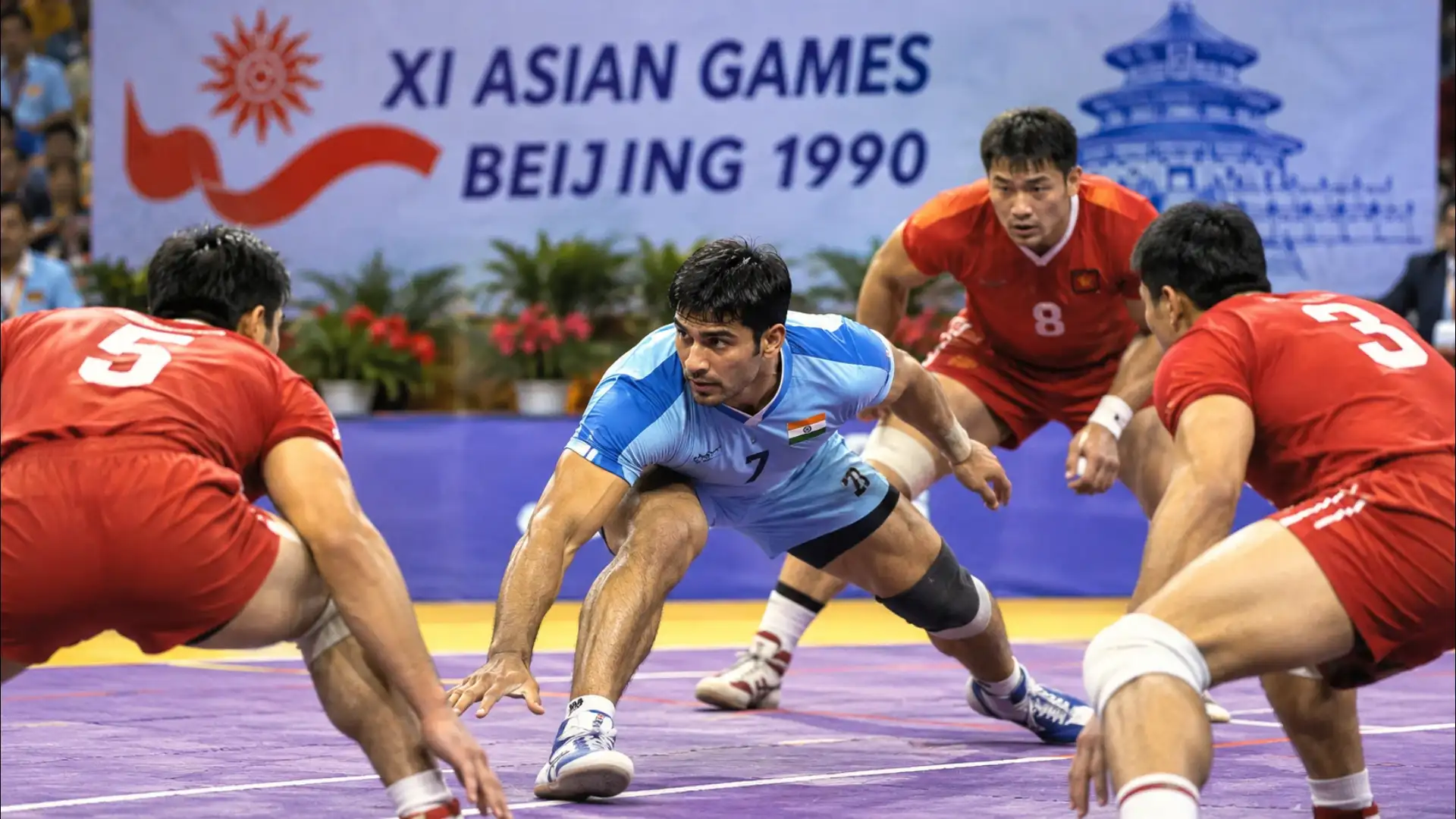
The Road to Beijing
The Amateur Kabaddi Federation of India was founded in 1950, and the first national championship followed the same year. Over the next three decades, the game spread across South Asia, each country developing its own slight variation in rules and mat dimensions. The Asian Kabaddi Federation was formed to bring those variations under one roof, and the push began to have the sport recognised at the continental level. The Asian Games, governed by the Olympic Council of Asia, agreed: kabaddi would be a medal sport at the 1990 edition, held in Beijing.What the 1990 Asian Games Looked Like
The Beijing Asian Games were the largest the continent had staged to that point, with athletes from across Asia competing across dozens of disciplines. Kabaddi entered as one of the newer additions, unfamiliar to most spectators outside South Asia. The format was straightforward: teams of seven on a mat, one raider crossing into enemy territory on a single breath, seven defenders trying to stop him from returning. India, the country that had done the most to carry the game into the international arena, was the clear favourite going in.India's Gold and What It Meant
India won the gold medal at that inaugural tournament, defeating a field that included teams from across Asia. The victory was not a surprise on paper, but the significance of the moment was larger than the scoreline. A sport that had never appeared at this level of international competition had now produced a champion. The gold confirmed that kabaddi could hold its shape under international rules, on a standardised mat, with referees from multiple countries applying the same code. India went on to win gold at every subsequent Asian Games edition the sport has been included in, a run of dominance that began on that Beijing mat.The Game That Stayed Itself
What the 1990 debut did not do was change the game's essential character. Kabaddi on an Asian Games mat is still one person holding a breath and seven people deciding whether that is enough. The raider still chants to prove the breath has not broken. The defenders still form a chain with their hands. The scoring logic, a life for a touch and a return, is the same logic that village players worked out long before any federation wrote it down. The Beijing tournament gave the game a stage, not a new identity.A Door That Stayed Open
After 1990, kabaddi appeared at every Asian Games where it was included, and the circle of competing nations widened. Countries that had no kabaddi tradition studied the game, built programmes, and began producing players who could trouble Indian defences. The 1990 debut was the door. What came through it, over the following decades, was a sport that found it had more reach than anyone standing at that door had guessed.Next Story