
Why Is Tennis Scored 15, 30 And 40? The Strange History Behind the Numbers

Tennis is one of the few sports where the scoring makes no obvious sense. A player wins a point and the scoreboard jumps to 15, then 30, then 40, skipping numbers, compressing the gap between the last two, and offering no explanation whatsoever. Historians have been arguing about why for well over a century, and the most accurate thing anyone can say is: we do not know for certain. What we have are theories, each with something going for it and none with enough evidence to close the debate.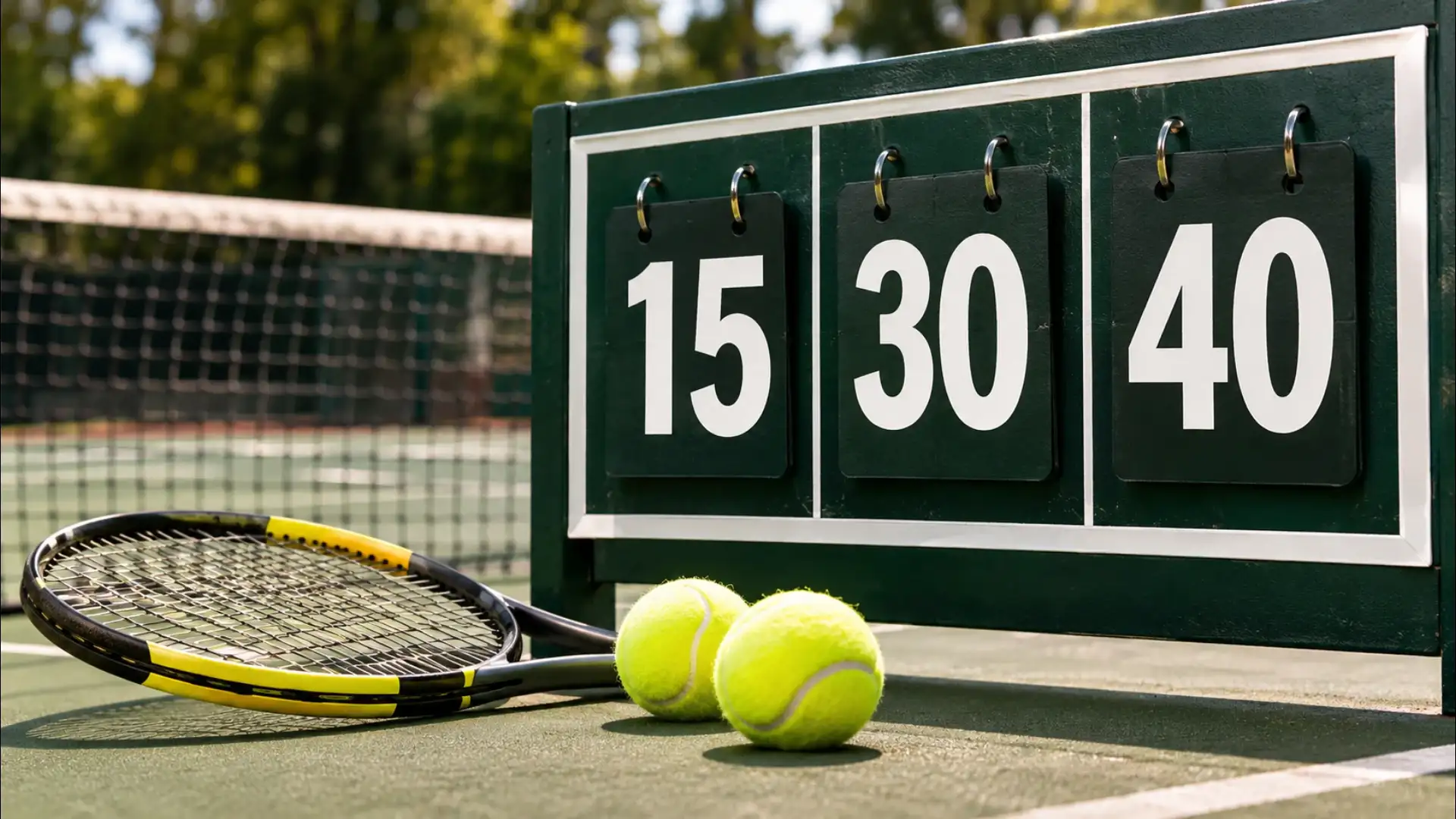
The problem is the 45. At some point it became 40, and the clock theory has no clean answer for why. One popular sub-theory says the hand was moved to 45 only after a point was won, so it stopped at 40 to leave room for deuce, the situation where a player must win two consecutive points from a tied position. If the score went to 45-45, there was no space left on the clock to show who was ahead. Stopping at 40 kept a gap. This is plausible, but there is no document from the period that confirms it. It is an explanation invented to patch a hole in an explanation.
There is also a theory that the word deuce comes from the French à deux, meaning two points needed to win from a tied position. That etymology is more solid than most in this area. What is harder to establish is whether the clock, the French counting system, or some combination of the two actually drove the scoring structure. The records from early jeu de paume, the indoor handball game from which tennis descended, are incomplete, and the rules were not standardised in the way modern sports rules are.
The theory is appealing because it grounds the numbers in something physical rather than symbolic. Its weakness is the same as the others: the court dimensions from that period are not reliably documented, and the accounts that describe this movement vary. It may be accurate. It may be a later rationalisation that fit the numbers neatly onto a story about the game's origins.
What the uncertainty reveals is how sports actually carry their history. Rules and scoring systems do not arrive fully formed from a single inventor. They accumulate, get borrowed, get adapted, and eventually harden into convention. By the time anyone thinks to document the origin, the people who could have answered the question are long gone. Tennis is not unusual in this. It is just unusually honest about it, because the scoring is strange enough that people keep asking.
The numbers 15, 30, and 40 are now so embedded in the game that changing them would feel like changing the game itself. Whatever they meant to the players who first used them, they now mean tennis, and that, in the end, may be the only meaning that has ever really mattered.
The Clock Face Theory
The most widely repeated explanation links the scoring to a clock. Picture a clock face divided into four quarters: 15, 30, 45, and 60. Each point moved the hand one quarter turn. Win four points, complete the circle, win the game. It is a satisfying image, and it matches the 15 and 30 that survive in the modern game.The problem is the 45. At some point it became 40, and the clock theory has no clean answer for why. One popular sub-theory says the hand was moved to 45 only after a point was won, so it stopped at 40 to leave room for deuce, the situation where a player must win two consecutive points from a tied position. If the score went to 45-45, there was no space left on the clock to show who was ahead. Stopping at 40 kept a gap. This is plausible, but there is no document from the period that confirms it. It is an explanation invented to patch a hole in an explanation.
The French Connection
A second theory points to France, where an early form of the game was played in the 15th and 16th centuries. The French word for 60 is soixante, and some historians have suggested the game was built around 60 as a complete unit, a common way of counting in medieval Europe, inherited from older Babylonian mathematics. Sixty divides neatly into four parts of 15.There is also a theory that the word deuce comes from the French à deux, meaning two points needed to win from a tied position. That etymology is more solid than most in this area. What is harder to establish is whether the clock, the French counting system, or some combination of the two actually drove the scoring structure. The records from early jeu de paume, the indoor handball game from which tennis descended, are incomplete, and the rules were not standardised in the way modern sports rules are.
The Jeu de Paume Court
Some researchers have looked at the physical dimensions of the jeu de paume court rather than at clocks or counting systems. In that game, a player started at the back of the court and moved forward with each point won. The distances were said to correspond to the point values: 15 feet, then 30 feet, then 45 feet, at which point the player would be too close to the net to move further, so the final step was shortened. This would explain both the sequence and the compression from 45 to 40.The theory is appealing because it grounds the numbers in something physical rather than symbolic. Its weakness is the same as the others: the court dimensions from that period are not reliably documented, and the accounts that describe this movement vary. It may be accurate. It may be a later rationalisation that fit the numbers neatly onto a story about the game's origins.
Why the Uncertainty Matters
It would be easy to pick the clock theory, call it settled, and move on. Most explainers do exactly that. The honest version is less tidy. Tennis scoring survived centuries of oral tradition and informal play before anyone wrote the rules down in a form that has reached us intact. The game crossed languages, courts, and countries. Numbers that started with one meaning could have picked up a second, and a third, before anyone thought to ask where they came from.What the uncertainty reveals is how sports actually carry their history. Rules and scoring systems do not arrive fully formed from a single inventor. They accumulate, get borrowed, get adapted, and eventually harden into convention. By the time anyone thinks to document the origin, the people who could have answered the question are long gone. Tennis is not unusual in this. It is just unusually honest about it, because the scoring is strange enough that people keep asking.
The numbers 15, 30, and 40 are now so embedded in the game that changing them would feel like changing the game itself. Whatever they meant to the players who first used them, they now mean tennis, and that, in the end, may be the only meaning that has ever really mattered.
Next Story