
How a Chess Clock Works and Why It Has Two Faces

Walk into any serious chess tournament and the first thing you notice, besides the silence, is the pair of clocks sitting beside every board. Each clock has two faces and one button on top. A player makes a move, slaps the button, and time starts draining from the opponent's side. It looks simple. The engineering behind it, and the thinking that led to it, is anything but.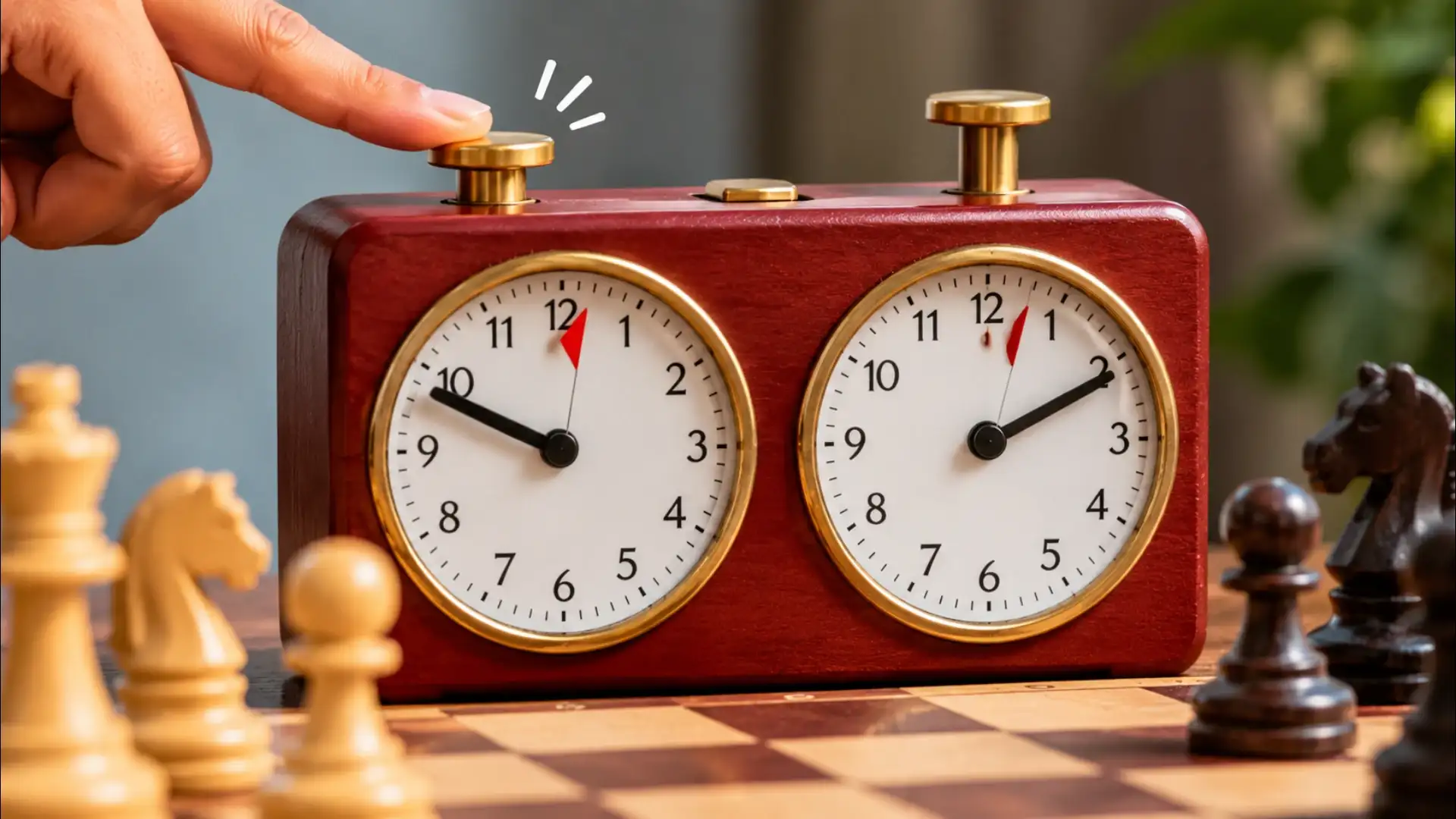
The first solution was a sandglass, one per player, turned over after each move. This worked but created a new problem: the referee had to physically handle the glass after every move, which was slow and error-prone. What was needed was a device that a player could operate with one hand, instantly, without leaving the board.
The single button on top is not a toggle. It is a rocker. Press your side down and the other side comes up. This is why you press after your move, not before, you are handing time to your opponent, not stopping your own.
Referees watched for the flag. Players watched for it. The falling flag became one of chess's most dramatic moments, because it could end a game that was otherwise winning. A player up a queen and a rook could still lose if his flag fell first. This is why fast finishes, the scramble to make moves before the flag drops, became their own skill inside the game.
The increment is set before the game begins and applies equally to both players. It does not reward fast moves, it only ensures that the clock never becomes the only thing that matters when the position on the board still has something to say.
The design also makes the state of the game readable at a glance from across the room. Two faces, two numbers, one running. A tournament director walking the hall can see in a second whose turn it is and how much time each player has left. No conversation required.
The chess clock looks like two clocks sharing a case. It is actually one machine built to enforce a rule: every second of thinking has a cost, and the cost falls on the person doing the thinking.
The Problem the Clock Was Built to Solve
Competitive chess without a clock is a different game entirely. In the early days of tournament chess, a player could simply sit and think for as long as he liked. A match in 1851 between Howard Staunton and Elijah Williams stretched to over fourteen hours across a single session. Players fell asleep at the board. Spectators gave up and went home. The game needed a way to distribute time fairly and force decisions.The first solution was a sandglass, one per player, turned over after each move. This worked but created a new problem: the referee had to physically handle the glass after every move, which was slow and error-prone. What was needed was a device that a player could operate with one hand, instantly, without leaving the board.
Two Faces, One Mechanism
The mechanical chess clock that became standard through most of the twentieth century is two clock movements housed in a single case, sharing one see-saw lever on top. When a player presses the button on their side, it depresses their clock and simultaneously lifts the opponent's, releasing the spring that drives it. The two movements are mechanically linked so that exactly one is always running and the other is always stopped. There is no neutral position. The moment one clock pauses, the other begins.The single button on top is not a toggle. It is a rocker. Press your side down and the other side comes up. This is why you press after your move, not before, you are handing time to your opponent, not stopping your own.
You may also like
- Vaibhav Sooryavanshi creates history! Smashes fastest-ever hundred in List A cricket with 28-ball ton
- DPS Ghatkesar, Nadergul secure second and third places in archery meet
- Bizarre scenes in Brazil: Football manager put in chokehold by security guard after being mistaken for pitch invader during wild goal celebration
- 'Had a feeling I would score a hundred': India-born Harpreet Bhatia's emotional ton on Guru Nanak Jayanti against India A
- 700 participants to compete in the inaugural Youth Artistic Gymnastics National C'ship at INS Hamla
The Flag and What It Meant
On the older mechanical clocks, a small red or orange flag sat at the twelve o'clock position on each face. As the minute hand approached twelve, it lifted the flag on a tiny cam. When time ran out, the hand passed twelve, the cam released, and the flag fell. A fallen flag meant the player had used all their time and lost on time, not on the board, but on the clock.Referees watched for the flag. Players watched for it. The falling flag became one of chess's most dramatic moments, because it could end a game that was otherwise winning. A player up a queen and a rook could still lose if his flag fell first. This is why fast finishes, the scramble to make moves before the flag drops, became their own skill inside the game.
Digital Clocks and the Increment
Digital chess clocks, which became standard in serious competition from the 1990s onward, replaced the mechanical movement with a microprocessor and a display, but kept the same two-button rocker logic. What they added was the increment: a small amount of time, typically a few seconds, added to a player's clock the moment he presses his button. This means a player can never run completely out of time simply by making legal moves quickly enough. The increment was designed to prevent the game from degenerating into pure speed at the end, where the quality of moves collapses entirely.The increment is set before the game begins and applies equally to both players. It does not reward fast moves, it only ensures that the clock never becomes the only thing that matters when the position on the board still has something to say.
Why Two Faces and Not One
The two-face design answers a question that seems obvious once asked: whose time is it? A single clock face with a pause button would require a referee to operate it, or would invite a player to pause it at a convenient moment. Two faces, mechanically linked so that one must always be running, remove both problems. Neither player controls the other's clock. Neither can pause both at once. The only person who can stop both clocks simultaneously is the referee, which is exactly how it should be.The design also makes the state of the game readable at a glance from across the room. Two faces, two numbers, one running. A tournament director walking the hall can see in a second whose turn it is and how much time each player has left. No conversation required.
The chess clock looks like two clocks sharing a case. It is actually one machine built to enforce a rule: every second of thinking has a cost, and the cost falls on the person doing the thinking.






Loving Newspoint? Download the app now
