
Apple iPhone 18 Pro, iPhone 18 Pro Max: First impressions


Apple took the wraps off its iPhone 18 series at its 'Surprise and Shine' event on September 9. Skipping the vanilla iPhone 18 this year, Apple launched only the iPhone 18 Pro and iPhone 18 Pro Max , alongside its first foldable smartphone, the iPhone Duo.
Both Pro models come with an advanced camera system featuring variable aperture and are powered by the all-new A20 Pro chipset , which promises a big step up in performance and battery life. We spent some time with both phones, and here are our first impressions.
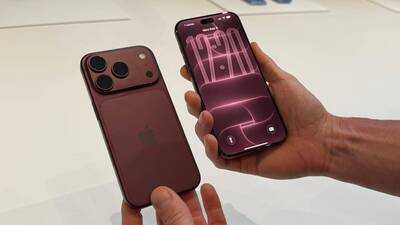
Design and DisplayThe iPhone 18 Pro and iPhone 18 Pro Max stick closely to Apple's familiar design language, with a few subtle refinements. The Dynamic Island has been redesigned using more advanced display technology, freeing up additional room without increasing its footprint.
It now supports up to three Live Activities at once. It is a small but useful change for anyone tracking multiple things at the same time, like a food delivery and a sports score, without having to open an app.
The horizontal camera plateau across the back carries over, but it has grown slightly this year to house the new variable-aperture mechanism. The six laser-cut blades that move to adjust the aperture need more internal room than a fixed-aperture setup did.
The front and back continue to be protected by Ceramic Shield, following the same approach to durability Apple introduced with the 17 Pro generation. The control layout stays the same too: the power button and Camera Control sit on the right edge for quick access to photo and video capture, the volume buttons and Action Button remain on the left, and a USB-C port sits at the bottom.
Apple hasn't made major changes to the display this year. Screen sizes stay at 6.3 inches on the iPhone 18 Pro and 6.9 inches on the Pro Max, with Super Retina XDR panels that support ProMotion for adaptive refresh rates and an Always-On display for checking information without lifting the phone.
Both phones come in four finishes: the familiar black and silver, a new icy glacier tone, and a bold new burgundy, the most distinctive colour the Pro lineup has had in a few years. In hand, the burgundy gives the Pro line a bit more personality than last year's more subdued palette.
Hardware and CameraThe camera is where Apple has clearly spent most of its engineering effort this year. The new 48MP Fusion Main camera brings variable aperture to the iPhone for the first time. Six laser-cut blades physically adjust the aperture opening, moving between four settings from ƒ/1.48 for low light to ƒ/4 for greater depth of field in group shots. The camera can also adjust this automatically depending on the scene.
For those who want more manual control, a new Pro controls interface in the Camera app lets you dial in aperture, shutter speed, and white balance directly, along with a histogram to check exposure in real time. These are pro-level tools that previously required a third-party app.
A new computational imaging pipeline makes photos sharper and more detailed straight out of the camera, while upgraded Photographic Styles add texture and grain adjustments for finer control over the final look.
Video gets upgrades too, with post-capture Cinematic effects now available at up to 60fps, 4K Dolby Vision HDR time-lapse, and an improved Audio Mix that can separate music from voices during recording.
Perhaps the most forward-looking addition is Apple Reference Image, a new authenticity feature powered by a sensor that can cryptographically sign every pixel it captures. When you shoot in Reference mode, the camera creates an unalterable reference image alongside the main photo. The two can be viewed side by side in the Photos app, much like a digital negative, making it possible to check whether an image has been edited later.
The feature is aimed mainly at photojournalists and professional photographers, but it shows where Apple sees image authenticity heading as AI-edited photos become harder to spot.
Both phones are powered by Apple's latest A20 Pro chipset, which is a big generational leap on paper. Built on a 2-nanometer process, the chip offers 50% more memory bandwidth than its predecessor. It also gets a 7-core GPU that is 40% faster and a new Dual 16-core Neural Engine with twice the AI processing power of the A19 Pro.
To keep things cool, Apple has added a redesigned vapour chamber with three times the surface area of the one in the iPhone 17 Pro. On the connectivity front, the new C2 modem offers faster uploads and 15% lower power consumption than its predecessor, while the N1 chip handles Wi-Fi 7 and Bluetooth 6.
Battery life sees a large jump this year, particularly on the Pro Max. Apple claims the eSIM-only models offer up to 45 hours of video playback on the Pro Max and up to 36 hours on the Pro, both well ahead of last year's figures. Fast charging improves as well, with the Pro reaching 50% in around 15 minutes on a wired charger. For a complete battery analysis, though, you will have to wait for our review.
What We ThinkThe iPhone 18 Pro and Pro Max make this an unusually substantial year for what is usually the "safe" choice in Apple's lineup. Variable aperture is a new capability rather than a repackaged feature, Pro controls finally give enthusiasts native manual tools worth using, and Apple Reference Image feels like a meaningful first step toward verifying photo authenticity.
Add the A20 Pro's promised performance gains and the Pro Max's big battery claims, and these phones hold their own next to Apple's flashier foldable.
The iPhone 18 Pro starts at Rs 1,64,900, while the iPhone 18 Pro Max starts at Rs 1,79,900. But are the new iPhones worth the upgrade? Stay tuned for our full review.
Both Pro models come with an advanced camera system featuring variable aperture and are powered by the all-new A20 Pro chipset , which promises a big step up in performance and battery life. We spent some time with both phones, and here are our first impressions.
Design and DisplayThe iPhone 18 Pro and iPhone 18 Pro Max stick closely to Apple's familiar design language, with a few subtle refinements. The Dynamic Island has been redesigned using more advanced display technology, freeing up additional room without increasing its footprint.
It now supports up to three Live Activities at once. It is a small but useful change for anyone tracking multiple things at the same time, like a food delivery and a sports score, without having to open an app.
The horizontal camera plateau across the back carries over, but it has grown slightly this year to house the new variable-aperture mechanism. The six laser-cut blades that move to adjust the aperture need more internal room than a fixed-aperture setup did.
The front and back continue to be protected by Ceramic Shield, following the same approach to durability Apple introduced with the 17 Pro generation. The control layout stays the same too: the power button and Camera Control sit on the right edge for quick access to photo and video capture, the volume buttons and Action Button remain on the left, and a USB-C port sits at the bottom.
Apple hasn't made major changes to the display this year. Screen sizes stay at 6.3 inches on the iPhone 18 Pro and 6.9 inches on the Pro Max, with Super Retina XDR panels that support ProMotion for adaptive refresh rates and an Always-On display for checking information without lifting the phone.
Both phones come in four finishes: the familiar black and silver, a new icy glacier tone, and a bold new burgundy, the most distinctive colour the Pro lineup has had in a few years. In hand, the burgundy gives the Pro line a bit more personality than last year's more subdued palette.
Hardware and CameraThe camera is where Apple has clearly spent most of its engineering effort this year. The new 48MP Fusion Main camera brings variable aperture to the iPhone for the first time. Six laser-cut blades physically adjust the aperture opening, moving between four settings from ƒ/1.48 for low light to ƒ/4 for greater depth of field in group shots. The camera can also adjust this automatically depending on the scene.
For those who want more manual control, a new Pro controls interface in the Camera app lets you dial in aperture, shutter speed, and white balance directly, along with a histogram to check exposure in real time. These are pro-level tools that previously required a third-party app.
A new computational imaging pipeline makes photos sharper and more detailed straight out of the camera, while upgraded Photographic Styles add texture and grain adjustments for finer control over the final look.
Video gets upgrades too, with post-capture Cinematic effects now available at up to 60fps, 4K Dolby Vision HDR time-lapse, and an improved Audio Mix that can separate music from voices during recording.
Perhaps the most forward-looking addition is Apple Reference Image, a new authenticity feature powered by a sensor that can cryptographically sign every pixel it captures. When you shoot in Reference mode, the camera creates an unalterable reference image alongside the main photo. The two can be viewed side by side in the Photos app, much like a digital negative, making it possible to check whether an image has been edited later.
The feature is aimed mainly at photojournalists and professional photographers, but it shows where Apple sees image authenticity heading as AI-edited photos become harder to spot.
Both phones are powered by Apple's latest A20 Pro chipset, which is a big generational leap on paper. Built on a 2-nanometer process, the chip offers 50% more memory bandwidth than its predecessor. It also gets a 7-core GPU that is 40% faster and a new Dual 16-core Neural Engine with twice the AI processing power of the A19 Pro.
To keep things cool, Apple has added a redesigned vapour chamber with three times the surface area of the one in the iPhone 17 Pro. On the connectivity front, the new C2 modem offers faster uploads and 15% lower power consumption than its predecessor, while the N1 chip handles Wi-Fi 7 and Bluetooth 6.
Battery life sees a large jump this year, particularly on the Pro Max. Apple claims the eSIM-only models offer up to 45 hours of video playback on the Pro Max and up to 36 hours on the Pro, both well ahead of last year's figures. Fast charging improves as well, with the Pro reaching 50% in around 15 minutes on a wired charger. For a complete battery analysis, though, you will have to wait for our review.
What We ThinkThe iPhone 18 Pro and Pro Max make this an unusually substantial year for what is usually the "safe" choice in Apple's lineup. Variable aperture is a new capability rather than a repackaged feature, Pro controls finally give enthusiasts native manual tools worth using, and Apple Reference Image feels like a meaningful first step toward verifying photo authenticity.
Add the A20 Pro's promised performance gains and the Pro Max's big battery claims, and these phones hold their own next to Apple's flashier foldable.
The iPhone 18 Pro starts at Rs 1,64,900, while the iPhone 18 Pro Max starts at Rs 1,79,900. But are the new iPhones worth the upgrade? Stay tuned for our full review.
Next Story