Why One Leaked Password Can Open Many Accounts: Credential Stuffing Explained

Your email and password from a shopping site you barely remember signing up for are sitting in a text file somewhere. That file has been sold three times. Right now, software is trying that exact combination on your bank, your email, your work login, and forty other services, all at once, all automatically.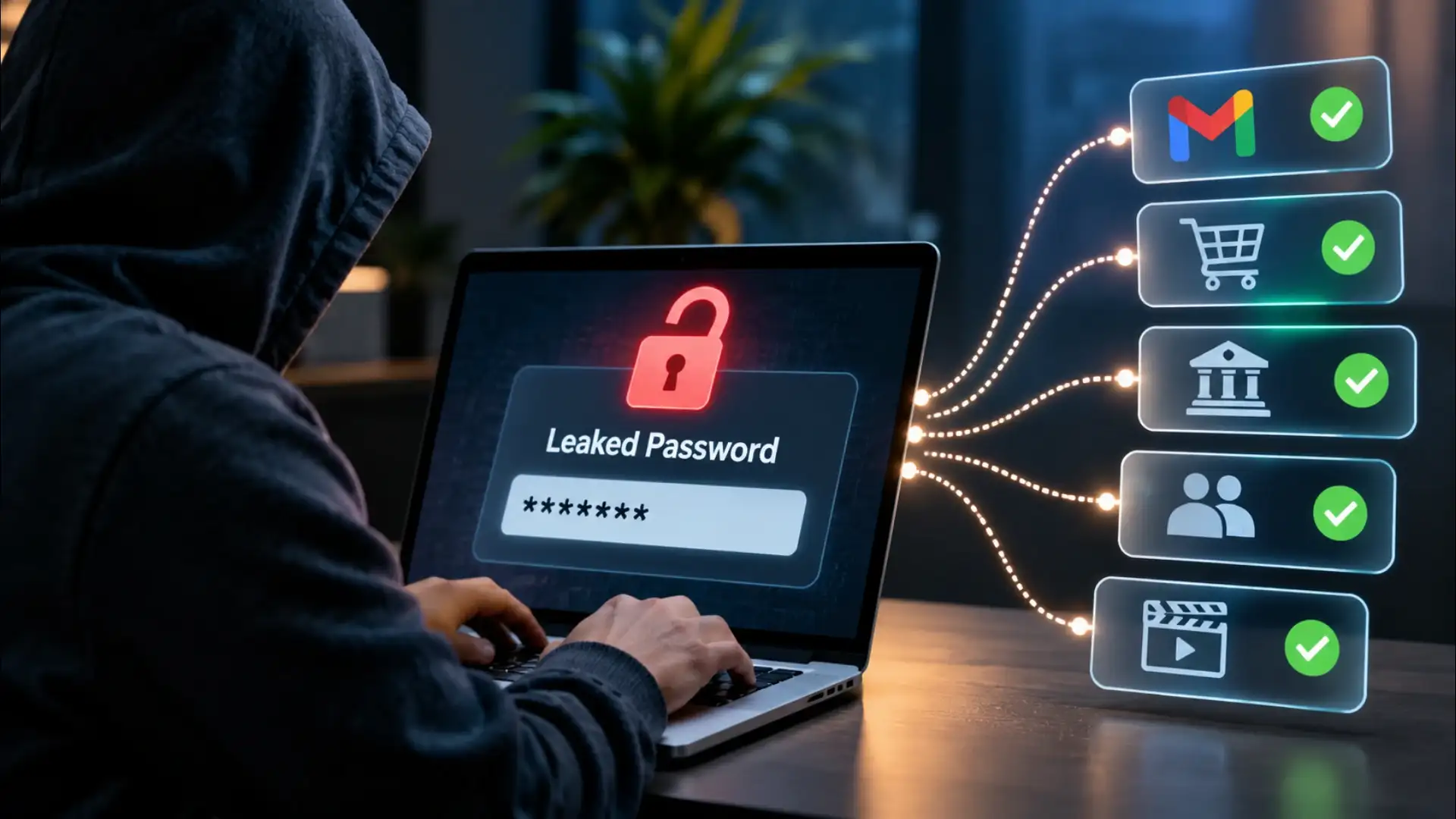
Credential stuffing is what happens next. Automated tools, widely available, requiring no programming skill, take that list and fire each username-password pair at other websites. The software mimics normal browser behaviour, rotates through different IP addresses to avoid blocks, and logs every successful login. A list of ten million stolen credentials might yield fifty thousand successful logins elsewhere. That fifty thousand is the product being sold or exploited.
The attack works because of one human habit: password reuse. If you used the same password on a breached forum as you use on your email account, the attacker does not need to crack anything. The door is already unlocked.
Some tools go further, solving the image-based puzzles that sites use to slow down automated traffic. Others mimic the timing patterns of human typing. The arms race between these tools and website defences is ongoing, but the attacker has one structural advantage: they only need to succeed occasionally. A website needs to block every single malicious attempt.
This is why the scale of the problem is larger than any single headline breach suggests. Hundreds of smaller breaches happen without public notice. The credentials from all of them aggregate into combined lists, sometimes called combo lists, that contain billions of unique pairs. Security researchers who study these lists regularly find credentials that are years old and still working, because the passwords behind them were never changed.
A password manager makes this practical. It generates a random string for each site, something like a forty-character sequence of letters, numbers, and symbols that you never see or type, and stores it encrypted on your device or in a vault. You remember one strong master password. The manager handles the rest.
The second layer is two-factor authentication. Even if an attacker successfully matches a credential pair, a second factor, a code sent to your phone, or generated by an authenticator app, means a correct password alone is not enough to get in. Most major services offer this. Enabling it on email and banking accounts first covers the highest-value targets.
There are services that tell you whether your email address appears in known breach data. Checking your address against one of these, they work by matching your email against published breach lists without revealing the actual passwords, tells you which old accounts need a password change.
None of these measures fully stop a determined, well-resourced attacker with a large proxy pool. They raise the cost and reduce the success rate. The user-side defence, unique passwords and a second factor, does not raise the cost. It removes the reward entirely. A correct credential pair that still cannot log in is worthless.
What Credential Stuffing Actually Is
When a service gets breached, attackers extract its user database. That database contains, at minimum, email addresses and passwords, sometimes hashed, sometimes stored in plain text by careless developers. These lists circulate on criminal marketplaces and forums, sometimes freely, sometimes for a few dollars per million records.Credential stuffing is what happens next. Automated tools, widely available, requiring no programming skill, take that list and fire each username-password pair at other websites. The software mimics normal browser behaviour, rotates through different IP addresses to avoid blocks, and logs every successful login. A list of ten million stolen credentials might yield fifty thousand successful logins elsewhere. That fifty thousand is the product being sold or exploited.
The attack works because of one human habit: password reuse. If you used the same password on a breached forum as you use on your email account, the attacker does not need to crack anything. The door is already unlocked.
How the Software Does the Work
The tools that run credential stuffing attacks are built around two capabilities. First, they send requests at a rate no human could match, thousands per minute across hundreds of target sites simultaneously. Second, they disguise that traffic. Each request might come from a different IP address, drawn from a pool of compromised home routers or rented proxy servers. The login attempt looks, to the target website, like it came from a different city each time.You may also like
- GTA 6 Mandy Character Explained: Who Is She and Can Jason Date Her?
- BSNL ₹2,449 Recharge Plan: Get 380 Days Validity, 2GB Daily Data and Insurance Benefits
- Best Samsung double door refrigerators in India: Refrigerators with Active Fresh Filter+, Twin Cooling Plus technology and others to consider
- Elon Musk says that he feels foolish about spending close to $500 million on US mid-terms; declares am not a MAGA, 'not sure' what MAGA actually means
- Jio ₹1,029 Recharge Plan: Get 2GB Daily Data, Amazon Prime Lite and JioHotstar for 84 Days
Some tools go further, solving the image-based puzzles that sites use to slow down automated traffic. Others mimic the timing patterns of human typing. The arms race between these tools and website defences is ongoing, but the attacker has one structural advantage: they only need to succeed occasionally. A website needs to block every single malicious attempt.
Why Breaches You Did Not Cause Still Hurt You
The breach does not have to be your fault or even at a service you care about. A gaming forum, a recipe site, a loyalty programme from a store you visited once, any of these, if they stored your credentials and were later breached, hands attackers a key that fits your more important locks.This is why the scale of the problem is larger than any single headline breach suggests. Hundreds of smaller breaches happen without public notice. The credentials from all of them aggregate into combined lists, sometimes called combo lists, that contain billions of unique pairs. Security researchers who study these lists regularly find credentials that are years old and still working, because the passwords behind them were never changed.
The One Habit That Breaks the Attack
Credential stuffing is structurally defeated by one practice: a different password for every account. If the breached forum had a unique password, the attacker's list entry for your email is useless against your bank. The key does not fit a different lock.A password manager makes this practical. It generates a random string for each site, something like a forty-character sequence of letters, numbers, and symbols that you never see or type, and stores it encrypted on your device or in a vault. You remember one strong master password. The manager handles the rest.
The second layer is two-factor authentication. Even if an attacker successfully matches a credential pair, a second factor, a code sent to your phone, or generated by an authenticator app, means a correct password alone is not enough to get in. Most major services offer this. Enabling it on email and banking accounts first covers the highest-value targets.
There are services that tell you whether your email address appears in known breach data. Checking your address against one of these, they work by matching your email against published breach lists without revealing the actual passwords, tells you which old accounts need a password change.
What Websites Do to Slow the Attack Down
Defenders on the website side use several techniques. Rate limiting restricts how many login attempts a single IP address can make in a short window. Device fingerprinting looks for patterns that suggest automated behaviour, too-consistent timing, missing browser characteristics that real users generate. Some sites add friction only when a login attempt looks suspicious, rather than making every user solve a puzzle every time.None of these measures fully stop a determined, well-resourced attacker with a large proxy pool. They raise the cost and reduce the success rate. The user-side defence, unique passwords and a second factor, does not raise the cost. It removes the reward entirely. A correct credential pair that still cannot log in is worthless.






Loving Newspoint? Download the app now