
Google just announced Genie 4: Here's what it can do, from building walk-through worlds out of a sentence to filling them with sound and speech, and when you might get to try it


Type a line describing a quiet lake on a misty morning, with a man playing the saxophone on a small floating platform, and Google 's new AI will build that place for you. You can then move around it, glide the camera over the water and hear the saxophone as you go.
This is Genie 4, the newest version of what Google calls a world model, unveiled by its research lab Google DeepMind on Tuesday. It is not open to the public yet, but a waitlist is already up, and the demos give a good sense of what it can do.
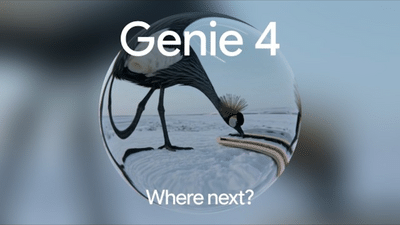
Genie 4 builds a scene around you while you explore itUsing it feels closer to playing a video game than watching a video. You start by typing a description or uploading a photo, and Genie 4 creates the scene on screen. Press the arrow keys to walk forward, turn around or move the camera, and it draws whatever lies in that direction, frame by frame, as you go.
Unlike a game, nothing here was designed beforehand. There are no ready-made levels or characters waiting to be found, and everything you see is created the moment you look at it.
You can also change the scene while you are in it. Type that you want it to start raining, ask for a different view or bring a new person into the frame, and the world adjusts without starting over. Behind the scenes, Google's Gemini AI makes sure these changes fit in naturally and that the place stays consistent as you move around.
Each session can now run for around two minutes while staying consistent, roughly twice as long as the previous version, Genie 3.
People, physics and sound now feel much closer to real lifeThe biggest change from Genie 3 is how real everything looks. Objects move the way you would expect them to, so a falling maple seed spins on its way to the ground and things collide more convincingly.
People are where you notice it most. Characters in the older version often moved stiffly, while those in Genie 4 walk naturally, react to what is around them and can be directed as the scene plays out. One of Google's examples is a crowded Japanese railway station from the 1980s, with passengers filling the platform and a long red train on the nearest track.
Sound is new as well. Every scene now comes with its own audio, from waves on a beach to wind in the trees, and characters can speak. They chat with each other and respond to what you do or to whatever happens around them.
A small group of testers has been putting all of this to use. Filmmakers are walking through scenes before shooting them, trying out camera angles, lighting and dialogue. Photographers are turning old photos into places you can step into, and game makers are testing ideas in minutes before writing a line of code. Google is also using it to let robots practise tasks in a simulated room before trying them in a real one.
Genie 4 is coming to paying subscribers first, and it still has rough edgesFor now, only a small group of testers can use Genie 4. Google says it will reach AI Ultra subscribers in the coming weeks through Project Genie , its app for creating these worlds, along with developers who build apps on Google's AI. Ultra is the most expensive of Google's AI plans, and there is no word yet on whether the cheaper ones will get access later. Anyone interested can sign up for the waitlist on the Project Genie page.
It is also clearly unfinished, and Google says as much. The longer you spend in a world, the more its details can drift, with objects changing shape or disappearing altogether. Sound does not always line up with what is on screen, and text such as signs or labels can come out hard to read.
To keep its creations from being mistaken for real footage, every video and audio clip Genie 4 makes carries an invisible watermark that marks it as AI-generated.
Typing a sentence and stepping into the place it describes is, at the moment, something only a handful of testers get to do, two minutes at a time. Google's plan is to widen that circle soon, starting with the people already paying for its top AI plan.
This is Genie 4, the newest version of what Google calls a world model, unveiled by its research lab Google DeepMind on Tuesday. It is not open to the public yet, but a waitlist is already up, and the demos give a good sense of what it can do.
Genie 4 builds a scene around you while you explore itUsing it feels closer to playing a video game than watching a video. You start by typing a description or uploading a photo, and Genie 4 creates the scene on screen. Press the arrow keys to walk forward, turn around or move the camera, and it draws whatever lies in that direction, frame by frame, as you go.
Unlike a game, nothing here was designed beforehand. There are no ready-made levels or characters waiting to be found, and everything you see is created the moment you look at it.
You can also change the scene while you are in it. Type that you want it to start raining, ask for a different view or bring a new person into the frame, and the world adjusts without starting over. Behind the scenes, Google's Gemini AI makes sure these changes fit in naturally and that the place stays consistent as you move around.
Each session can now run for around two minutes while staying consistent, roughly twice as long as the previous version, Genie 3.
People, physics and sound now feel much closer to real lifeThe biggest change from Genie 3 is how real everything looks. Objects move the way you would expect them to, so a falling maple seed spins on its way to the ground and things collide more convincingly.
People are where you notice it most. Characters in the older version often moved stiffly, while those in Genie 4 walk naturally, react to what is around them and can be directed as the scene plays out. One of Google's examples is a crowded Japanese railway station from the 1980s, with passengers filling the platform and a long red train on the nearest track.
Sound is new as well. Every scene now comes with its own audio, from waves on a beach to wind in the trees, and characters can speak. They chat with each other and respond to what you do or to whatever happens around them.
A small group of testers has been putting all of this to use. Filmmakers are walking through scenes before shooting them, trying out camera angles, lighting and dialogue. Photographers are turning old photos into places you can step into, and game makers are testing ideas in minutes before writing a line of code. Google is also using it to let robots practise tasks in a simulated room before trying them in a real one.
Genie 4 is coming to paying subscribers first, and it still has rough edgesFor now, only a small group of testers can use Genie 4. Google says it will reach AI Ultra subscribers in the coming weeks through Project Genie , its app for creating these worlds, along with developers who build apps on Google's AI. Ultra is the most expensive of Google's AI plans, and there is no word yet on whether the cheaper ones will get access later. Anyone interested can sign up for the waitlist on the Project Genie page.
It is also clearly unfinished, and Google says as much. The longer you spend in a world, the more its details can drift, with objects changing shape or disappearing altogether. Sound does not always line up with what is on screen, and text such as signs or labels can come out hard to read.
To keep its creations from being mistaken for real footage, every video and audio clip Genie 4 makes carries an invisible watermark that marks it as AI-generated.
Typing a sentence and stepping into the place it describes is, at the moment, something only a handful of testers get to do, two minutes at a time. Google's plan is to widen that circle soon, starting with the people already paying for its top AI plan.
Next Story