
Google launches Genie 4: What's new, what changes from Genie 3 and who all can try it


Google has opened up Genie 4, the latest version of its world model, to eligible Google AI Ultra subscribers . It arrives as part of a refreshed Project Genie experience, which also brings upgrades to Genie 3, a new creation agent and a community gallery where users can explore and remix what others have built.
Project Genie first appeared earlier this year as an experimental research prototype that let users generate interactive worlds and move around inside them. The idea was impressive, but the control was limited. Early testers told Google they wanted more say over what happens inside these spaces, along with simpler ways to build and share them. This update is the company’s answer to that feedback.
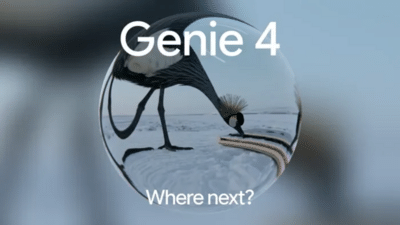
Genie 4 lets you rewrite a scene while you are still inside itThe biggest change with Genie 4 is mid-session prompting. Users can now type a new prompt while navigating, and the environment changes in real time. The weather can shift, a character can be dropped into the scene, or the action can take a different direction altogether.
Google calls Genie 4 its most realistic and interactive world model so far, with its highest-fidelity visuals and physics yet. The more notable addition, though, is sound. For the first time, the visuals come paired with real-time native audio that adapts as the scene unfolds, covering everything from ambient background noise to character dialogue.
Genie 3 stays on for longer, wider explorationsGenie 4 does not replace its predecessor. Genie 3 remains in Project Genie’s model picker, and Google is positioning it as the pick for longer runs and panorama-based spaces. It gets three upgrades of its own.
Sessions now last up to three minutes per generation, up from 60 seconds, and multiple worlds can be chained together for longer journeys. Users can also seed new environments from 360-degree panorama images. Google showed this off with Petra, where the canyon and its carved facade stay consistent as the camera turns. Genie 3 also picks up real-time in-world events, so the surroundings can be changed with natural-language prompts mid-exploration. One demo uses this to fly across forests, underwater ruins and icy seas in a single continuous run, before summoning a dragon to ride.
Project Genie now lets you build, remix and share your own worldsThe new Project Genie agent takes creation past a single text or image prompt. Users describe what they have in mind in plain language, and the agent pulls in Google’s multimodal models to create the initial visuals that set the look of the world, along with a background score matched to its mood.
Gemini can also join a session as a companion. It watches what is happening on screen, offers suggestion chips for where to head next, and can trigger events on its own as the exploration unfolds.
For those who would rather explore than build, the new gallery collects curated worlds alongside community creations. “Living Memory” turns personal photos into explorable spaces, “Dino Field Guide” offers prehistoric habitats built from 360-degree panoramas, and “Rock Paper Scissors” sets themed objects against each other on a desk, with Gemini acting as the referee.
Google has also worked with creators who had early access to the tools. Creative technologist Will aka BLVCKL!GHT helped build “Villa Giallo”, a room-by-room mystery set inside a gothic manor, while filmmaker Anand Gandhi worked on “The Life of Ants”, which uses Genie 4’s photorealism to let users move through a colony from an ant’s point of view. Anything in the gallery can be remixed with the agent, from its underlying structure to its soundtrack and rules, and then published back for others to try.
Genie 4 is limited to AI Ultra subscribers for nowThe new Project Genie experience is rolling out to eligible Google AI Ultra subscribers, and it runs directly in the browser. Google AI Pro members cannot try it yet, but they can join a waitlist from the same page.
Google says all video and audio generated in Project Genie carries SynthID watermarking, and every input and output goes through safety screening. The company also admits both models remain frontier research, with camera latency, complex physical interactions, audio precision and long-term scene permanence still being worked on.
Those who do get in will find the kind of control early testers asked for, from rewriting a scene mid-run to remixing someone else’s creation and sharing it back.
Project Genie first appeared earlier this year as an experimental research prototype that let users generate interactive worlds and move around inside them. The idea was impressive, but the control was limited. Early testers told Google they wanted more say over what happens inside these spaces, along with simpler ways to build and share them. This update is the company’s answer to that feedback.
Genie 4 lets you rewrite a scene while you are still inside itThe biggest change with Genie 4 is mid-session prompting. Users can now type a new prompt while navigating, and the environment changes in real time. The weather can shift, a character can be dropped into the scene, or the action can take a different direction altogether.
Google calls Genie 4 its most realistic and interactive world model so far, with its highest-fidelity visuals and physics yet. The more notable addition, though, is sound. For the first time, the visuals come paired with real-time native audio that adapts as the scene unfolds, covering everything from ambient background noise to character dialogue.
Genie 3 stays on for longer, wider explorationsGenie 4 does not replace its predecessor. Genie 3 remains in Project Genie’s model picker, and Google is positioning it as the pick for longer runs and panorama-based spaces. It gets three upgrades of its own.
Sessions now last up to three minutes per generation, up from 60 seconds, and multiple worlds can be chained together for longer journeys. Users can also seed new environments from 360-degree panorama images. Google showed this off with Petra, where the canyon and its carved facade stay consistent as the camera turns. Genie 3 also picks up real-time in-world events, so the surroundings can be changed with natural-language prompts mid-exploration. One demo uses this to fly across forests, underwater ruins and icy seas in a single continuous run, before summoning a dragon to ride.
Project Genie now lets you build, remix and share your own worldsThe new Project Genie agent takes creation past a single text or image prompt. Users describe what they have in mind in plain language, and the agent pulls in Google’s multimodal models to create the initial visuals that set the look of the world, along with a background score matched to its mood.
Gemini can also join a session as a companion. It watches what is happening on screen, offers suggestion chips for where to head next, and can trigger events on its own as the exploration unfolds.
For those who would rather explore than build, the new gallery collects curated worlds alongside community creations. “Living Memory” turns personal photos into explorable spaces, “Dino Field Guide” offers prehistoric habitats built from 360-degree panoramas, and “Rock Paper Scissors” sets themed objects against each other on a desk, with Gemini acting as the referee.
Google has also worked with creators who had early access to the tools. Creative technologist Will aka BLVCKL!GHT helped build “Villa Giallo”, a room-by-room mystery set inside a gothic manor, while filmmaker Anand Gandhi worked on “The Life of Ants”, which uses Genie 4’s photorealism to let users move through a colony from an ant’s point of view. Anything in the gallery can be remixed with the agent, from its underlying structure to its soundtrack and rules, and then published back for others to try.
Genie 4 is limited to AI Ultra subscribers for nowThe new Project Genie experience is rolling out to eligible Google AI Ultra subscribers, and it runs directly in the browser. Google AI Pro members cannot try it yet, but they can join a waitlist from the same page.
Google says all video and audio generated in Project Genie carries SynthID watermarking, and every input and output goes through safety screening. The company also admits both models remain frontier research, with camera latency, complex physical interactions, audio precision and long-term scene permanence still being worked on.
Those who do get in will find the kind of control early testers asked for, from rewriting a scene mid-run to remixing someone else’s creation and sharing it back.
Next Story