
In 1967, a Cambridge student spotted a 'scruffy' printout blip that revealed the universe's mysterious ticking stars


Looking into the heavens in the middle part of the twentieth century did not always require viewing the starry night through a glass lens. Some scientists spent several weeks examining endless sheets of paper charts that showed erratic squiggles. It was during the winter of 1967 that a young graduate student at the University of Cambridge was doing just that. She was studying data received from the newly constructed radio telescope in order to find some other astral phenomenon when she stumbled upon something bizarre. An unusual squiggle that filled less than half an inch of space among miles of paper.

That student was Jocelyn Bell Burnell , whose curiosity made this minor mystery one of the most important astronomical discoveries of the entire century. The signal she had been tracking showed the same amazing regularity; it was pulsing in perfect synchronicity every 1.33 seconds. In jest, her team dubbed the source "LGM 1" or Little Green Men and seriously considered whether it could be an alien communication station. As it turned out, reality was even stranger than fiction; this mysterious signal was a sign of a completely unknown kind of celestial body.
How a pulsating star revealed the existence of cosmic ghosts
This unusual radio signal did not originate from any aliens, but from a quickly rotating stellar corpse. The groundbreaking discovery, Observation of a Rapidly Pulsating Radio Source, described the first known pulsar in scientific literature in the Nature journal. According to their theory, when a large star consumes all its fuel, its core collapses under its tremendous gravity and turns into an extremely dense neutron star. No one had been able to find evidence that these celestial bodies exist until Jocelyn Bell Burnell discovered this signal while studying the British countryside.
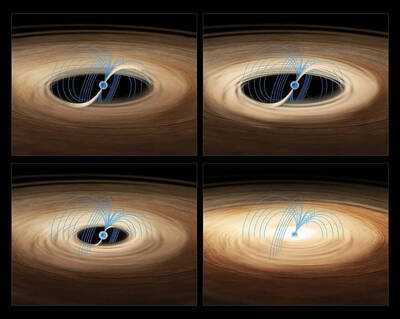
Pulsar is, perhaps, an excellent example of a space lighthouse. A pulsar is a collapsed star that has shrunk into the size of a regular city while having a much larger mass than the Sun. Thanks to its extremely high speed of rotation and magnetic fields, pulsars emit powerful rays of energy out into space. Every time the star rotates, its energy ray falls onto the planet Earth, creating the characteristic tick of the star that we observe with telescopes. Pulsar discovery was one of the first instances where the mathematics of neutron stars became an observable reality, thus showing that there are numerous pulsars inside our universe.
The cosmic clocks revolutionising our perception of the universe
The discovery of pulsars opened up an entirely new perspective on modern astrophysics due to their clock-like nature. As noted in the historical analysis Journeys of Discovery published by the University of Cambridge, pulsars have proven extremely useful as a means to understand the boundaries of possible physics. Because of the exact nature of their ticks, even minor variations can provide valuable information about the universe.
Scientists soon realised they could use these cosmic clocks to test Albert Einstein's theories of relativity under extreme gravitational pressure that could never be recreated on Earth. Decades later, observing pairs of these spinning stars even provided the first indirect confirmation of gravitational waves , which are ripples in the fabric of space-time itself. A simple, persistent look at a piece of paper chart paper by an observant student had opened up a new era of space exploration , changing how we track the movements of the universe.
In today’s world, there is no denying that pulsars still make up a large part of deep space studies. Their discovery itself stands as a testament to the fact that some of the greatest discoveries lie hidden in the little things that people overlook.
It is astounding to think that, whereas we go about our daily activities with the help of wrist watches, time itself has been running for billions of years according to the ticks of dead stars twirling in the pitch darkness of space. It makes us stare into the starry sky in amazement, thinking about other hidden cycles that must be passing over Earth.
That student was Jocelyn Bell Burnell , whose curiosity made this minor mystery one of the most important astronomical discoveries of the entire century. The signal she had been tracking showed the same amazing regularity; it was pulsing in perfect synchronicity every 1.33 seconds. In jest, her team dubbed the source "LGM 1" or Little Green Men and seriously considered whether it could be an alien communication station. As it turned out, reality was even stranger than fiction; this mysterious signal was a sign of a completely unknown kind of celestial body.
How a pulsating star revealed the existence of cosmic ghosts
This unusual radio signal did not originate from any aliens, but from a quickly rotating stellar corpse. The groundbreaking discovery, Observation of a Rapidly Pulsating Radio Source, described the first known pulsar in scientific literature in the Nature journal. According to their theory, when a large star consumes all its fuel, its core collapses under its tremendous gravity and turns into an extremely dense neutron star. No one had been able to find evidence that these celestial bodies exist until Jocelyn Bell Burnell discovered this signal while studying the British countryside.
Pulsar is, perhaps, an excellent example of a space lighthouse. A pulsar is a collapsed star that has shrunk into the size of a regular city while having a much larger mass than the Sun. Thanks to its extremely high speed of rotation and magnetic fields, pulsars emit powerful rays of energy out into space. Every time the star rotates, its energy ray falls onto the planet Earth, creating the characteristic tick of the star that we observe with telescopes. Pulsar discovery was one of the first instances where the mathematics of neutron stars became an observable reality, thus showing that there are numerous pulsars inside our universe.
The cosmic clocks revolutionising our perception of the universe
The discovery of pulsars opened up an entirely new perspective on modern astrophysics due to their clock-like nature. As noted in the historical analysis Journeys of Discovery published by the University of Cambridge, pulsars have proven extremely useful as a means to understand the boundaries of possible physics. Because of the exact nature of their ticks, even minor variations can provide valuable information about the universe.
Scientists soon realised they could use these cosmic clocks to test Albert Einstein's theories of relativity under extreme gravitational pressure that could never be recreated on Earth. Decades later, observing pairs of these spinning stars even provided the first indirect confirmation of gravitational waves , which are ripples in the fabric of space-time itself. A simple, persistent look at a piece of paper chart paper by an observant student had opened up a new era of space exploration , changing how we track the movements of the universe.
In today’s world, there is no denying that pulsars still make up a large part of deep space studies. Their discovery itself stands as a testament to the fact that some of the greatest discoveries lie hidden in the little things that people overlook.
It is astounding to think that, whereas we go about our daily activities with the help of wrist watches, time itself has been running for billions of years according to the ticks of dead stars twirling in the pitch darkness of space. It makes us stare into the starry sky in amazement, thinking about other hidden cycles that must be passing over Earth.
Next Story