
In 2025, Dutch designers built a 60-metre highway noise barrier from retired wind-turbine blades; tests found it performed like concrete walls


A 60-metre noise barrier was made from retired wind-turbine blades and was installed beside the A58 highway near Oirschot in the Netherlands in 2025. After six months, initial measurements found that the recycled-blade structure was able to produce noise reduction that is comparable to a conventional concrete barrier.
The project is called the Blade Barrier , and was unveiled on July 2, 2025, at InnovA58, an infrastructure testing site operated by Rijkswaterstaat. The installation was designed as a test and is being monitored through the end of 2026.
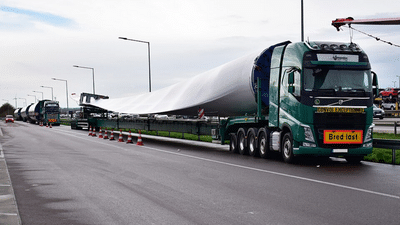
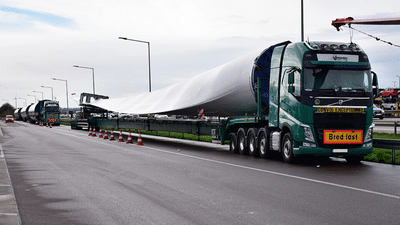 Two complete blades form the main structure
The barrier uses two complete wind-turbine blades and a section cut from a third, with the blades positioned along an earth embankment rather than mounted on the same type of foundation that is normally used for a conventional noise wall. The test structure is about 60 metres long and roughly 3.5 metres high, and the arrangement allows researchers to examine several types of connections and construction methods while the barrier is in use beside a working motorway.
Blade–Made is the Dutch company that designed the system around the idea that old turbine blades could be reused with relatively little processing. Its horizontal design uses about 45 blades per kilometre, while a vertical configuration could use as many as 200 blades per kilometre.
The blades that were used in the test were supplied from decommissioned wind turbines. The project keeps large sections of the blades intact and incorporates them directly into the infrastructure instead of cutting the composite material into smaller pieces.
The barrier is being tested beside a live highway
InnovA58 was set up as a place where new infrastructure ideas could be tested under real conditions, and the Blade Barrier is one of several experimental noise barriers being evaluated along the A58. Researchers are also examining how easily the structure can be built, how it performs over time, what maintenance it requires and how its environmental costs compare with other types of barriers.
The blades sit partly on an earth embankment, which reduces the amount of foundation material that might be required in comparison to some conventional designs. The embankment itself was planted with native flowers and herbs. Rijkswaterstaat said the trial would continue until the end of 2026, and the aim is to collect enough information to assess whether the approach could be used at other locations.
Initial measurements compared with a concrete wall
The first acoustic results were reported in February 2026, about six months after the barrier was installed. InnovA58 said measurements showed noise reduction that is comparable to a standard concrete noise barrier. The Blade Barrier varies in height between about three and four metres. Researchers used measurements and scientific modelling to compare its acoustic performance with a conventional barrier, and the results indicated that its performance was comparable to a traditional noise barrier about 3.3 metres high. The findings do not mean the testing is complete, since monitoring is continuing through 2026, with other aspects of the installation still under evaluation.
 A second use for difficult-to-recycle blades
Wind-turbine blades can be difficult to recycle because they are made largely from composite materials like glass or carbon fibres embedded in resin. When turbines are retired, the blades present a different waste challenge from materials such as steel, which can be processed through established recycling systems.
Blade–Made says that noise barriers are suited to blade reuse because the blades can remain largely intact instead of being shredded or processed into another material. The company is also examining whether the same approach could be used in other infrastructure applications.
The Blade Barrier is being developed with Rijkswaterstaat and construction company Dura Vermeer, and has financial support from the Province of Noord-Brabant. Its evaluation covers acoustic performance, manufacturability, financial feasibility, sustainability, maintenance and safety. The 60-metre installation will remain at the InnovA58 site while those tests continue through the end of 2026.
The project is called the Blade Barrier , and was unveiled on July 2, 2025, at InnovA58, an infrastructure testing site operated by Rijkswaterstaat. The installation was designed as a test and is being monitored through the end of 2026.
The barrier uses two complete wind-turbine blades and a section cut from a third, with the blades positioned along an earth embankment rather than mounted on the same type of foundation that is normally used for a conventional noise wall. The test structure is about 60 metres long and roughly 3.5 metres high, and the arrangement allows researchers to examine several types of connections and construction methods while the barrier is in use beside a working motorway.
Blade–Made is the Dutch company that designed the system around the idea that old turbine blades could be reused with relatively little processing. Its horizontal design uses about 45 blades per kilometre, while a vertical configuration could use as many as 200 blades per kilometre.
The blades that were used in the test were supplied from decommissioned wind turbines. The project keeps large sections of the blades intact and incorporates them directly into the infrastructure instead of cutting the composite material into smaller pieces.
The barrier is being tested beside a live highway
InnovA58 was set up as a place where new infrastructure ideas could be tested under real conditions, and the Blade Barrier is one of several experimental noise barriers being evaluated along the A58. Researchers are also examining how easily the structure can be built, how it performs over time, what maintenance it requires and how its environmental costs compare with other types of barriers.
The blades sit partly on an earth embankment, which reduces the amount of foundation material that might be required in comparison to some conventional designs. The embankment itself was planted with native flowers and herbs. Rijkswaterstaat said the trial would continue until the end of 2026, and the aim is to collect enough information to assess whether the approach could be used at other locations.
Initial measurements compared with a concrete wall
The first acoustic results were reported in February 2026, about six months after the barrier was installed. InnovA58 said measurements showed noise reduction that is comparable to a standard concrete noise barrier. The Blade Barrier varies in height between about three and four metres. Researchers used measurements and scientific modelling to compare its acoustic performance with a conventional barrier, and the results indicated that its performance was comparable to a traditional noise barrier about 3.3 metres high. The findings do not mean the testing is complete, since monitoring is continuing through 2026, with other aspects of the installation still under evaluation.
Wind-turbine blades can be difficult to recycle because they are made largely from composite materials like glass or carbon fibres embedded in resin. When turbines are retired, the blades present a different waste challenge from materials such as steel, which can be processed through established recycling systems.
Blade–Made says that noise barriers are suited to blade reuse because the blades can remain largely intact instead of being shredded or processed into another material. The company is also examining whether the same approach could be used in other infrastructure applications.
The Blade Barrier is being developed with Rijkswaterstaat and construction company Dura Vermeer, and has financial support from the Province of Noord-Brabant. Its evaluation covers acoustic performance, manufacturability, financial feasibility, sustainability, maintenance and safety. The 60-metre installation will remain at the InnovA58 site while those tests continue through the end of 2026.
Next Story