
Powering StanChart's transformation


Standard Chartered Bank once had multiple payment systems talking to one another across markets, creating more opportunities for errors, operational risks and uneven customer experiences. Engineering teams in India helped build a single platform to bring those systems together. The payoff goes beyond smoother payments: the bank can now introduce new technologies without having to replicate the work across a patchwork of systems.
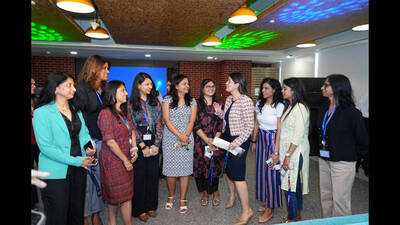
SC Pay, the largely home-built platform, illustrates the impact of India’s talent on the bank’s global operations, says Tanuj Kapilashrami , its group chief operating officer. Indian engineers, she says, have also moved into product management roles overseas, including in Singapore.
For a bank operating across more than 50 markets, this consolidation matters. Its long history, acquisitions and differing regulatory requirements had left it with disparate systems. Common platforms help reduce friction, support growth and accelerate innovation. They also help, Tanuj says, an established bank compete with fintechs built around the internet from the outset.
The daughter of an army officer, Tanuj grew up across India, completed her undergraduate studies at Delhi’s Lady Shri Ram College and then attended XLRI. She entered banking in 2000, spending more than 17 years at HSBC in roles spanning India, Hong Kong, Singapore, London and the Middle East.
She joined Standard Chartered to work on transformation, subsequently serving as chief human resources officer for five years. Today, as group COO, she oversees corporate functions and transformation, bringing together the people, processes and technology she sees as inseparable from the bank’s next phase of growth.
40% of global workforceStandard Chartered is headquartered in Britain, but its network is concentrated across Asia, Africa and the Middle East. Its focus is cross-border banking for corporate and institutional clients, and affluent customers.
India accounts for about 40% of its global workforce. Of roughly 32,000 employees here, 22,000 work in global business services centres in Bengaluru and Chennai. These operations began as Scope International in 2001.
The move of global companies’ India centres beyond back-office processing is now well established. The question now is how much responsibility India teams carry. At Standard Chartered, finance specialists here work on balance-sheet, liquidity and treasury management. They help determine where cross-border transactions should be booked, weighing tax rules, regulatory requirements and the availability of funds in individual markets.
Artificial intelligence is adding another dimension. The bank has introduced agents to support employee onboarding, with deployment happening through its shared service centres. Developed in collaboration with SAP, whose platform supports its human resources systems, the agents take over routine administrative tasks alongside human teams.
Tanuj says this has reduced hiring managers’ effort by 35%. At a bank hiring 25,000 to 27,000 people globally each year, that represents a substantial opportunity to free up time.
But she says employees were prepared for their changed roles before the agents arrived. The team assessed whether people had the skills to handle the higher-order work that would remain, and completed reskilling before deployment.
Skills as currency of work“My big work over the last few years has been the move away from jobs as a currency of work to skills being a currency of work in the age of AI. To me, it's about how you're embedding that technology in the flow of work. It's the technologists who get excited by cool tech. What I get excited about is how are we using end-to-end process redesign, how are we getting a really granular view of the skills that underpin that work, and how are we making intentional choices around work that gets fully automated – agents can run it – and work that gets augmented,” Tanuj says.
The bank has rolled out an AI factory to deploy applications at scale. A generative AI tool supports environmental, social and governance checks on corporate clients, improving turnaround time and reducing human effort.
AI is also helping untangle the bank’s accumulated controls. Teams fed control registers into an internal copilot to identify overlaps. New regulations often produce additional checks without removing older ones, leaving duplication across departments or countries.
Some parts of the operation have reported a 25% to 27% reduction in controls over a quarter, Tanuj says. The broader simplification programme could deliver in a year what would previously have taken three.
AI has enabled growth opportunities too. Teams have developed a copilot that gives wealth relationship managers insights about clients on their phones, reducing time spent searching multiple systems. Tanuj says teams adopting it are reaching more of their client base and seeing higher assets under management. The same workforce, she says, can provide more advice.
Next Story