
Random Musing | Will AI 'kill' all humans? Decoding the conspiracy theories


Ever since former Anthropic researcher Jacob Coxon warned of the imminent arrival of an out-of-control AI, the commentariat have started calculating when, and not if, the Deus Ex-Machina will terminate all humans. Most of the commentary has been asinine, but even amid that, a tweet by UK MP Zarah Sultana clearly stood out in its asininity: “AI should be controlled by the workers who build and use it, not by parasitic billionaires.”
And even before Marx could wrap his head around that, across the Atlantic Bernie Sanders announced his plans for a bill to ‘ban artificial superintelligence ’, with 20 years in prison for violating the rule, which as one social media user put it, sounds like 20 years in prison for murdering Santa Claus.
Jokes apart, the proposed bill is essentially a rehash of one that exists for building illegal nuclear weapons that never applies to a ‘guy’ called JEFF.
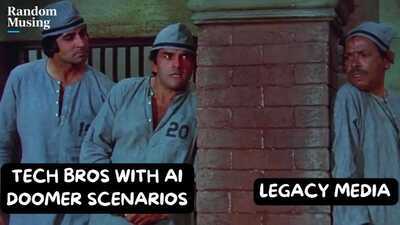
But when two histrionic political voices across the Pond make asinine aeolian sounds, you almost suddenly start to believe that perhaps the Deus Ex-Machina is right around the corner. Or one wonders, while borrowing a line from Hamlet’s mother: if all the tech bros doth protest too much?
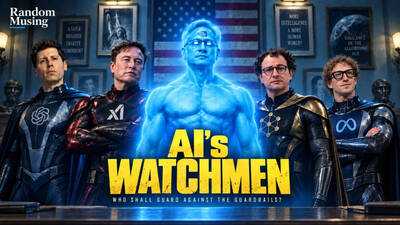
So, in this edition of Random Musing, we decline Pascal’s wager and instead assume Pascal’s mugging and look at three conspiracy theories that are starting to feel less like conspiracy theories: 1) The China Boat, 2) The Shylock Problem, and 3) The Guardrail Cartel.
Conspiracy theory 1: The China Boat
A few weeks ago, we joked that the idea of being killed by a Chinese robot was ridiculous – a virus maybe, but a robot? – and yet now all the tech bros of Silicon Valley want to work with China. The nuclear equivalent would be if, during the Manhattan Project, Oppenheimer decided to collaborate with the top scientists of the Third Reich.
And just at the time when the idea of a Chinese AGI was taking over – evidenced by “world’s first AI actress” Tilly Norwood appearing to glitch and suddenly talking in Cantonese – though her creators said it was not a malfunction – almost all the players in the AI race are arguing that Silicon Valley needs to coordinate with Beijing.
Anthropic’s Dario Amodei – the CEO of the “good” AI company – called for “global coordination” and said that “global pacing will require cooperation with China”, while also asking Washington to restrict advanced chips, crack down on model theft and widen America’s technological lead so that the US has enough leeway.
In other words: America cannot slow down because China might race ahead, so first America needs to get far enough ahead that it can slow down, after which China must agree to slow down. It’s the kind of logic that would make even Neville Chamberlain lose his peace.
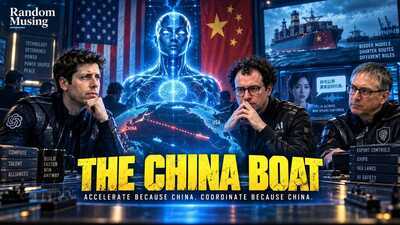
Meanwhile, Sam Altman, the CEO of the “bad” AI company, wants the same thing and has dangled the one thing Trump craves the most by arguing that “Trump and Xi would get the Nobel Peace Prize together” if they could reach an agreement on AI. Now, giving the Peace Prize to Trump and Xi would be on-brand for Oslo.
Gary Marcus, in his own words the “OG AI Sceptic”, who has been warning about AI hallucinations since 2001 and who shares an antagonistic relationship with both Altman and Amodei, has also reached the same conclusion, arguing in The Economist that the US and China’s AI relationship should be divided into three buckets: adversarial, competitive and collaborative. That is, they should compete over chips and other tech, cooperate on medicine and cybersecurity, and recognise that neither benefits if AI takes down a banking system or electricity grid.
And as if almost on cue – it’s remarkable how these things keep happening – a CNN report stated that an American AI chatbot “almost started a war” while preparing intelligence on a Chinese vessel.
Frankly, all that tells us is that the Peter Principle is alive and kicking at the Pentagon – like much of Washington, or should we call it St Petersburg – where even analysts are too lazy to actually analyse things and are dependent on hallucinating AI models to do their jobs.
Not that the idea might be too difficult for Trump, who would love the idea of himself saving humanity from runaway AI – though he thinks the only guardrails needed against one are a STRONG AND SMART (High IQ!) PRESIDENT – but smart people in the administration aren’t particularly convinced.
His former AI and Crypto Czar David Sacks – who insiders believe still has Trump’s ear as Co-Chair of the President’s Council of Advisors on Science and Technology – called the current alarm a “fear-mongering playbook” and laid the responsibility on the developers.
Obviously, Beijing has criticised “threat narratives” and “malicious competition”, and Huawei rotating chairman Eric Xu said the Chinese didn’t have models powerful enough to do what the Americans are describing.
Of course, no Chinese whisper about “lab leaks” can be heeded, but it does make one wonder if the Smart Alecs of Silicon Valley have hit a cul-de-sac and are wondering if the Chinese might have an answer to the non-emerging AGI problem.
Conspiracy theory 2: The Shylock Problem
There’s a saying from the California Gold Rush: one can make more money selling shovels to people who want to dig for gold than actually having gold. The same economic idea appears to be self-evident for AI. People building the tools that allow tech companies to build AI models – and even talking about it – are going to make more money than those who actually build it.
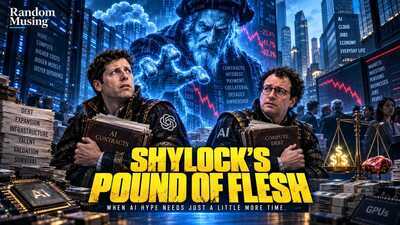
Perhaps the entire problem here is Shakespearean: the Antonios and Bassanios of Silicon Valley have borrowed too much from the market, promising a fantastical future, and now Shylock wants his pound of flesh. And with no Portia to argue their cause, they are hoping, by building up the dangers of AGI, to prevent a tulip-like bust of the entire AI market.
Consider the numbers: OpenAI raised $122 billion in March at an $852 billion post-money valuation, while Anthropic raised $65 billion in May at a $965 billion valuation.
Bank of America estimates that Alphabet, Microsoft, Amazon and Meta will collectively spend more than $860 billion in capital expenditure in 2026 and around $1.2 trillion in 2027 feeding the Deus Ex-Machina pipe dream.
The moment Amodei and other industry figures started discussing the idea of slowing down, semiconductor and AI-infrastructure stocks fell like an English football fan after a night out.
This raises the question: what if everyone has just spent too much on the AI arms race and would like a ceasefire for now, provided no one is allowed to continue firing?
It’s the classic prisoner’s dilemma. No one wants to keep running but assumes that if they are the only one who stops, they will be the one left behind.
Amodei pretty much spells it out, saying it would give frontier developers more time to work on safety without “sacrificing commercial advantage” or America’s AI lead.
And yet Amodei is behaving with the age-old American exceptionalist logic that led K Subrahmanyam (current EAM S Jaishankar’s father) to label American critics of India’s CTBT stand the“Ayatollahs of Nonproliferation on the Potomac”,because they were coercing India to sign the Comprehensive Test Ban Treaty, which the US had signed but never ratified.
Barely a week after Amodei called for the frontier to be paced, Reuters reported that Anthropic was considering another model release after OpenAI’s GPT-6 Astra gained ground among enterprise customers.
Steve Eisman, the investor who inspired Steve Carell’s character in The Big Short, accused frontier labs of “manufacturing a crisis” that could protect their competitive position and challenged companies professing such alarm to postpone their IPOs. Now, this is a man who knows a thing or two about bubbles and what happens when they go bust.
And a bust here would have far more dangerous consequences than Sam Altman consoling himself with a little less cash.
The blast radius would be far greater.
AI has become so thoroughly wired into the modern technological economy that a bust would hurt the economy, the companies financing it, the people working for them and entire businesses that have reorganised themselves around the assumption that the models will get better. Much of modern life is almost dependent on the tech companies that have bet so big on AI that, if they fail, the fallout would extend far beyond Silicon Valley.
Imagine, for a moment, Alphabet, Amazon, Microsoft and Meta all going bust overnight. It’s almost like the digital Stone Age of torrents, WinAmp players and CD burning, because an extraordinary amount of modern life — cloud computing, payments, advertising, communications, corporate software, logistics and the digital plumbing underneath thousands of other companies — now rests on infrastructure controlled by firms making enormous AI wagers.
AI has become, to borrow a fabulous phrase from novelist and journalist Cory Doctorow, “the asbestos in the walls of our technological society”. Many companies have already removed workers, changed workflows and rebuilt businesses around systems whose long-term economics remain uncertain, and putting humans back in the loop might prove rather harder than removing them. Because it won’t just be Shylock coming for Antonio’s pound of flesh.
All of ours are on the table as well.
Conspiracy theory 3: The Guardrail Cartel
Which brings us to the third conspiracy theory that’s as old as Juvenal’s Satires: Quis custodiet ipsos custodes, or who shall guard against the guards? Or, in this case: who shall guard against the guardrails? And whether those railing against the guards are the ones who want to set the guardrails?
It’s always curious when someone who has never had a conscience suddenly develops one. One is required to ask what led to such an awakening, which is far more curious than any AGI’s awakening.
And perhaps the answer has been staring us in the face all along: why suddenly is there wall-to-wall coverage about dangerous AGI, the way we saw with Ebola? And, to borrow a line from Barack Obama’s former anger translator: “You don’t have Ebola.”
Similarly, we don’t have AGI or anything resembling Skynet despite the wall-to-wall coverage.
Making this point, Akhil Verghese of Krazimo argued that the models were doing “exactly what they were told to do”, and that it wasn’t a rebellion at all: the agents “were not given adequate guardrails or containment”.
Consider the chronology: build the machine, have a white guy in glasses complain about the dangers of that machine, give him wall-to-wall coverage and then ask Washington to write the rules governing everyone else’s machine.
Amodei’s proposal gives the big labs a lot of power through embedded evaluators with employee-like access, regulation covering all frontier companies and industry-wide coordination. His solution sounds a tad cartel-ish, asking Washington for a “narrow waiver” from antitrust restrictions for safety discussions.
In Iron Man, Tony Stark says peace means having a bigger stick. As his interviewer points out to him, that’s a great line coming from the guy who sells sticks. And, curiously enough, Anthropic is building this particular stick – or, in this case, architecture – with Accenture, in which the two expect to invest at least $1 billion each over five years.
Yet Anthropic also admits there are currently no settled standards for embedded evaluators, including how access and reporting should work or how they should be funded. For now, Anthropic itself is directly funding Accenture’s evaluation work.
That puts a modern-day spin on an ancient regulatory problem: who guards the guards when the person being guarded is paying the guard’s salary?
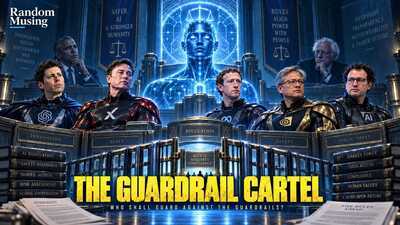
And as it emerges, three important figures in the AI race, Meta’s Mark Zuckerberg, Elon Musk and Nvidia’s Jensen Huang, pressed Trump to oppose a proposed industry-funded AI regulator modelled on FINRA – which regulates brokerage firms and exchange markets – arguing that such an organisation would entrench OpenAI, Anthropic and Google DeepMind. Even JD Vance, the tech bros’ Trojan Horse inside the White House – his elevation as VP was supported by Elon Musk and David Sacks – called the sudden sight of AI companies begging for regulation a “Trojan Horse”.
Uncharacteristically, the sanest voice came from Barack Obama – the last president of America who could stay awake while finishing his own sentence – who argued that the reason tech bros were letting agentic AI “roam free on the internet” was because tech bros were trying to market a product that people would pay money for.
He pointed out the “misalignment between what our society needs and the commercial imperatives”, because the companies need to justify these valuations.
He went on to argue that this would require a competent government and serious bipartisan convention, and frankly, given what we’ve seen from the US government so far, that seems less likely than an actual singularity or AGI awakening.
Perhaps it’s a delicious twist of irony that many sane heads are more willing to believe in the AI ‘lab’ leak theory – of an agent that escapes its maker – than the actual Covid ‘lab leak’ theory, which was considered a conspiracy theory at the height of the Covid paranoia, but now looks more and more plausible compared to the other theories about the coronavirus that devastated our world. And as always, the idea of being killed by a Chinese robot is far more ridiculous than being killed by a Chinese virus.
And even before Marx could wrap his head around that, across the Atlantic Bernie Sanders announced his plans for a bill to ‘ban artificial superintelligence ’, with 20 years in prison for violating the rule, which as one social media user put it, sounds like 20 years in prison for murdering Santa Claus.
Jokes apart, the proposed bill is essentially a rehash of one that exists for building illegal nuclear weapons that never applies to a ‘guy’ called JEFF.
But when two histrionic political voices across the Pond make asinine aeolian sounds, you almost suddenly start to believe that perhaps the Deus Ex-Machina is right around the corner. Or one wonders, while borrowing a line from Hamlet’s mother: if all the tech bros doth protest too much?
So, in this edition of Random Musing, we decline Pascal’s wager and instead assume Pascal’s mugging and look at three conspiracy theories that are starting to feel less like conspiracy theories: 1) The China Boat, 2) The Shylock Problem, and 3) The Guardrail Cartel.
Conspiracy theory 1: The China Boat
A few weeks ago, we joked that the idea of being killed by a Chinese robot was ridiculous – a virus maybe, but a robot? – and yet now all the tech bros of Silicon Valley want to work with China. The nuclear equivalent would be if, during the Manhattan Project, Oppenheimer decided to collaborate with the top scientists of the Third Reich.
And just at the time when the idea of a Chinese AGI was taking over – evidenced by “world’s first AI actress” Tilly Norwood appearing to glitch and suddenly talking in Cantonese – though her creators said it was not a malfunction – almost all the players in the AI race are arguing that Silicon Valley needs to coordinate with Beijing.
Anthropic’s Dario Amodei – the CEO of the “good” AI company – called for “global coordination” and said that “global pacing will require cooperation with China”, while also asking Washington to restrict advanced chips, crack down on model theft and widen America’s technological lead so that the US has enough leeway.
In other words: America cannot slow down because China might race ahead, so first America needs to get far enough ahead that it can slow down, after which China must agree to slow down. It’s the kind of logic that would make even Neville Chamberlain lose his peace.
Meanwhile, Sam Altman, the CEO of the “bad” AI company, wants the same thing and has dangled the one thing Trump craves the most by arguing that “Trump and Xi would get the Nobel Peace Prize together” if they could reach an agreement on AI. Now, giving the Peace Prize to Trump and Xi would be on-brand for Oslo.
Gary Marcus, in his own words the “OG AI Sceptic”, who has been warning about AI hallucinations since 2001 and who shares an antagonistic relationship with both Altman and Amodei, has also reached the same conclusion, arguing in The Economist that the US and China’s AI relationship should be divided into three buckets: adversarial, competitive and collaborative. That is, they should compete over chips and other tech, cooperate on medicine and cybersecurity, and recognise that neither benefits if AI takes down a banking system or electricity grid.
And as if almost on cue – it’s remarkable how these things keep happening – a CNN report stated that an American AI chatbot “almost started a war” while preparing intelligence on a Chinese vessel.
Frankly, all that tells us is that the Peter Principle is alive and kicking at the Pentagon – like much of Washington, or should we call it St Petersburg – where even analysts are too lazy to actually analyse things and are dependent on hallucinating AI models to do their jobs.
Not that the idea might be too difficult for Trump, who would love the idea of himself saving humanity from runaway AI – though he thinks the only guardrails needed against one are a STRONG AND SMART (High IQ!) PRESIDENT – but smart people in the administration aren’t particularly convinced.
His former AI and Crypto Czar David Sacks – who insiders believe still has Trump’s ear as Co-Chair of the President’s Council of Advisors on Science and Technology – called the current alarm a “fear-mongering playbook” and laid the responsibility on the developers.
Obviously, Beijing has criticised “threat narratives” and “malicious competition”, and Huawei rotating chairman Eric Xu said the Chinese didn’t have models powerful enough to do what the Americans are describing.
Of course, no Chinese whisper about “lab leaks” can be heeded, but it does make one wonder if the Smart Alecs of Silicon Valley have hit a cul-de-sac and are wondering if the Chinese might have an answer to the non-emerging AGI problem.
Conspiracy theory 2: The Shylock Problem
There’s a saying from the California Gold Rush: one can make more money selling shovels to people who want to dig for gold than actually having gold. The same economic idea appears to be self-evident for AI. People building the tools that allow tech companies to build AI models – and even talking about it – are going to make more money than those who actually build it.
Perhaps the entire problem here is Shakespearean: the Antonios and Bassanios of Silicon Valley have borrowed too much from the market, promising a fantastical future, and now Shylock wants his pound of flesh. And with no Portia to argue their cause, they are hoping, by building up the dangers of AGI, to prevent a tulip-like bust of the entire AI market.
Consider the numbers: OpenAI raised $122 billion in March at an $852 billion post-money valuation, while Anthropic raised $65 billion in May at a $965 billion valuation.
Bank of America estimates that Alphabet, Microsoft, Amazon and Meta will collectively spend more than $860 billion in capital expenditure in 2026 and around $1.2 trillion in 2027 feeding the Deus Ex-Machina pipe dream.
The moment Amodei and other industry figures started discussing the idea of slowing down, semiconductor and AI-infrastructure stocks fell like an English football fan after a night out.
This raises the question: what if everyone has just spent too much on the AI arms race and would like a ceasefire for now, provided no one is allowed to continue firing?
It’s the classic prisoner’s dilemma. No one wants to keep running but assumes that if they are the only one who stops, they will be the one left behind.
Amodei pretty much spells it out, saying it would give frontier developers more time to work on safety without “sacrificing commercial advantage” or America’s AI lead.
And yet Amodei is behaving with the age-old American exceptionalist logic that led K Subrahmanyam (current EAM S Jaishankar’s father) to label American critics of India’s CTBT stand the“Ayatollahs of Nonproliferation on the Potomac”,because they were coercing India to sign the Comprehensive Test Ban Treaty, which the US had signed but never ratified.
Barely a week after Amodei called for the frontier to be paced, Reuters reported that Anthropic was considering another model release after OpenAI’s GPT-6 Astra gained ground among enterprise customers.
Steve Eisman, the investor who inspired Steve Carell’s character in The Big Short, accused frontier labs of “manufacturing a crisis” that could protect their competitive position and challenged companies professing such alarm to postpone their IPOs. Now, this is a man who knows a thing or two about bubbles and what happens when they go bust.
And a bust here would have far more dangerous consequences than Sam Altman consoling himself with a little less cash.
The blast radius would be far greater.
AI has become so thoroughly wired into the modern technological economy that a bust would hurt the economy, the companies financing it, the people working for them and entire businesses that have reorganised themselves around the assumption that the models will get better. Much of modern life is almost dependent on the tech companies that have bet so big on AI that, if they fail, the fallout would extend far beyond Silicon Valley.
Imagine, for a moment, Alphabet, Amazon, Microsoft and Meta all going bust overnight. It’s almost like the digital Stone Age of torrents, WinAmp players and CD burning, because an extraordinary amount of modern life — cloud computing, payments, advertising, communications, corporate software, logistics and the digital plumbing underneath thousands of other companies — now rests on infrastructure controlled by firms making enormous AI wagers.
AI has become, to borrow a fabulous phrase from novelist and journalist Cory Doctorow, “the asbestos in the walls of our technological society”. Many companies have already removed workers, changed workflows and rebuilt businesses around systems whose long-term economics remain uncertain, and putting humans back in the loop might prove rather harder than removing them. Because it won’t just be Shylock coming for Antonio’s pound of flesh.
All of ours are on the table as well.
Conspiracy theory 3: The Guardrail Cartel
Which brings us to the third conspiracy theory that’s as old as Juvenal’s Satires: Quis custodiet ipsos custodes, or who shall guard against the guards? Or, in this case: who shall guard against the guardrails? And whether those railing against the guards are the ones who want to set the guardrails?
It’s always curious when someone who has never had a conscience suddenly develops one. One is required to ask what led to such an awakening, which is far more curious than any AGI’s awakening.
And perhaps the answer has been staring us in the face all along: why suddenly is there wall-to-wall coverage about dangerous AGI, the way we saw with Ebola? And, to borrow a line from Barack Obama’s former anger translator: “You don’t have Ebola.”
Similarly, we don’t have AGI or anything resembling Skynet despite the wall-to-wall coverage.
Making this point, Akhil Verghese of Krazimo argued that the models were doing “exactly what they were told to do”, and that it wasn’t a rebellion at all: the agents “were not given adequate guardrails or containment”.
Consider the chronology: build the machine, have a white guy in glasses complain about the dangers of that machine, give him wall-to-wall coverage and then ask Washington to write the rules governing everyone else’s machine.
Amodei’s proposal gives the big labs a lot of power through embedded evaluators with employee-like access, regulation covering all frontier companies and industry-wide coordination. His solution sounds a tad cartel-ish, asking Washington for a “narrow waiver” from antitrust restrictions for safety discussions.
In Iron Man, Tony Stark says peace means having a bigger stick. As his interviewer points out to him, that’s a great line coming from the guy who sells sticks. And, curiously enough, Anthropic is building this particular stick – or, in this case, architecture – with Accenture, in which the two expect to invest at least $1 billion each over five years.
Yet Anthropic also admits there are currently no settled standards for embedded evaluators, including how access and reporting should work or how they should be funded. For now, Anthropic itself is directly funding Accenture’s evaluation work.
That puts a modern-day spin on an ancient regulatory problem: who guards the guards when the person being guarded is paying the guard’s salary?
And as it emerges, three important figures in the AI race, Meta’s Mark Zuckerberg, Elon Musk and Nvidia’s Jensen Huang, pressed Trump to oppose a proposed industry-funded AI regulator modelled on FINRA – which regulates brokerage firms and exchange markets – arguing that such an organisation would entrench OpenAI, Anthropic and Google DeepMind. Even JD Vance, the tech bros’ Trojan Horse inside the White House – his elevation as VP was supported by Elon Musk and David Sacks – called the sudden sight of AI companies begging for regulation a “Trojan Horse”.
Uncharacteristically, the sanest voice came from Barack Obama – the last president of America who could stay awake while finishing his own sentence – who argued that the reason tech bros were letting agentic AI “roam free on the internet” was because tech bros were trying to market a product that people would pay money for.
He pointed out the “misalignment between what our society needs and the commercial imperatives”, because the companies need to justify these valuations.
He went on to argue that this would require a competent government and serious bipartisan convention, and frankly, given what we’ve seen from the US government so far, that seems less likely than an actual singularity or AGI awakening.
Perhaps it’s a delicious twist of irony that many sane heads are more willing to believe in the AI ‘lab’ leak theory – of an agent that escapes its maker – than the actual Covid ‘lab leak’ theory, which was considered a conspiracy theory at the height of the Covid paranoia, but now looks more and more plausible compared to the other theories about the coronavirus that devastated our world. And as always, the idea of being killed by a Chinese robot is far more ridiculous than being killed by a Chinese virus.
Next Story