
Why Home Internet Downloads Faster Than It Uploads

Streaming a film, loading a webpage, pulling a photo from the cloud, almost everything a home internet user does involves receiving data, not sending it. That asymmetry is not accidental. The way home broadband is built reflects it at every level, from the physics of the cable to the decisions engineers made decades ago about who gets the bigger share of the pipe.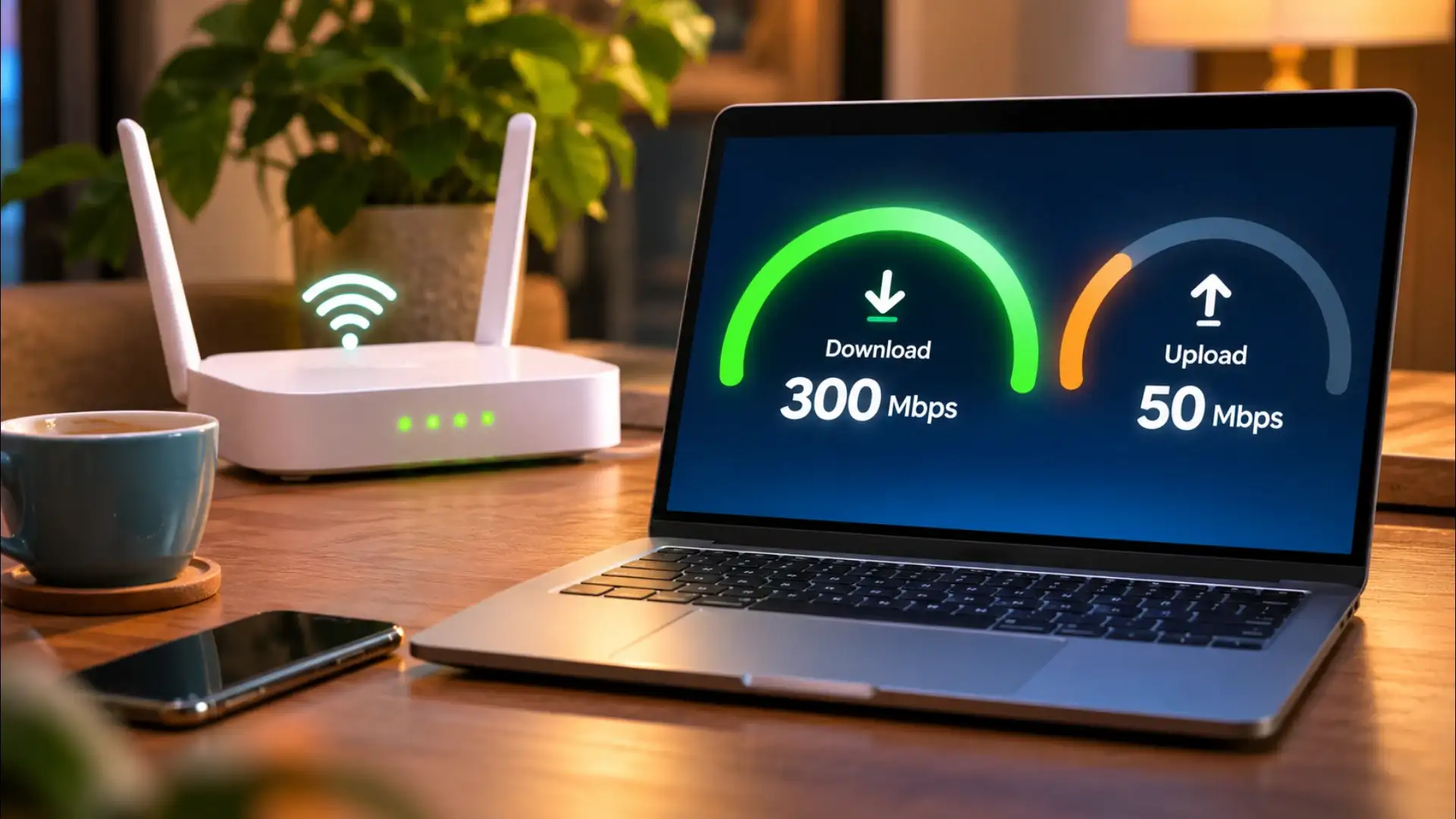
The Cable Was Designed This Way
Most home connections in India run on one of two physical technologies: cable (coaxial, the same wire that carries cable TV) or fibre. On a cable connection, the wire carries a wide range of radio frequencies. Engineers split those frequencies into two unequal lanes. The large lane, the downstream, carries data coming to your home. The small lane, the upstream, carries data going out. The split is roughly 80 to 20 in favour of download. This standard, called DOCSIS, was set in the 1990s when engineers observed that home users download far more than they upload. The physics of radio frequency allocation made a fixed split the cleanest solution. The cable itself did not change; the assignment of its capacity did.Fibre Is Different, But Your Plan May Not Be
Fibre-optic connections do not share the same physical constraint. Light travels through glass in both directions simultaneously, so a fibre line can, in principle, carry identical upload and download speeds. Some providers offer exactly this, a symmetric plan where upload equals download. Most home fibre plans in India do not. Providers deliberately configure the network equipment to give download the larger share, because symmetric capacity costs more to provision across millions of customers and most home users do not need it. The limitation is no longer in the wire; it is in how the provider has configured the network at their end.What Asymmetric Design Assumes About You
The engineering assumption is that a home connection serves a consumer, not a producer. A consumer requests a web page (a small upload, a few hundred bytes of request data) and receives it (a large download, hundreds of kilobytes of HTML, images, and scripts). The ratio of what goes out to what comes in for a typical browsing or streaming session is roughly one to ten or more. Provisioning equal upload capacity for every home would mean leaving most of that capacity idle most of the time. For an individual user, that feels like a reasonable trade-off. For a provider managing millions of connections, it is the difference between a sustainable network and one that costs twice as much to run.When the Assumption Breaks Down
The asymmetric model was built for a world of consumers. It creaks when a home becomes a production node. Video calls send a continuous stream of data upstream. Working from home and sharing large files reverses the usual ratio. Running a home server, backing up a large photo library to the cloud, or uploading long videos all hit the upload ceiling hard. The wire or the fibre can carry the data; the allocated capacity cannot. This is why a video call can look fine on the receiving end but choppy on the sender's end, the downstream is wide open, but the upstream is saturated. The solution is a plan that offers higher upload speeds, which exists but costs more, because it requires the provider to reconfigure how they allocate capacity on their network.The Practical Upshot
Download speed governs the experiences most people notice: buffering, page load times, how fast a file arrives. Upload speed governs the experiences that become visible only when they fail: a pixelated video call, a backup that runs all night, a file transfer that stalls. The gap between them is not a flaw in your router or a sign that something is broken. It is the network working exactly as it was designed, for a user who takes in far more than they send out. If your work or habits have shifted that balance, the design is simply no longer built for what you do.Next Story