
Sigma FP2, used just the way it comes


Sigma makes the kind of cameras that leave you asking, at least once, why would anyone do it this way? I asked it more than a few times with the BF last year. A single block of aluminium, a handful of buttons, no card slot, no viewfinder and no way to add one. By the end of three weeks, I'd come around to most of it.The FP2 asks the same question, just from the other end.
Where the BF took things away and left it at that, the FP2 hands you a bare body and a list of things to screw onto it. A grip on one side. A viewfinder on the other. A hot shoe, if you want flash. Even the strap lugs come as two loose threaded pieces you fit yourself. It’s an idea Sigma has stuck with since the original fp in 2019, and the 61MP fp L after it, neither of which I got around to using. The box itself has only got smaller since. Sigma calls it the world’s smallest full-frame camera, at 112.8 x 69.9 x 41.8mm and 376g, and it’s even a few millimetres slimmer than those two, which is a neat trick given the tilting screen and bigger battery it’s carrying.
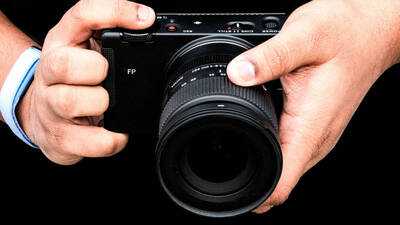
I've spent the past two days with the FP2 just as it comes, which in India means a Rs 2,16,500 body with nothing bolted on apart from the strap lugs, and the Contemporary 20-60mm F2.8-4 DG zoom on the front. That's the camera at its smallest, and it has already taught me a fair bit about what all those add-ons are for.
Holding it bare takes a little getting used toThe first time I picked it up, my fingers went looking for a grip that wasn't there. There's a strip of textured rubber on the right and a small ridge at the back for the thumb, and that's the whole arrangement. With the 20-60mm on, the weight tips forward, so my left hand ended up living under the lens for most of day one. Coming off my Fujifilm, which gives my fingers something to wrap around, it felt like holding a camera that hadn't been finished yet. By day two, my hands had sorted it out. Mostly.
Funnily enough, most of that tilt is down to the lens, which weighs more than the camera it's mounted on: 385g against the body's 376g.
The body itself is dense. For something this small, there's enough heft that I stopped worrying about the odd knock against a doorframe, and Sigma says it's dust and splash resistant too, which I haven't tested on purpose. The strap lugs go into the same quarter-inch threads the grip and viewfinder use, and on the first walk, I checked them more times than I'd like to admit.
The controls are where the FP2 stops being minimal. Most of the layout carries over from the older fps, but coming from the BF, which had one dial and barely any buttons, it felt like a lot at first: two dials, a STILL and CINE switch on top and a Color button right there on the back that I pressed far more often than I'd planned to. A QS button pulls up eight settings of my choosing, and after one evening of setting it up, I barely touched the main menu. Props to Sigma for keeping that menu clean, though. It's one of the few camera menus I didn't have to fight with.
Day and night bring out different sides of itThere were murmurs that the fp 2 would finally get a built-in viewfinder, but it’s still a separate module, the EVF-21, so without it, the screen is the only way to frame a shot. It's a 3.15-inch panel, and this time it tilts, 90 degrees up and 45 down, something neither the BF nor the earlier fps could do. Of everything new on the FP2, this is the bit I've used the most. I shot most of my first walk from the waist, looking down at the screen, and it's a lot less obvious on the street than holding a camera up to my face. Low angles don't need a crouch anymore either, which my knees appreciated. The catch is that it only tilts up and down, so the moment I turned the camera for a vertical shot, the hinge was no help at all.
Shooting from the waist meant leaning on autofocus more than usual, and it kept up. The original fp got by on contrast detection alone, and while the fp L added phase detection, the FP2's take on it is quicker than I remember the BF being, which I never thought of as slow to begin with. It picked up eyes and faces almost the moment they were in frame, and tracking held on to people crossing the street and a delivery guy on a scooter. Birds are new to the detection list, but the pigeons around me weren't in a cooperative mood, so that one's still pending.
There's still no mechanical shutter, so everything is shot electronically. That usually means bent lines with anything moving fast, and it's something the first fp got a fair bit of flak for. The new 24.5MP partially stacked sensor reads out much quicker, though, and the handful of 20fps bursts I fired at passing traffic came back clean. The buffer has grown from around a dozen shots on the first fp to 180 raw frames, which I never came close to filling.
The zoom range helped too. The 20-60mm starts at 20mm and f/2.8, wider than most standard zooms, and ends at 60mm and f/4. I'm a long-lens person by habit, and 60mm is usually where I'm just getting warmed up, but on a body this size, I didn't miss the extra reach as much as I expected to.
What I didn't see coming was how close it focuses, down to 15.8cm around the 28mm mark, and I spent more time than planned on small details I'd normally walk past.
And the afternoon sun? That's where I wanted the module I didn't have. The screen is sharp and bright enough in shade, but under harsh light, I was cupping a hand over it and guessing at the shadows. After sunset, the FP2 asked a little more of me. There's no in-body stabilisation, and the zoom doesn't have any either, so it was me, a steady hand and an ISO number that kept climbing. Stills do get two base ISOs, 320 and 2500, and I leaned on the second one more than once.
Those files need a closer look, and a few more nights.
Back home, the Color button took over. It's been a Sigma thing since the fp days, and it works much like the BF's, with more to play with. There are 13 modes, from Standard, Rich and Calm to Teal and Orange, Warm Gold, Powder Blue, Forest Green and Sunset Red, along with two FOV Classic looks, Cinema, 709 Look and Monochrome. Each can be dialled down, with highlights, shadows and black levels tweakable per mode. I ran the first day's raw files through most of them using the in-camera conversion, and I'm yet to pick a favourite. Cinema and 709 Look, though, are clearly there for the other half of this camera.
It’s still serious about video, just more so this timeJust as on the fp and fp L, there's a STILL and CINE switch on top, and on CINE, the camera rearranges itself around video. Shutter speeds become shutter angles, apertures can show as T-stops, waveform, false colour and zebras are all there, and small red tally lights come on while it records. I lost a good half hour to it on the first evening.
There's a lot packed into a body this size, starting with 6K open gate. It uses the whole sensor, so footage can be cropped to vertical or widescreen later, and it's well past the 4K the earlier fps managed. Given how little the screen helps with vertical framing, that might end up being my way of shooting vertical. 4K goes up to 60fps from the full width and 120fps with a crop, ProRes RAW goes to an external SSD over USB-C, and H.264, H.265 and L-Log record internally. Log gets its own pair of base ISOs too, 1250 and 10000, and Sigma claims up to 14.1 stops of dynamic range. After an evening of watching ISO climb on stills, a proper night shoot in Log is near the top of my list.
I've only shot short clips so far, mostly in H.265 with L-Log, and the camera stayed cool through them. The 20-60mm barely breathes when focus shifts, which helps, and with no IBIS to fall back on, the FP2 records gyro data for stabilising footage later in Gyroflow.
There's even a Director's Viewfinder mode that mimics the framing of cinema cameras from ARRI, RED and Sony, a feature I didn't expect to find on something this size.
On the side, the fiddly micro HDMI from the earlier fps has made way for a full-size port, next to a mic input that doubles as timecode in, with audio recording in 32-bit float. Headphones, though, have to go through USB-C.
All of that ran off one battery on day one, and there was still a bit left by the end. The BP-91 is the same one Panasonic uses in its Lumix cameras, so Lumix spares work here too. There's 70GB of storage built in, something neither earlier fp had, along with an SD card slot. What's missing is Wi-Fi and Bluetooth, so photos go to the phone over a USB-C cable, with the camera showing up as a drive.
Two days in, some of Sigma's way of doing things is starting to make sense. I already know which modules I'd want first: the grip, for my fingers, and the viewfinder, for the afternoons. The hot shoe can wait, since I can't remember the last time I used a flash. How the FP2 feels with those on, and how much of its video side I can push without them, is what I want to find out next.
Where the BF took things away and left it at that, the FP2 hands you a bare body and a list of things to screw onto it. A grip on one side. A viewfinder on the other. A hot shoe, if you want flash. Even the strap lugs come as two loose threaded pieces you fit yourself. It’s an idea Sigma has stuck with since the original fp in 2019, and the 61MP fp L after it, neither of which I got around to using. The box itself has only got smaller since. Sigma calls it the world’s smallest full-frame camera, at 112.8 x 69.9 x 41.8mm and 376g, and it’s even a few millimetres slimmer than those two, which is a neat trick given the tilting screen and bigger battery it’s carrying.
I've spent the past two days with the FP2 just as it comes, which in India means a Rs 2,16,500 body with nothing bolted on apart from the strap lugs, and the Contemporary 20-60mm F2.8-4 DG zoom on the front. That's the camera at its smallest, and it has already taught me a fair bit about what all those add-ons are for.
Holding it bare takes a little getting used toThe first time I picked it up, my fingers went looking for a grip that wasn't there. There's a strip of textured rubber on the right and a small ridge at the back for the thumb, and that's the whole arrangement. With the 20-60mm on, the weight tips forward, so my left hand ended up living under the lens for most of day one. Coming off my Fujifilm, which gives my fingers something to wrap around, it felt like holding a camera that hadn't been finished yet. By day two, my hands had sorted it out. Mostly.
Funnily enough, most of that tilt is down to the lens, which weighs more than the camera it's mounted on: 385g against the body's 376g.
The body itself is dense. For something this small, there's enough heft that I stopped worrying about the odd knock against a doorframe, and Sigma says it's dust and splash resistant too, which I haven't tested on purpose. The strap lugs go into the same quarter-inch threads the grip and viewfinder use, and on the first walk, I checked them more times than I'd like to admit.
The controls are where the FP2 stops being minimal. Most of the layout carries over from the older fps, but coming from the BF, which had one dial and barely any buttons, it felt like a lot at first: two dials, a STILL and CINE switch on top and a Color button right there on the back that I pressed far more often than I'd planned to. A QS button pulls up eight settings of my choosing, and after one evening of setting it up, I barely touched the main menu. Props to Sigma for keeping that menu clean, though. It's one of the few camera menus I didn't have to fight with.
Day and night bring out different sides of itThere were murmurs that the fp 2 would finally get a built-in viewfinder, but it’s still a separate module, the EVF-21, so without it, the screen is the only way to frame a shot. It's a 3.15-inch panel, and this time it tilts, 90 degrees up and 45 down, something neither the BF nor the earlier fps could do. Of everything new on the FP2, this is the bit I've used the most. I shot most of my first walk from the waist, looking down at the screen, and it's a lot less obvious on the street than holding a camera up to my face. Low angles don't need a crouch anymore either, which my knees appreciated. The catch is that it only tilts up and down, so the moment I turned the camera for a vertical shot, the hinge was no help at all.
Shooting from the waist meant leaning on autofocus more than usual, and it kept up. The original fp got by on contrast detection alone, and while the fp L added phase detection, the FP2's take on it is quicker than I remember the BF being, which I never thought of as slow to begin with. It picked up eyes and faces almost the moment they were in frame, and tracking held on to people crossing the street and a delivery guy on a scooter. Birds are new to the detection list, but the pigeons around me weren't in a cooperative mood, so that one's still pending.
There's still no mechanical shutter, so everything is shot electronically. That usually means bent lines with anything moving fast, and it's something the first fp got a fair bit of flak for. The new 24.5MP partially stacked sensor reads out much quicker, though, and the handful of 20fps bursts I fired at passing traffic came back clean. The buffer has grown from around a dozen shots on the first fp to 180 raw frames, which I never came close to filling.
The zoom range helped too. The 20-60mm starts at 20mm and f/2.8, wider than most standard zooms, and ends at 60mm and f/4. I'm a long-lens person by habit, and 60mm is usually where I'm just getting warmed up, but on a body this size, I didn't miss the extra reach as much as I expected to.
What I didn't see coming was how close it focuses, down to 15.8cm around the 28mm mark, and I spent more time than planned on small details I'd normally walk past.
And the afternoon sun? That's where I wanted the module I didn't have. The screen is sharp and bright enough in shade, but under harsh light, I was cupping a hand over it and guessing at the shadows. After sunset, the FP2 asked a little more of me. There's no in-body stabilisation, and the zoom doesn't have any either, so it was me, a steady hand and an ISO number that kept climbing. Stills do get two base ISOs, 320 and 2500, and I leaned on the second one more than once.
Those files need a closer look, and a few more nights.
Back home, the Color button took over. It's been a Sigma thing since the fp days, and it works much like the BF's, with more to play with. There are 13 modes, from Standard, Rich and Calm to Teal and Orange, Warm Gold, Powder Blue, Forest Green and Sunset Red, along with two FOV Classic looks, Cinema, 709 Look and Monochrome. Each can be dialled down, with highlights, shadows and black levels tweakable per mode. I ran the first day's raw files through most of them using the in-camera conversion, and I'm yet to pick a favourite. Cinema and 709 Look, though, are clearly there for the other half of this camera.
It’s still serious about video, just more so this timeJust as on the fp and fp L, there's a STILL and CINE switch on top, and on CINE, the camera rearranges itself around video. Shutter speeds become shutter angles, apertures can show as T-stops, waveform, false colour and zebras are all there, and small red tally lights come on while it records. I lost a good half hour to it on the first evening.
There's a lot packed into a body this size, starting with 6K open gate. It uses the whole sensor, so footage can be cropped to vertical or widescreen later, and it's well past the 4K the earlier fps managed. Given how little the screen helps with vertical framing, that might end up being my way of shooting vertical. 4K goes up to 60fps from the full width and 120fps with a crop, ProRes RAW goes to an external SSD over USB-C, and H.264, H.265 and L-Log record internally. Log gets its own pair of base ISOs too, 1250 and 10000, and Sigma claims up to 14.1 stops of dynamic range. After an evening of watching ISO climb on stills, a proper night shoot in Log is near the top of my list.
I've only shot short clips so far, mostly in H.265 with L-Log, and the camera stayed cool through them. The 20-60mm barely breathes when focus shifts, which helps, and with no IBIS to fall back on, the FP2 records gyro data for stabilising footage later in Gyroflow.
There's even a Director's Viewfinder mode that mimics the framing of cinema cameras from ARRI, RED and Sony, a feature I didn't expect to find on something this size.
On the side, the fiddly micro HDMI from the earlier fps has made way for a full-size port, next to a mic input that doubles as timecode in, with audio recording in 32-bit float. Headphones, though, have to go through USB-C.
All of that ran off one battery on day one, and there was still a bit left by the end. The BP-91 is the same one Panasonic uses in its Lumix cameras, so Lumix spares work here too. There's 70GB of storage built in, something neither earlier fp had, along with an SD card slot. What's missing is Wi-Fi and Bluetooth, so photos go to the phone over a USB-C cable, with the camera showing up as a drive.
Two days in, some of Sigma's way of doing things is starting to make sense. I already know which modules I'd want first: the grip, for my fingers, and the viewfinder, for the afternoons. The hot shoe can wait, since I can't remember the last time I used a flash. How the FP2 feels with those on, and how much of its video side I can push without them, is what I want to find out next.
Next Story