
Why a Bright Screen Feels Harsher in a Dark Room

Your eyes are doing two jobs at the same time, and those jobs pull in opposite directions. That is the whole story, and everything else is the detail of how it plays out inside the eye.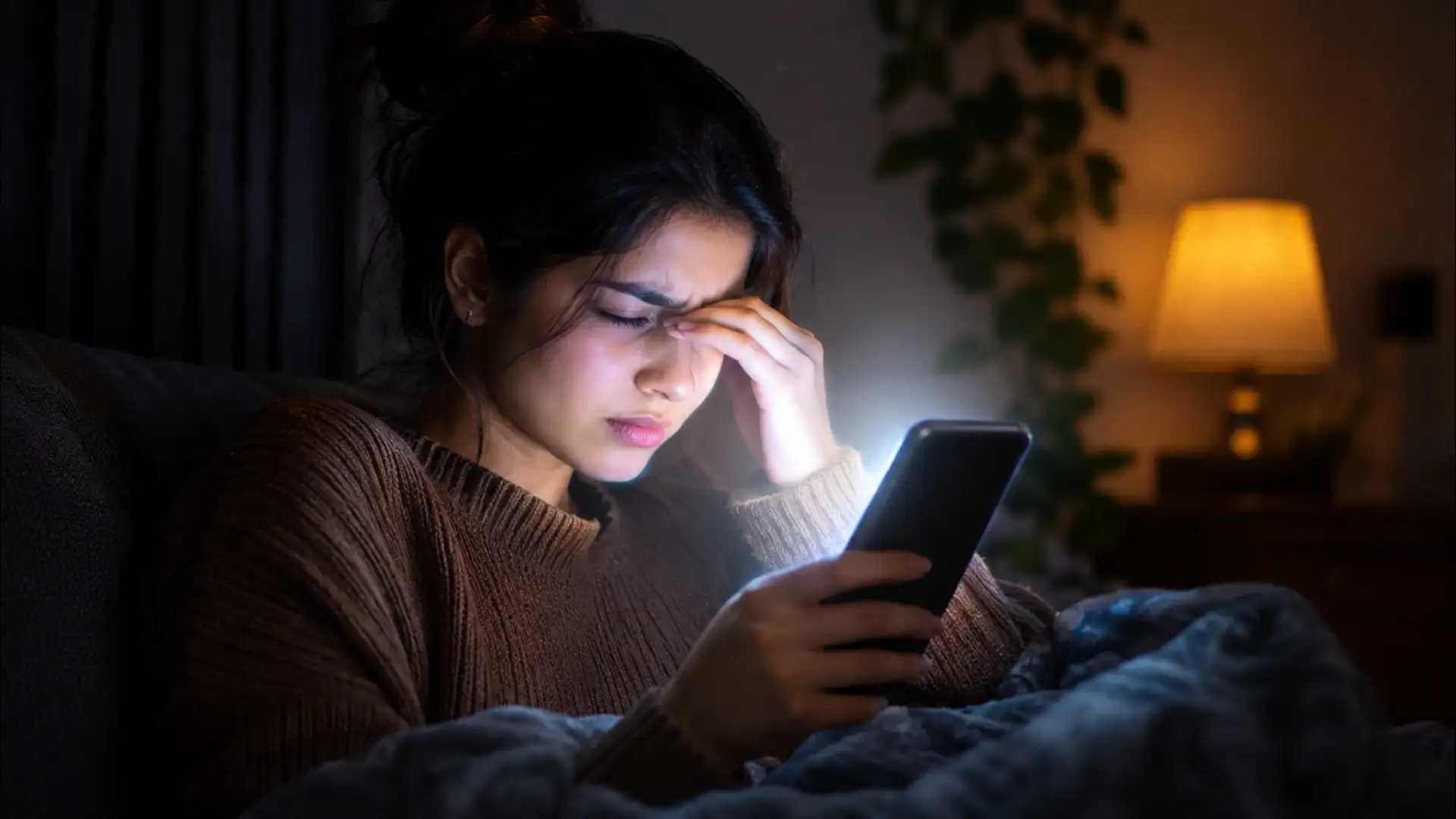
How the Eye Adjusts to Darkness
When you walk into a dim room, the pupil opens wide. This is the iris dilating to let in more of the available light, so the photoreceptors at the back of the eye have enough signal to work with. The process is not instant. Full dark adaptation, where the rod cells in the retina reach their maximum sensitivity, takes roughly twenty to thirty minutes. During that window, the eye is in a transitional state: the pupil is already wide, but the rods are still ramping up.The pupil's job is to control how much light reaches the retina. In a dark room, it opens as far as it can go.What the Screen Is Actually Sending Into That Open Pupil
A modern phone display emits light directly. It is not reflecting light from a source behind you, the way a book does. It is a light source in itself, with brightness measured in nits. A typical phone screen at full brightness can output anywhere from 400 to over 1000 nits, depending on the panel. That number does not change based on what is happening in the room around it.When the pupil is wide open in a dark room and a bright screen fires directly into it, the retina receives far more light energy than it would in a lit room, where the pupil would have contracted to protect it. The photoreceptors are flooded. The visual cortex registers this as harshness, sometimes as mild pain. The eye then attempts to constrict the pupil, but it cannot constrict fully without losing the ability to see the dark surroundings. It is stuck negotiating between two environments.The Role of Contrast, Not Just Brightness
The discomfort is not purely about the screen's absolute brightness. It is about the ratio between the screen and everything around it. This is called the luminance contrast ratio, and the human visual system is acutely sensitive to it.In a well-lit room, the screen is bright and so is the wall behind it. The ratio is manageable. In a dark room, the screen is bright and the wall is close to zero. The ratio becomes extreme. The eye's adaptation system, which is built to handle gradual changes in ambient light, cannot reconcile a very bright object sitting inside a very dark field. The result is a kind of visual stress that a single bright object in a lit room would never produce at the same screen brightness.This is also why a candle in a dark room looks far more intense than the same candle on a sunny afternoon. The candle's output has not changed. The context around it has.Blue Light's Specific Role in This
Phone screens emit across the visible spectrum, but they lean toward shorter wavelengths in the blue range, roughly 400 to 490 nanometres. The eye's photosensitive ganglion cells, a third type of light-sensing cell distinct from rods and cones, are particularly responsive to this part of the spectrum. These cells are connected to the brain's circadian clock and to the pupillary light reflex.In a dark room, with the pupil wide and the retina already sensitised, the blue-weighted output of a screen hits these cells more forcefully than it would in daylight. This contributes to both the subjective harshness and the well-documented suppression of melatonin that makes it harder to fall asleep after late-night screen use. The two effects share the same cause: a light source calibrated for daytime use, encountered by an eye that has already committed to the dark.What Actually Helps
The practical response follows directly from the mechanism. Reducing screen brightness narrows the luminance gap between the screen and the room. Raising the room's ambient light even slightly, a lamp on the far side of the room rather than complete darkness, gives the pupil a reason to stay partly constricted, which reduces the flood of screen light reaching the retina. Night mode or warm-tone display settings shift the screen's output away from the blue range, reducing the load on the ganglion cells most responsible for the harsh signal.None of these fully eliminates the effect, because the underlying conflict, a self-luminous display used in a dark-adapted eye, remains. They reduce the severity of it. The eye is not malfunctioning when a screen hurts in the dark. It is working correctly in two environments that were never designed to coexist.Next Story