
Does Putting a Wet Phone in Rice Actually Work? Here's What Science Says

The rice trick is one of those ingenious concepts that seems so logical that it often goes unchallenged. The idea is to submerge the phone in rice, wait a couple of days, and then cross your fingers, hoping for a favorable outcome. Since rice is known to absorb moisture from the surrounding atmosphere, it stands to reason that it would likewise draw moisture out of a damaged phone. The rationale appears to be straightforward and reasonable. However, the science behind it is, unfortunately, not quite as sound.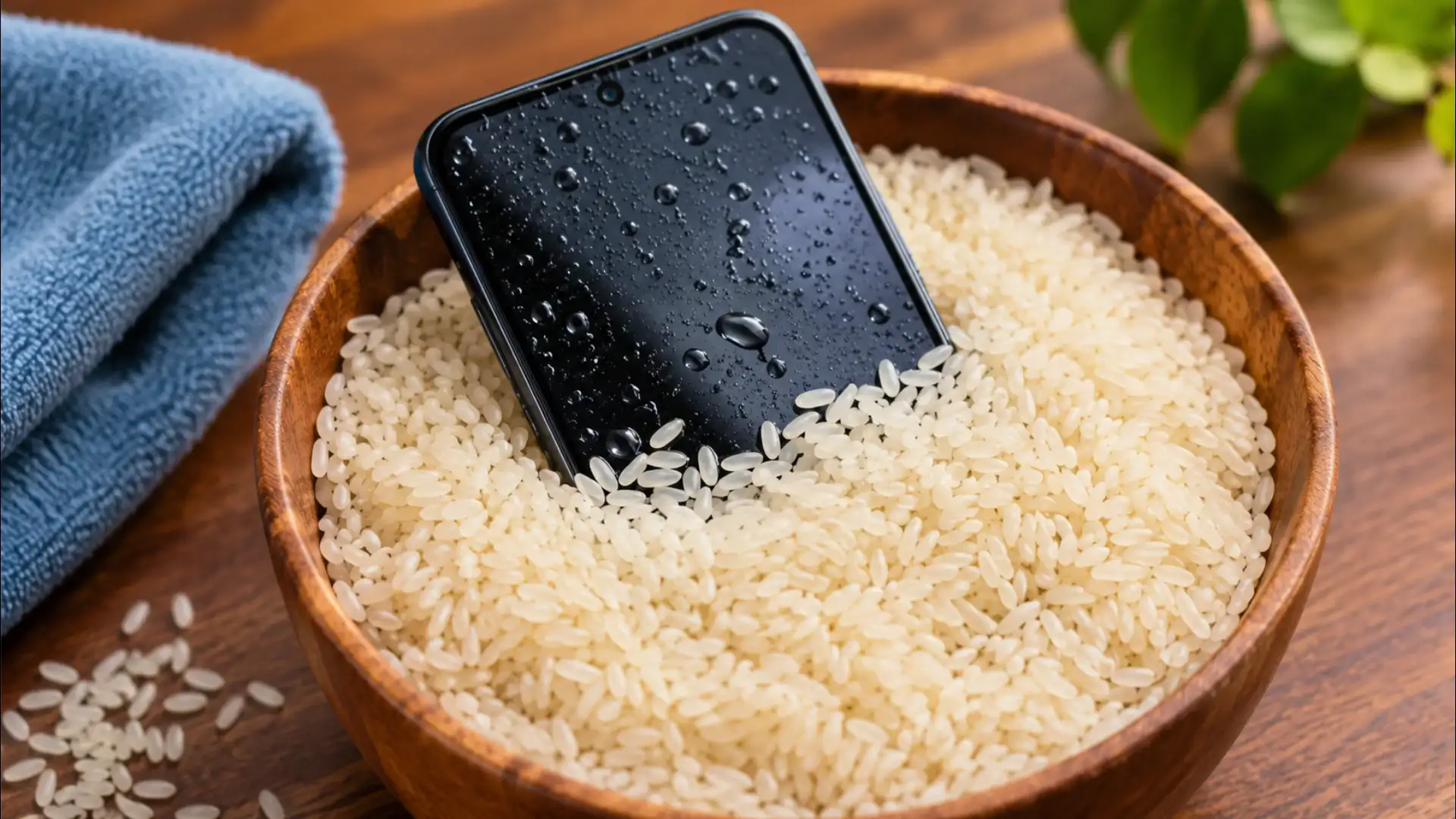
What Rice Can and Cannot Do
Rice is a reasonable desiccant in the right situation. Left in a humid pantry, it does draw water vapour from the surrounding air. The problem is that the water inside a wet phone is not vapour floating around a jar. It is liquid sitting on circuit boards, pooled in ports, and trapped under components. Rice has no mechanism to pull liquid water out of a sealed enclosure. The grains sit in the jar, the water sits on the motherboard, and the two never meaningfully interact. Independent tests by consumer electronics researchers have found that rice performs no better than simply leaving the phone on a table in open air, and in some cases performs worse, because the starch dust that rice sheds can work its way into charging ports and headphone jacks.The Real Enemy: Time and Ions
The damage from water immersion is rarely instant. Pure water is actually a poor conductor of electricity. What causes short circuits is the dissolved minerals, salts, and ions that water carries, and those become dangerous the moment current runs through them. Every second a wet phone stays powered on, or every time someone presses the power button to check whether it still works, is a moment where electricity is passing through water-contaminated pathways. The corrosion that follows is cumulative and often shows up days or weeks later as the phone starts behaving strangely long after it seemed to recover. The rice jar delays this reckoning without addressing it.What Actually Helps
The first move after water exposure is to power the phone off immediately and leave it off. Do not plug it in, do not press buttons, do not try to charge it. If the back panel is removable, take it off and remove the SIM tray to open any path for air. Shake the phone gently to dislodge pooled water from ports, then dab visible moisture with a lint-free cloth. After that, the goal is airflow, not absorption. A phone placed in a dry room with gentle air circulation, near a fan set to low, not a hairdryer, which can push heat into components and warp connectors, has a better chance than one sealed in a jar of rice. Silica gel packets, the kind that come in shoe boxes and electronics packaging, are a genuine desiccant and work on vapour in the surrounding air, which is at least a real mechanism. They will not extract liquid water either, but they keep the ambient humidity around the phone low while it air-dries. Forty-eight hours of powered-off air drying is the minimum before attempting to switch the device back on.When to Stop Experimenting at Home
If the phone was submerged rather than splashed, or if it was in salt water, a swimming pool, or any liquid other than clean tap water, home drying is unlikely to be enough. Salt and chlorine accelerate corrosion dramatically. A phone service centre that offers ultrasonic cleaning can flush the board with a cleaning solution designed to displace water and neutralise ionic contamination. This is a real process with a real mechanism, and it is worth considering before the corrosion that started on day one finishes its work on day thirty.Rice became the default fix because it is always in the kitchen and it feels like doing something. The honest version of doing something is powering off immediately, keeping the phone off, and giving it time and air. The jar of rice is not the rescue, it is the waiting room.Next Story