
UIDAI announces new SOP for changing name on Aadhaar, here's what you need to know


UIDAI (Unique Identification Authority of India) has issued a revised Standard Operating Procedure (SOP) for updating names in Aadhaar. The authority has introduced separate rules and documents requirements depending on the type of name change being requested. The new SOP, which came into effect on September 18, 2026, replaces the earlier process introduced in 2021. The updated procedure categorises requests into multiple categories, including minor spelling corrections, data-entry errors, surname changes after marriage or divorce, regional-language corrections and major name changes. According to UIDAI, documents, affidavits and Gazette notifications submitted with requests will be subject to stricter verification to prevent misuse and identity-related fraud.
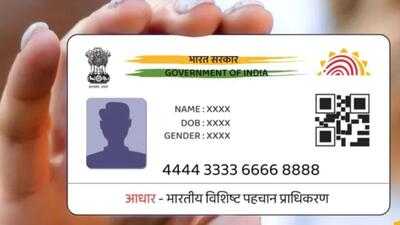
The basic rules for name change in AadhaarUnder the revised SOP, names recorded in Aadhaar must appear in block letters, with no titles, prefixes (such as Shri, Smt, Ms, Dr, or Prof), aliases, ranks, or special characters permitted. Updates are governed under Regulation 19 of the Aadhaar (Enrolment & Update) Regulations, 2016, and any name change must be backed by documents listed under Schedule II. A name will be updated exactly as it appears — in spelling, sequence, and abbreviation — in the document the applicant submits as proof.
What counts as a minor Aadhaar name changeUIDAI treats several routine corrections as minor name changes, requiring only standard Proof of Identity (PoI), or Proof of Relationship (PoR) for children under 18:
Regional language errors get their own trackA separate category covers cases where the English spelling of a name on Aadhaar is correct, but the regional-language version contains an error — for instance, निर्मला being incorrectly recorded as निर्मल. These cases also require a standard PoI document to correct.
Special cases with dedicated requirements
The SOP carves out specific documentation paths for several commonly occurring situations:
How many times can you change your name on Aadhaar cardUnder UIDAI's existing framework, a person can generally update their Aadhaar name twice in total. Once that limit is exhausted, any further name change requests must go through a separate exception-handling process. For context, gender on Aadhaar can typically be changed only once, and date of birth only once as well, under separate SOPs UIDAI maintains for those fields.
What users need to do to for name change on Aadhaar cardTo apply for a name correction or change under the new SOP, applicants need to follow a set sequence of steps:
The basic rules for name change in AadhaarUnder the revised SOP, names recorded in Aadhaar must appear in block letters, with no titles, prefixes (such as Shri, Smt, Ms, Dr, or Prof), aliases, ranks, or special characters permitted. Updates are governed under Regulation 19 of the Aadhaar (Enrolment & Update) Regulations, 2016, and any name change must be backed by documents listed under Schedule II. A name will be updated exactly as it appears — in spelling, sequence, and abbreviation — in the document the applicant submits as proof.
What counts as a minor Aadhaar name changeUIDAI treats several routine corrections as minor name changes, requiring only standard Proof of Identity (PoI), or Proof of Relationship (PoR) for children under 18:
- Expanding or abbreviating initials (for example, T R D Prasad becoming Tadi Rama Durga Prasad)
- Adding or deleting a middle or last name
- Changing the sequence or order of an existing name (Divakar Anand to Anand Divakar)
- Minor spelling corrections (Ram to Rama)
Regional language errors get their own trackA separate category covers cases where the English spelling of a name on Aadhaar is correct, but the regional-language version contains an error — for instance, निर्मला being incorrectly recorded as निर्मल. These cases also require a standard PoI document to correct.
Special cases with dedicated requirements
The SOP carves out specific documentation paths for several commonly occurring situations:
- Marriage or divorce-related surname changes require an affidavit (Annexure D) along with PoI.
- Name changes due to gender transition require applicable PoI documentation.
- Updating a child's Aadhaar from "Baby of ___" to an actual name can be done on a Head-of-Family basis, with applicable PoR.
- Dropping ranks, designations, or prefixes, and removing random capital letters or dots, require no supporting documents at all.
- Removing an "urf" or alias entry requires an affidavit along with PoI or PoR.
How many times can you change your name on Aadhaar cardUnder UIDAI's existing framework, a person can generally update their Aadhaar name twice in total. Once that limit is exhausted, any further name change requests must go through a separate exception-handling process. For context, gender on Aadhaar can typically be changed only once, and date of birth only once as well, under separate SOPs UIDAI maintains for those fields.
What users need to do to for name change on Aadhaar cardTo apply for a name correction or change under the new SOP, applicants need to follow a set sequence of steps:
- Visit an Aadhaar Seva Kendra or Aadhaar Enrolment/Update Centre. the process requires an in-person visit; it is not currently available end-to-end online for most categories of name change.
- Fill out the Aadhaar Enrolment/Update form, writing the name in block letters, free of titles, aliases, or unapproved abbreviations.
- Submit the prescribed supporting documents based on the specific category the request falls under — ranging from a simple PoI for minor corrections to a mandatory Gazette Notification for a major name change.
- Complete identity verification and biometric authentication at the centre as part of the same visit.
- Pay the applicable demographic update fee, currently listed by UIDAI at ₹75 when a name update is processed as a standalone request.
- Collect the acknowledgement receipt, which includes an Update Request Number (URN) that can be used to track the status of the request online afterward.
Next Story