
How Lightning Surges Travel Through Wires and Destroy Electronics

A bolt of lightning does not have to hit your building to damage what is inside it. It can strike a transformer down the road, a tree near a buried cable, or even the ground itself, and the energy still finds its way to your sockets. Understanding why requires following the surge from the sky to the circuit board.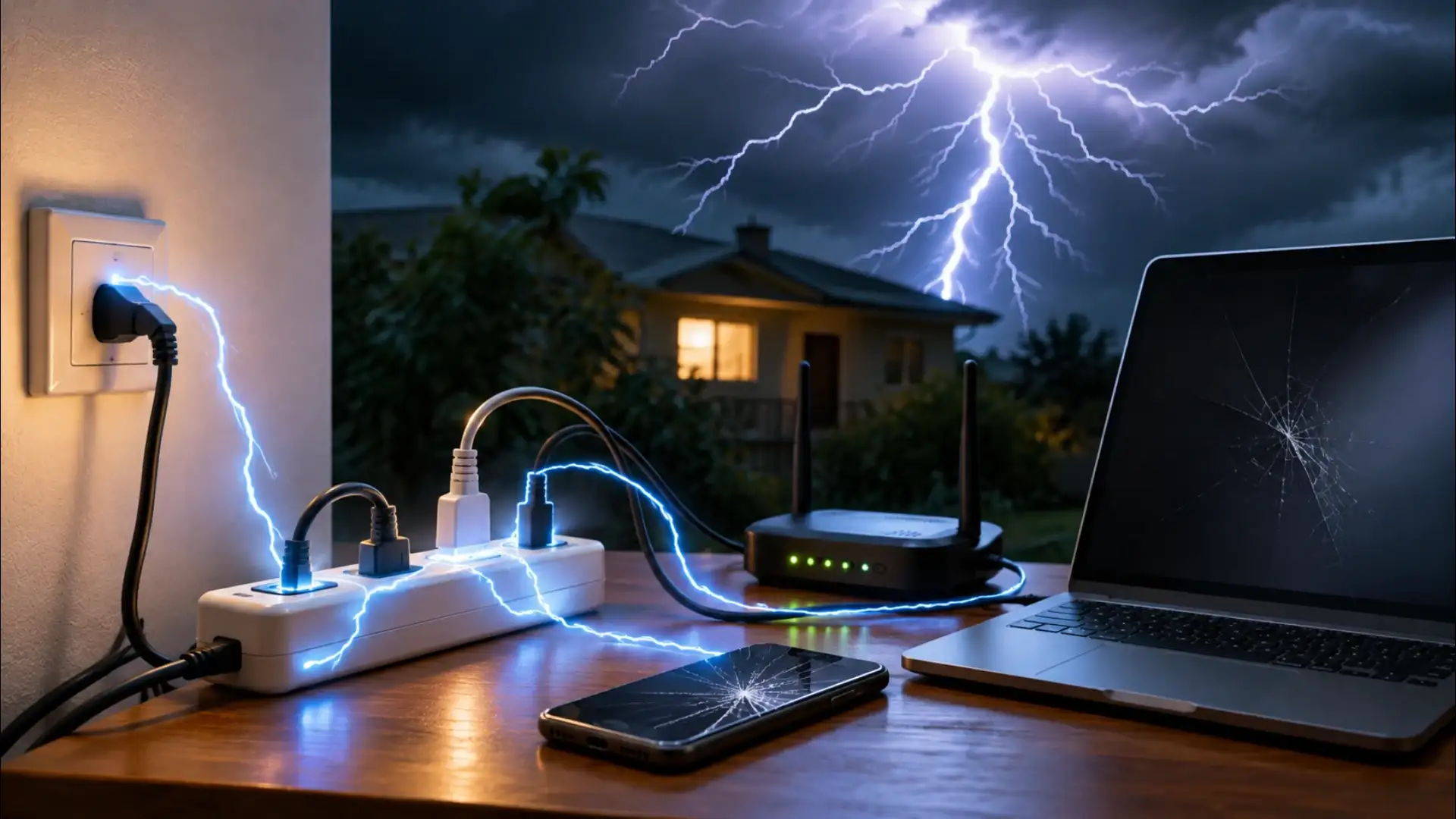
The physics behind a lightning surge is straightforward: energy follows conductors, and every wire entering a building is a conductor. The components inside modern electronics are extraordinarily capable, but that capability comes from precision, and precision has no tolerance for a spike that carries ten thousand times the design voltage. Disconnecting devices from every cable, power and data, before a storm is the one intervention that works, because it removes the conductor entirely. Everything else is a matter of how much of the surge a protective device can absorb before the rest gets through.
What a Surge Actually Is
A power surge is a sudden, brief spike in electrical voltage far above the level your wiring is designed to carry. Normal household current in India runs at 220 to 240 volts. A lightning-induced surge can push tens of thousands of volts down the same wire in a fraction of a second. The duration is short, sometimes microseconds, but voltage is what does the damage, and that amount of it overwhelms insulation, melts thin conductor traces, and destroys the components that regulate power inside a device.From the Sky into the Grid
When lightning strikes a power line or a nearby object, it dumps an enormous charge into whatever conductor is closest. Power lines are long, continuous metal paths, exactly what a surge needs to travel. The spike rides the line in both directions from the strike point, moving at a significant fraction of the speed of light. Transformers on the street step voltage up and down for distribution, but they are not designed to absorb a surge of this magnitude. Much of the energy passes through or around them and continues toward homes and businesses connected to that section of the grid.You may also like
- Best Samsung double door refrigerators in India: Refrigerators with Active Fresh Filter+, Twin Cooling Plus technology and others to consider
- Elon Musk says that he feels foolish about spending close to $500 million on US mid-terms; declares am not a MAGA, 'not sure' what MAGA actually means
- Jio ₹1,029 Recharge Plan: Get 2GB Daily Data, Amazon Prime Lite and JioHotstar for 84 Days
- Airtel Fast Lane Family Plan: Get 4 SIM Cards, Unlimited Data and Multiple OTT Benefits for ₹1,249
- GTA 6 sales tracker: How pre-orders, units sold and revenue may have shattered all previous records
Into Your Building's Wiring
The surge enters through the service connection, the point where the utility line meets your building's internal wiring. From there, it spreads through every circuit in the building simultaneously. The wiring itself acts as a conductor, and every socket on every circuit becomes a potential exit point for the energy. The surge does not look for a specific device; it simply follows every available path. Devices that are plugged in but switched off at the device's own switch are still connected to the wiring and still vulnerable, because the switch only interrupts one side of the circuit inside the device.Why Electronics Are Especially Vulnerable
Older appliances, motors, heating elements, incandescent bulbs, tolerate voltage spikes relatively well because their internal components are robust and simple. Modern electronics are the opposite. Smartphones, laptops, routers, televisions, and anything with a circuit board contain components engineered to operate within a narrow voltage window, often just a few volts on the logic side. The power supply inside the device converts mains voltage down to these levels, but it is not built to absorb a surge. When the spike arrives, it can punch through the power supply's protection, reach the sensitive logic circuits, and destroy them instantly. The failure is often invisible from the outside, the device simply never turns on again.Ground Paths and Indirect Routes
Lightning also travels through the ground. When a bolt strikes nearby soil, it spreads outward in a radial pattern, and buried cables, telephone lines, cable television lines, internet cables, pick up that ground current and carry it indoors. This is why a surge can arrive through a phone line or a coaxial cable rather than the power socket. Any wire entering a building is a potential path. Devices connected to both a power socket and a data cable, a modem, a desktop computer, a set-top box, face the risk from two directions at once.The physics behind a lightning surge is straightforward: energy follows conductors, and every wire entering a building is a conductor. The components inside modern electronics are extraordinarily capable, but that capability comes from precision, and precision has no tolerance for a spike that carries ten thousand times the design voltage. Disconnecting devices from every cable, power and data, before a storm is the one intervention that works, because it removes the conductor entirely. Everything else is a matter of how much of the surge a protective device can absorb before the rest gets through.






Loving Newspoint? Download the app now
