
Why Does Your Phone Battery Drain Faster After a Few Years? Here's the Science Behind It

A brand-new phone battery often gives the impression of being almost magnanimous, as it holds a charge that seems to last for an extensive period. However, fast forward to a year later, and that same phone may require a recharging session by the evening hours. After two years, it might struggle to last throughout an entire workday without needing a boost. Interestingly, this decline is not due to any dramatic incident, such as a fall, a sudden exposure to water, or even a singular overcharge incident. Rather, the degradation is much more subtle and is fundamentally embedded in the inherent chemistry of the battery itself.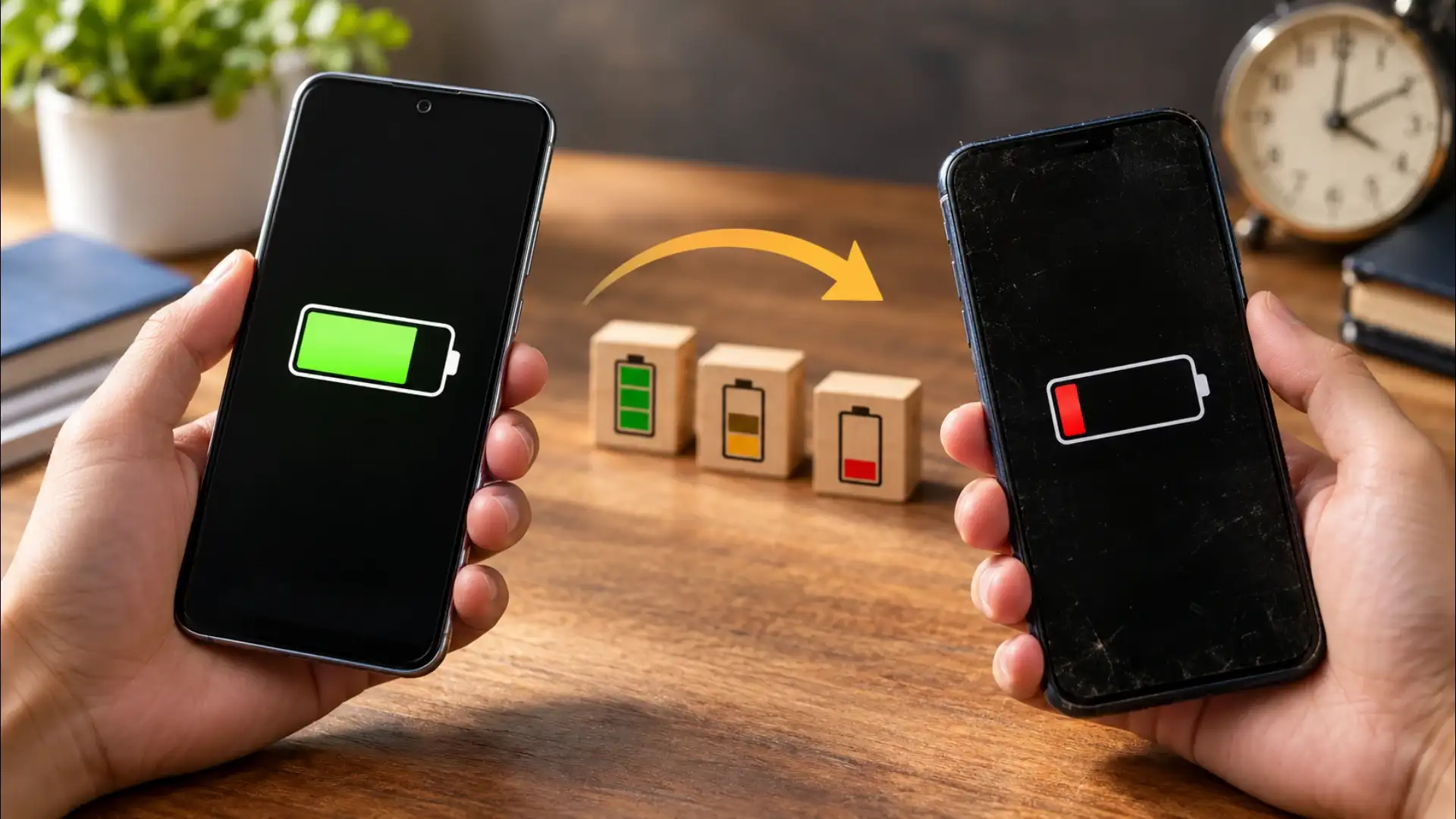
Every lithium-ion battery is consuming itself while it powers the device, that trade-off is built into the technology. The ions that migrate back and forth are finite, the electrodes that host them wear with each cycle, and heat speeds the whole process along. Knowing this does not stop the decline, but it does explain why keeping a phone cool, avoiding full overnight charges when software allows it, and not grinding the battery to zero regularly adds months to how long the battery stays useful.
What a Lithium-Ion Battery Actually Does
Every charge and discharge cycle in a lithium-ion battery is a migration. Lithium ions travel from one electrode to the other through a liquid electrolyte. When you charge the phone, ions move into the graphite anode and park there. When you use the phone, they travel back to the cathode, releasing energy along the way. The electrodes are not passive storage tanks, they expand slightly as ions enter and contract as ions leave. This mechanical stress, repeated thousands of times, gradually degrades the electrode material.Why Capacity Shrinks With Every Cycle
Two processes eat away at usable capacity over time. The first is the formation and growth of a layer called the solid electrolyte interphase, or SEI. This layer forms on the anode surface during the very first charge and keeps growing with each subsequent cycle. It traps lithium ions permanently, locking them out of future use. The second process is lithium plating, when ions arrive at the anode faster than the electrode can absorb them, they deposit as metallic lithium instead of embedding cleanly. This happens most readily during fast charging and in cold temperatures. Plated lithium is largely inactive, reducing the pool of ions available for future cycles. The result of both processes is the same: fewer ions doing useful work, less energy delivered per charge.You may also like
- Tesla rolls out Halloween Mode for 'Model Y' in India
- Amkette One Z wireless gamepad launched at Rs 3,299
- SpaceX's 34.5% of its revenue during the last quarter came from a single client paying, identified as 'Customer B', and it is the company whose CEO Elon Musk told: I do not agree with your donation to …
- AU Small Finance Bank Investigates Possible Data Leak Amid Hacker Claims
- Hackers steal $6.3 billion from world's largest cryptocurrency exchange Binance in what analysts say the biggest crypto hack ever; Co-CEO speaks directly about what happened
Heat Is the Fastest Way to Age a Battery
Temperature accelerates every chemical reaction inside the cell. A battery sitting at sustained high temperatures, inside a car on a summer afternoon, under a pillow while charging, next to a hot laptop, degrades its electrolyte faster, corrodes electrode surfaces, and thickens the SEI layer more quickly than the same battery kept at room temperature. Cold is a different problem: it does not permanently damage capacity the way heat does, but it slows ion movement so much that the battery appears to have lost charge. Most of that apparent loss returns when the phone warms up. Heat damage does not return.What Charge Level Does to Long-Term Health
Lithium-ion cells are under the least mechanical and chemical stress when they sit between roughly 20 and 80 percent charge. A cell held at 100 percent for hours, as happens when a phone charges overnight and stays plugged in, keeps the anode fully expanded and the electrolyte under sustained oxidative pressure. A cell regularly drained close to zero stresses the cathode. Neither extreme destroys a battery in a single session, but both accelerate the capacity loss that accumulates over hundreds of cycles. Most phones now include charge-limiting software that learns overnight charging patterns and holds the battery at around 80 percent until just before the usual wake time, a direct response to this chemistry.Why the Decline Feels Sudden Even Though It Is Gradual
Battery capacity does not fall off a cliff, it erodes steadily, roughly one to two percent per month under typical use. The reason the decline feels sudden is that phones display charge as a percentage of current maximum capacity, not of the original. When that maximum has quietly fallen to 80 percent of what it once was, the phone still shows 100 percent at full charge. The gap only becomes obvious when the phone shuts off at what the screen calls 15 percent, or when a full charge no longer gets through a day that used to be easy. The chemistry has been working the whole time; the display was not telling the full story.Every lithium-ion battery is consuming itself while it powers the device, that trade-off is built into the technology. The ions that migrate back and forth are finite, the electrodes that host them wear with each cycle, and heat speeds the whole process along. Knowing this does not stop the decline, but it does explain why keeping a phone cool, avoiding full overnight charges when software allows it, and not grinding the battery to zero regularly adds months to how long the battery stays useful.






Loving Newspoint? Download the app now
