
Why Websites Ask You to Prove You Are Not a Robot

You click a box that says 'I am not a robot' and the website lets you in. Or it shows you nine images and asks you to pick every one with a bicycle. It feels like a minor inconvenience, but there is a real security system running underneath it, one that has been in an arms race with automated software for decades.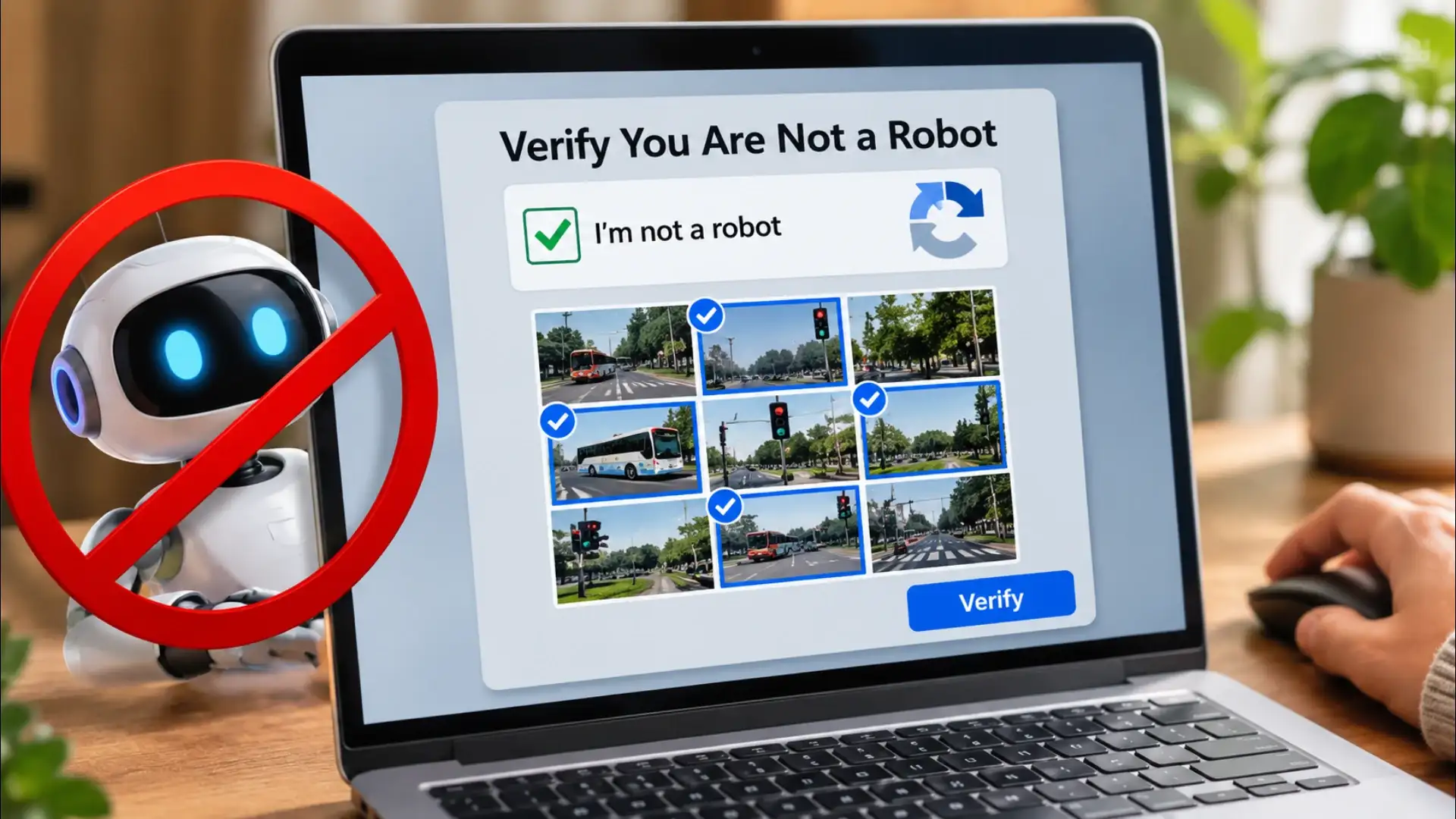
The need for this check came from a simple problem. Websites that allow anyone to sign up, post, or vote can be overwhelmed by automated programs called bots. A bot can create thousands of fake accounts in seconds, stuff an online poll with identical votes, buy up all the tickets for a concert before any real person gets a chance, or flood a comment section with spam. CAPTCHAs exist as a gate that bots find hard to pass.
This worked for a while. Then machine learning improved, and programs trained on large collections of distorted text got better at reading them than many humans. Security researchers found that some CAPTCHA systems were being solved by automated tools with higher accuracy than the people they were designed to stop. The distorted-text approach had run its course.
The underlying test is still the same: can you interpret a scene the way a human does? Recognising that a partially obscured red octagon on a pole is a stop sign requires the kind of contextual understanding that was, for a long time, much easier for humans than for software. As computer vision has improved, the grids have become harder, sometimes asking about ambiguous images where the correct answer is not obvious even to humans.
A bot moving a cursor tends to move it in unnaturally straight or mechanically smooth lines. A human moves with small corrections and slight hesitations. The system scores all of these signals together. If the score is confident enough that you are human, the checkbox tick is all it needs. If the score is uncertain, it escalates to an image grid or another challenge. Most real users never see the hard version because their browsing behaviour already looks human before they touch anything.
This is why CAPTCHA design is not a solved problem. It is an ongoing competition between the people building the gates and the people trying to open them without a key. Each generation of CAPTCHA is designed around whatever the current generation of bots finds hardest, and that target keeps moving as the underlying technology on both sides advances.
The friction you feel when a website asks you to find every bicycle in a grid is the surface of something much larger: a continuous, automated negotiation between human users and the systems built to tell them apart from machines. The fact that it occasionally annoys you is, in a way, the point. A gate that is easy for everyone to open is not much of a gate.
What Is a CAPTCHA and Why Does It Exist
The name is an acronym: Completely Automated Public Turing test to tell Computers and Humans Apart. The Turing test, named after the British mathematician Alan Turing, was originally a thought experiment about whether a machine could convincingly imitate a human in conversation. A CAPTCHA flips the idea: instead of a human judging whether a machine is human, the machine judges whether you are human.The need for this check came from a simple problem. Websites that allow anyone to sign up, post, or vote can be overwhelmed by automated programs called bots. A bot can create thousands of fake accounts in seconds, stuff an online poll with identical votes, buy up all the tickets for a concert before any real person gets a chance, or flood a comment section with spam. CAPTCHAs exist as a gate that bots find hard to pass.
How the Early Versions Worked
The first widely used CAPTCHAs, developed in the early 2000s, showed distorted text, letters and numbers stretched, overlapping, and set against a noisy background. The logic was that human eyes can read text even when it is badly warped, while the image-recognition software of that era could not. Users typed what they saw, and the website compared the answer to the known correct one.This worked for a while. Then machine learning improved, and programs trained on large collections of distorted text got better at reading them than many humans. Security researchers found that some CAPTCHA systems were being solved by automated tools with higher accuracy than the people they were designed to stop. The distorted-text approach had run its course.
The Image Grid and What It Is Really Testing
The image-selection challenge, pick all the squares with a bus, a fire hydrant, a crosswalk, looks like a visual puzzle, but it is also doing something else. These image grids were partly powered by a need to label photographs for training computer vision systems. When you identified a storefront or a set of traffic lights, you were sometimes contributing to a dataset used to teach machines to see.The underlying test is still the same: can you interpret a scene the way a human does? Recognising that a partially obscured red octagon on a pole is a stop sign requires the kind of contextual understanding that was, for a long time, much easier for humans than for software. As computer vision has improved, the grids have become harder, sometimes asking about ambiguous images where the correct answer is not obvious even to humans.
The Invisible Check Behind the Simple Checkbox
The single checkbox, 'I am not a robot', looks like the easiest test of all, but almost no checking happens at the moment you click. The real analysis runs in the background before and after that click, watching how your mouse moved toward the box, how long the page has been open, what kind of device and browser you are using, whether your IP address has been seen doing suspicious things recently, and dozens of other signals at once.A bot moving a cursor tends to move it in unnaturally straight or mechanically smooth lines. A human moves with small corrections and slight hesitations. The system scores all of these signals together. If the score is confident enough that you are human, the checkbox tick is all it needs. If the score is uncertain, it escalates to an image grid or another challenge. Most real users never see the hard version because their browsing behaviour already looks human before they touch anything.
Why Bots Keep Getting Better at Beating Them
Every CAPTCHA system that becomes widely used becomes a target. Developers of automated tools study the system, collect examples, train models on them, and eventually build solvers. There is also a darker side: CAPTCHA-solving services employ people in low-wage markets to sit and solve challenges manually, which gets fed back to the bot as the correct answer in real time.This is why CAPTCHA design is not a solved problem. It is an ongoing competition between the people building the gates and the people trying to open them without a key. Each generation of CAPTCHA is designed around whatever the current generation of bots finds hardest, and that target keeps moving as the underlying technology on both sides advances.
The friction you feel when a website asks you to find every bicycle in a grid is the surface of something much larger: a continuous, automated negotiation between human users and the systems built to tell them apart from machines. The fact that it occasionally annoys you is, in a way, the point. A gate that is easy for everyone to open is not much of a gate.
Next Story