
US government website found to be using Chinese AI model that FBI recently blamed for 'stealing' from Anthropic


FBI recently accused Chinese technology giant Alibaba of “malicious” copying of artificial intelligence (AI) technology from US rival Anthropic . Now, a US government website that helps users search proposed federal regulations was also found to use an AI model developed by Alibaba. According to a report by the news agency Reuters, the Federal Register website , operated by the National Archives, had a search tool powered by Alibaba’s Qwen AI model .
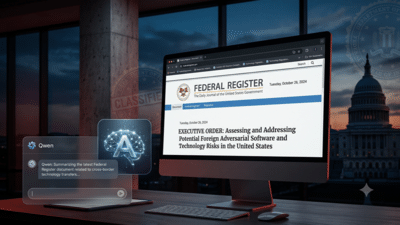
The tool was available alongside other search options before it was taken down around the same time social media posts about its use began appearing. The development is notable because it comes just days after US officials accused Chinese AI companies of engaging in “malicious” copying of American technology on an “industrial scale”, adding another layer to the growing debate in Washington over the use of Chinese AI models by US organisations.
Federal Register website used Alibaba's Qwen AI modelThe Federal Register website provides a daily record of proposed and final federal regulations and allows users to search through public comments. Reuters found that one of its search options was powered by Alibaba's Qwen AI model.
It was not immediately clear when the Qwen-powered tool was added. Screenshots and an archived version of the website's source code reviewed by Reuters showed that the feature was available on Wednesday before being taken down later that day.
The timing drew attention because the FBI recently accused Alibaba of copying Anthropic's AI models. US officials said Chinese AI companies were involved in “malicious” copying of US technology on an “industrial scale.”
A spokesperson for the Chinese embassy in Washington said the allegations of copying were “unfounded.”
Why was the US government using QwenQwen is an open-weight AI model, meaning key components of the system are publicly available. Developers can download and modify such models for specific applications, potentially making them cheaper and easier to deploy than closed AI systems offered by companies such as Anthropic and OpenAI.
Security experts said using Qwen on the Federal Register website may not have created an immediate national security threat because the website primarily handles information that is already public.
Georgetown Law Professor Anupam Chander said the use of Qwen did not appear to present an immediate cybersecurity risk, although the risk could depend on how the model was trained. As the Federal Register's content is publicly available, the model apparently was not being used to process classified or otherwise sensitive government information.
However, using a Chinese AI model has raised questions about whether US government agencies should use such technology while Washington increasingly warns about potential risks associated with Chinese AI systems.
Daniel Castro, president of the Information Technology and Innovation Foundation, said there was a disconnect between the US-China competition over AI and a US agency's decision to use a Chinese-developed model.
“It's one of the most insane things I've ever seen," he said.
US lawmakers question use of Chinese AI modelsUS Representative John Moolenaar, a Michigan Republican who chairs the House China Committee, also criticised the federal government's use of Qwen.
“No federal government entity should use a Chinese AI model," he said. "Doing so only makes the federal government more dependent on Chinese AI models and that is not in the national interest.”
At the same time, security experts noted that open-weight models can be deployed on an organisation's own infrastructure. This can give users greater control over data than AI services where an external provider processes information.
Democratic US Senator Mark Warner of Virginia, vice chairman of the Senate Intelligence Committee, said the security implications depend on whether US government data crossed the government's security boundary and was processed on Alibaba-controlled systems.
The issue has also drawn scrutiny beyond the Federal Register. In April, US House committees on China and homeland security sent a letter to Airbnb, which also uses Qwen, seeking details about its deployment of Chinese AI technology as part of an investigation into the “national security risks created by the integration” of Chinese AI tools into platforms used by Americans.
The tool was available alongside other search options before it was taken down around the same time social media posts about its use began appearing. The development is notable because it comes just days after US officials accused Chinese AI companies of engaging in “malicious” copying of American technology on an “industrial scale”, adding another layer to the growing debate in Washington over the use of Chinese AI models by US organisations.
Federal Register website used Alibaba's Qwen AI modelThe Federal Register website provides a daily record of proposed and final federal regulations and allows users to search through public comments. Reuters found that one of its search options was powered by Alibaba's Qwen AI model.
It was not immediately clear when the Qwen-powered tool was added. Screenshots and an archived version of the website's source code reviewed by Reuters showed that the feature was available on Wednesday before being taken down later that day.
The timing drew attention because the FBI recently accused Alibaba of copying Anthropic's AI models. US officials said Chinese AI companies were involved in “malicious” copying of US technology on an “industrial scale.”
A spokesperson for the Chinese embassy in Washington said the allegations of copying were “unfounded.”
Why was the US government using QwenQwen is an open-weight AI model, meaning key components of the system are publicly available. Developers can download and modify such models for specific applications, potentially making them cheaper and easier to deploy than closed AI systems offered by companies such as Anthropic and OpenAI.
Security experts said using Qwen on the Federal Register website may not have created an immediate national security threat because the website primarily handles information that is already public.
Georgetown Law Professor Anupam Chander said the use of Qwen did not appear to present an immediate cybersecurity risk, although the risk could depend on how the model was trained. As the Federal Register's content is publicly available, the model apparently was not being used to process classified or otherwise sensitive government information.
However, using a Chinese AI model has raised questions about whether US government agencies should use such technology while Washington increasingly warns about potential risks associated with Chinese AI systems.
Daniel Castro, president of the Information Technology and Innovation Foundation, said there was a disconnect between the US-China competition over AI and a US agency's decision to use a Chinese-developed model.
“It's one of the most insane things I've ever seen," he said.
US lawmakers question use of Chinese AI modelsUS Representative John Moolenaar, a Michigan Republican who chairs the House China Committee, also criticised the federal government's use of Qwen.
“No federal government entity should use a Chinese AI model," he said. "Doing so only makes the federal government more dependent on Chinese AI models and that is not in the national interest.”
At the same time, security experts noted that open-weight models can be deployed on an organisation's own infrastructure. This can give users greater control over data than AI services where an external provider processes information.
Democratic US Senator Mark Warner of Virginia, vice chairman of the Senate Intelligence Committee, said the security implications depend on whether US government data crossed the government's security boundary and was processed on Alibaba-controlled systems.
The issue has also drawn scrutiny beyond the Federal Register. In April, US House committees on China and homeland security sent a letter to Airbnb, which also uses Qwen, seeking details about its deployment of Chinese AI technology as part of an investigation into the “national security risks created by the integration” of Chinese AI tools into platforms used by Americans.
Next Story