
International Day of Non-Violence: Gandhis Message of Peace Resonates Globally


New Delhi, October 1 (Daily Kiran) : October 2 is a significant date for India as it marks the birth anniversary of Mahatma Gandhi, the father of the nation. However, it also serves as a moment for the entire world to reflect on the principles of peace, dialogue, and non-violence that Gandhi championed. The coincidence of Gandhi Jayanti and the International Day of Non-Violence gives this day a unique importance.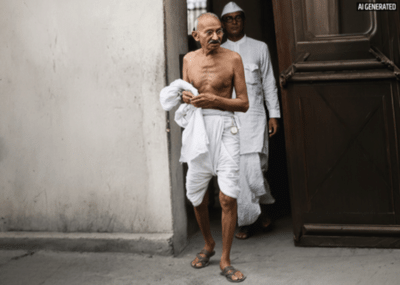 While it is a day of national remembrance for India, it has also become a universal message through the United Nations. Mahatma Gandhi led India's struggle for independence, anchoring his philosophy in the tenets of non-violence. His name has emerged as a powerful symbol of peace and humanitarianism, a legacy that continues to resonate today. The global recognition of his principles was solidified when the United Nations General Assembly passed a resolution on June 15, 2007, declaring October 2 as the International Day of Non-Violence.The aim of this resolution was to promote the message of non-violence worldwide. This resolution garnered widespread international support, with over 140 countries co-sponsoring it. The proposal, introduced by India's then Minister of State for External Affairs Anand Sharma, was adopted unanimously without a vote. The UN resolution highlights the universal relevance of non-violence and expresses a commitment to fostering a culture of peace, tolerance, understanding, and non-violence.Gandhi's philosophy is presented as a guiding principle for the future of humanity. For Gandhi, non-violence was not merely an idea; it was a path to resolve conflicts. He advanced the message of peace through this very approach during India's freedom struggle. The breadth of Gandhi's thoughts is evident as his messages are often linked to contemporary global issues within the United Nations. Events and statements by the Secretary-General frequently reference Gandhi's teachings in the context of current conflicts.These discussions reveal that Gandhi's belief in truth and non-violence is regarded as more powerful than any weapon. In India, October 2 is celebrated as Gandhi Jayanti. Tributes are paid at Raj Ghat, and various cultural and educational programs highlight Gandhi's ideals. This day serves not only as a remembrance of Gandhi but also as an opportunity to keep his thoughts alive through public life and social campaigns. The unique aspect of Gandhi Jayanti and the International Day of Non-Violence is that they converge on the same day, merging national tribute with a global message.This day, linked to Gandhi's memory in India, reaches various parts of the world through the United Nations. Commemorative events are held in countries like Belgium, the USA, Spain, Serbia, Switzerland, Thailand, Kazakhstan, and the Netherlands. The core message of the International Day of Non-Violence is that conflict should not always be met with more conflict. It emphasizes the need to integrate peace, tolerance, understanding, and dialogue into social life.The UN resolution also stresses the importance of spreading the message of non-violence through education and public awareness. The world remembers Mahatma Gandhi not only for his unwavering commitment to non-violence and humanitarianism but also as an ideal that can guide public life, political thought, government policies, and shared hopes for the future. October 2 is significant not only because it is Gandhi's birthday but also as a day to reaffirm that the direction of the world can be shaped by peace and non-violence, rather than violence.The International Day of Non-Violence serves as a tribute to Gandhi while reminding the world that even amidst conflict, there is room for dialogue.
Next Story