
Private fuel retailers post sales decline in October


New Delhi: Private fuel retailers, led by Reliance-BP and Nayara Energy, recorded a 44% year-on-year decline in diesel sales and 16% in petrol in October, as comparatively higher prices pushed customers towards state-run rivals.
The shift boosted diesel and petrol sales at state-run retailers, including Indian Oil, Bharat Petroleum and Hindustan Petroleum, by 20% and 6%, respectively, according to official data.
A surge in international crude and fuel prices prompted private retailers to raise pump rates by ₹3-5 per litre in October. State-run companies however abstained from any increase. The resulting price gap drove customers away from private pumps, particularly commercial buyers, for whom even small price differences can translate into substantial savings due to large volumes.
Before raising prices, private retailers had also capped the volume of diesel customers could buy at their pumps, prompting a warning from the oil ministry.
State-run companies' retail pumps are also absorbing additional demand from bulk customers, who accounted for about 13% of India's diesel sales in 2025-26. With bulk diesel, typically sold at a discount to retail, now about Rs 40 per litre pricier, some large consumers moved purchases to petrol pumps. This contributed to a 33% year-on-year drop in bulk diesel sales in October. State-run retailers are managing additional demand from both these shifts smoothly, unlike in the first few months of the Iran war, when a sudden surge in demand led to reports of brief shortages in some states. Having learnt from that experience, they can now anticipate additional demand and ensure adequate supplies at individual stations, said an industry executive.
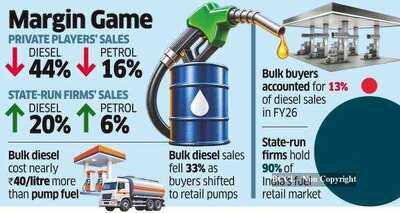
The shift from private to state-run pumps has become a recurring pattern, reflecting how private retailers adjust their domestic presence according to the margins available in export markets. When domestic margins fall below export margins, private refiners prioritise overseas sales, ceding market share at home. This disparity typically emerges when state-run retailers, who have a dominant 90% share of the domestic market, hold pump prices steady despite rising international fuel rates. The reverse happens when international prices fall but state-run retailers delay passing on the decline to consumers to recover previous losses. Domestic margins then improve, prompting private companies to expand sales and capture a larger share of the market.
Both state-run and private retailers are expected to align pump prices with international rates. However, state-run firms have moved away from this practice in recent years, smoothing out global price increases and declines over longer periods to keep domestic prices stable. Private retailers, by contrast, adjust their domestic sales according to relative profitability of local and export markets.
The shift boosted diesel and petrol sales at state-run retailers, including Indian Oil, Bharat Petroleum and Hindustan Petroleum, by 20% and 6%, respectively, according to official data.
A surge in international crude and fuel prices prompted private retailers to raise pump rates by ₹3-5 per litre in October. State-run companies however abstained from any increase. The resulting price gap drove customers away from private pumps, particularly commercial buyers, for whom even small price differences can translate into substantial savings due to large volumes.
Before raising prices, private retailers had also capped the volume of diesel customers could buy at their pumps, prompting a warning from the oil ministry.
State-run companies' retail pumps are also absorbing additional demand from bulk customers, who accounted for about 13% of India's diesel sales in 2025-26. With bulk diesel, typically sold at a discount to retail, now about Rs 40 per litre pricier, some large consumers moved purchases to petrol pumps. This contributed to a 33% year-on-year drop in bulk diesel sales in October. State-run retailers are managing additional demand from both these shifts smoothly, unlike in the first few months of the Iran war, when a sudden surge in demand led to reports of brief shortages in some states. Having learnt from that experience, they can now anticipate additional demand and ensure adequate supplies at individual stations, said an industry executive.
The shift from private to state-run pumps has become a recurring pattern, reflecting how private retailers adjust their domestic presence according to the margins available in export markets. When domestic margins fall below export margins, private refiners prioritise overseas sales, ceding market share at home. This disparity typically emerges when state-run retailers, who have a dominant 90% share of the domestic market, hold pump prices steady despite rising international fuel rates. The reverse happens when international prices fall but state-run retailers delay passing on the decline to consumers to recover previous losses. Domestic margins then improve, prompting private companies to expand sales and capture a larger share of the market.
Both state-run and private retailers are expected to align pump prices with international rates. However, state-run firms have moved away from this practice in recent years, smoothing out global price increases and declines over longer periods to keep domestic prices stable. Private retailers, by contrast, adjust their domestic sales according to relative profitability of local and export markets.
Next Story