
About 5 billion lbs of carpet are removed from US buildings each year; a cement kiln test found it worked as fuel, but transport costs were too high


Approximately 5 billion lbs of carpet will be removed from buildings in the US each year for the foreseeable future, according to a report by Georgia Tech Research Corporation . The face of that carpet contains plastic that can be reused, but it is held in place by a latex cross-linked polymer heavily loaded with calcium carbonate. The report states that this backing has almost no value as a recycled material. Researchers then burnt carpet as fuel at Lehigh Cement's kiln in Evansville, Pennsylvania. Carpet proved technically suitable, yet the report concludes that the economic barriers were too high.
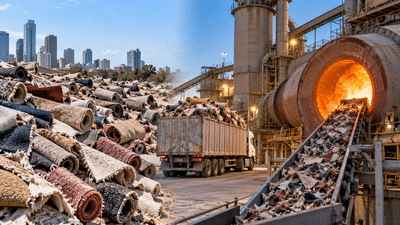
Why carpet is being studied as an alternative fuel in cement kilns
Carpet tile is typically made for the commercial market and has a heavier backing, often PVC. According to the final report, Carpet As An Alternative Fuel in Cement Kilns, PVC tiles are, at the time of the report, handled through a recycling system run by Interface or Tandus, so they were excluded from the study. Broadloom, in contrast, "is not recycled in significant volumes compared to its sales" and is the subject of the report. Broadloom comes with two backing types, an SB latex and a polyurethane foam back, and with two face constructions: level loop and tufted.
For latex-backed carpet, the report lists four main components: the face fibre, the primary backing layer, the filled latex glue layer and the secondary backing layer. It states that the face fibre is typically nylon 6, nylon 66 or polypropylene, with smaller amounts of PET and wool. The primary and secondary backings are polypropylene. The latex styrene butadiene glue is "typically filled with calcium carbonate, fly ash, or ground glass." The report notes that the two backing types affect the products of combustion and the melting points: the polyurethane backing tends to melt if it gets too hot, while the latex does not.
How calcium carbonate affects carpet as an alternative fuel
The executive summary describes how the carpet is held together. The face is woven through a backing fabric and held in place by a "glue" that is, in most cases, a latex cross-linked polymer heavily loaded with chalk (calcium carbonate). The report states directly that "this backing has almost no value as a recycled material." It also describes carpet as a bulky material that is difficult to handle and ship and must be kept dry.
Table 1 of the report, from the SB Latex Carpet Life Cycle Inventory by Dr Michael Overcash, gives a representative composition for a final product of 1.92 kg per square yard. The entries are calcium carbonate at 0.48 kg, nylon 6 fibre at 0.81 kg, polypropylene at 0.18 kg, aluminium hydroxide at 0.24 kg and SB latex at 0.21 kg. Stain blocker is listed at 1.89E-04 kg and other additives at 1.29E-03 kg. The report also says the filler content influences how abrasive the material is during size reduction, and that calcium carbonate causes aggressive wear on cutting surfaces.
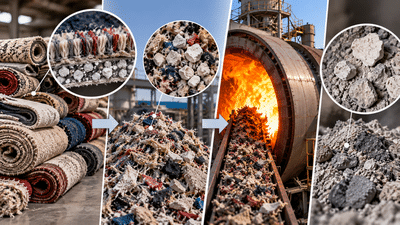
How carpet performed as an alternative fuel in a cement kiln trial
The project's research question was whether carpet could be used as a fuel in a cement kiln. The trial took place at Lehigh Cement's long dry kiln at Evansville, Pennsylvania. The report records that carpet was burnt at rates approximating 10–15% of the fuel load, at about 2–2.5 tons per hour, and that this did not negatively impact the kiln's emissions. According to Table 9, NOx and SO2 emissions were below the allowed limits for both coal and carpet co-firing, although SO2 appeared higher for carpet. The report concludes that "carpet was technically a suitable fuel."
The existing feed system, designed for wood chips, would jam unless closely supervised, and only 200 tons of the targeted 1000 tons were fed. On economics, the report states that carpet was worth approximately 1.2 c/lb as a fuel, based on coal at about $1.60 per mmbtu and 7500 btu/lb. Actual freight was $550 per load over 100 miles, which the report says "immediately wipes out the value of the carpet." It concludes that "the economic barriers to the adoption of carpet at this kiln are too high."
Why carpet is being studied as an alternative fuel in cement kilns
Carpet tile is typically made for the commercial market and has a heavier backing, often PVC. According to the final report, Carpet As An Alternative Fuel in Cement Kilns, PVC tiles are, at the time of the report, handled through a recycling system run by Interface or Tandus, so they were excluded from the study. Broadloom, in contrast, "is not recycled in significant volumes compared to its sales" and is the subject of the report. Broadloom comes with two backing types, an SB latex and a polyurethane foam back, and with two face constructions: level loop and tufted.
For latex-backed carpet, the report lists four main components: the face fibre, the primary backing layer, the filled latex glue layer and the secondary backing layer. It states that the face fibre is typically nylon 6, nylon 66 or polypropylene, with smaller amounts of PET and wool. The primary and secondary backings are polypropylene. The latex styrene butadiene glue is "typically filled with calcium carbonate, fly ash, or ground glass." The report notes that the two backing types affect the products of combustion and the melting points: the polyurethane backing tends to melt if it gets too hot, while the latex does not.
How calcium carbonate affects carpet as an alternative fuel
The executive summary describes how the carpet is held together. The face is woven through a backing fabric and held in place by a "glue" that is, in most cases, a latex cross-linked polymer heavily loaded with chalk (calcium carbonate). The report states directly that "this backing has almost no value as a recycled material." It also describes carpet as a bulky material that is difficult to handle and ship and must be kept dry.
Table 1 of the report, from the SB Latex Carpet Life Cycle Inventory by Dr Michael Overcash, gives a representative composition for a final product of 1.92 kg per square yard. The entries are calcium carbonate at 0.48 kg, nylon 6 fibre at 0.81 kg, polypropylene at 0.18 kg, aluminium hydroxide at 0.24 kg and SB latex at 0.21 kg. Stain blocker is listed at 1.89E-04 kg and other additives at 1.29E-03 kg. The report also says the filler content influences how abrasive the material is during size reduction, and that calcium carbonate causes aggressive wear on cutting surfaces.
How carpet performed as an alternative fuel in a cement kiln trial
The project's research question was whether carpet could be used as a fuel in a cement kiln. The trial took place at Lehigh Cement's long dry kiln at Evansville, Pennsylvania. The report records that carpet was burnt at rates approximating 10–15% of the fuel load, at about 2–2.5 tons per hour, and that this did not negatively impact the kiln's emissions. According to Table 9, NOx and SO2 emissions were below the allowed limits for both coal and carpet co-firing, although SO2 appeared higher for carpet. The report concludes that "carpet was technically a suitable fuel."
The existing feed system, designed for wood chips, would jam unless closely supervised, and only 200 tons of the targeted 1000 tons were fed. On economics, the report states that carpet was worth approximately 1.2 c/lb as a fuel, based on coal at about $1.60 per mmbtu and 7500 btu/lb. Actual freight was $550 per load over 100 miles, which the report says "immediately wipes out the value of the carpet." It concludes that "the economic barriers to the adoption of carpet at this kiln are too high."
Next Story