
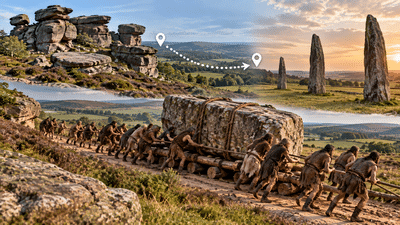
Britain's Devil's Arrows came from Brimham Rocks 18 km away, revealing that prehistoric people deliberately moved the giant stones


Britain’s tallest surviving stone row may have travelled farther than archaeologists once believed, after scientists traced tiny mineral grains on its weathered surfaces to a distinctive rocky landscape 18 kilometres away. The Devil’s Arrows, a group of enormous prehistoric stones near Boroughbridge in North Yorkshire, have long been linked to a closer gritstone source. According to the new study published in The Royal Society , titled ‘Deliberate prehistoric sourcing of the Devil's Arrows, Britain's tallest stone row’, strips of adhesive tape were placed against the stones to recover mineral grains without damaging the protected monument. Dating 236 zircon grains has now produced a striking geological fingerprint, pointing towards Brimham Rocks rather than the nearer Plumpton Rocks.
Peel method reveals hidden clues from the Devil’s Arrows
The researchers needed a way to examine the Devil’s Arrows without taking conventional rock samples from the protected monument. They therefore used what the study describes as a novel “peel method”. Twenty-centimetre sections of adhesive tape were placed against dry, inconspicuous areas of the stones for five minutes, collecting tiny grains from their surfaces. The approach was carried out under Scheduled Monument Consent granted by Historic England.
The material recovered from the three surviving stones was enough to produce 236 concordant zircon U–Pb dates. Stone 1 provided 67 ages, Stone 2 produced 64 and Stone 3 produced 105. Statistical tests found no significant difference between the zircon age patterns of the three stones, allowing the researchers to combine them into one dataset for comparison with potential source rocks.
Zircon fingerprints link the Devil’s Arrows to Brimham Rocks
The zircon record from the Devil’s Arrows contains several distinctive age groups, including dominant Palaeozoic grains dating to roughly 460–400 million years ago, alongside Mesoproterozoic grains from about 1.3–1.0 billion years ago and Palaeoproterozoic grains from around 1.8–1.5 billion years ago. There are also smaller Archean populations, with the oldest analysed grains reaching more than 3.7 billion years.
When fingerprints were matched with potential source areas, Brimham Rocks produced the closest match. According to the study, the Devil’s Arrows and Brimham Rocks share the same broad polymodal zircon pattern and similar proportions of the different age groups. The statistical comparison was particularly strong with a Kolmogorov–Smirnov test, while Plumpton Rocks showed a substantially different zircon spectrum.
Plumpton Rocks ruled out as the Devil’s Arrows’ likely source
Plumpton Rocks has long been considered a possible source because it is nearer to the Devil’s Arrows and has the appropriate Millstone Grit lithology. The study notes that it is the source named in the Historic England Official List entry. Yet the mineral evidence tells a different story: the zircon population from Plumpton Rocks differs from both the monument and Brimham Rocks.
The researchers explain that even outcrops belonging to the same Upper Plumpton Grit interval can have different mineral fingerprints because sediment was carried through separate ancient river channels. In their statistical comparison, the Devil’s Arrows had a much closer relationship with Brimham Rocks than with Plumpton Rocks, supporting Brimham as the more likely source.
Why prehistoric people chose Brimham Rocks
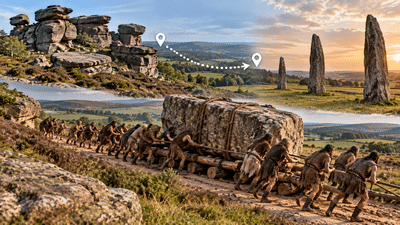
The researchers argue that the choice may have combined practical and cultural considerations. Brimham is a prominent tor landscape with unusual, weather-eroded rock formations, while natural joints and bedding planes create elongated blocks that could have made the lifting of large stones easier.
There are also signs that Brimham itself was a place of prehistoric activity. The study points to a three-metre-long gritstone near the rocks carrying wavy engravings and around 21 cup-and-ring marks dating from the Late Neolithic to the Bronze Age. Taken together, the geological and archaeological evidence suggests that the Devil’s Arrows were not simply made from whatever suitable stone happened to be closest. As the researchers conclude, the monument represents an “intentional km-scale relocation” of material from a distinctive upland landscape into a lowland ceremonial setting.
The Devil’s Arrows therefore add another example to evidence from monuments such as Stonehenge, Orkney and Irish passage tombs, where prehistoric communities transported stone over considerable distances. The new provenance evidence suggests that the people who raised the approximately seven-metre-high stones near Boroughbridge may have deliberately sought out.
Peel method reveals hidden clues from the Devil’s Arrows
The researchers needed a way to examine the Devil’s Arrows without taking conventional rock samples from the protected monument. They therefore used what the study describes as a novel “peel method”. Twenty-centimetre sections of adhesive tape were placed against dry, inconspicuous areas of the stones for five minutes, collecting tiny grains from their surfaces. The approach was carried out under Scheduled Monument Consent granted by Historic England.
The material recovered from the three surviving stones was enough to produce 236 concordant zircon U–Pb dates. Stone 1 provided 67 ages, Stone 2 produced 64 and Stone 3 produced 105. Statistical tests found no significant difference between the zircon age patterns of the three stones, allowing the researchers to combine them into one dataset for comparison with potential source rocks.
Zircon fingerprints link the Devil’s Arrows to Brimham Rocks
The zircon record from the Devil’s Arrows contains several distinctive age groups, including dominant Palaeozoic grains dating to roughly 460–400 million years ago, alongside Mesoproterozoic grains from about 1.3–1.0 billion years ago and Palaeoproterozoic grains from around 1.8–1.5 billion years ago. There are also smaller Archean populations, with the oldest analysed grains reaching more than 3.7 billion years.
When fingerprints were matched with potential source areas, Brimham Rocks produced the closest match. According to the study, the Devil’s Arrows and Brimham Rocks share the same broad polymodal zircon pattern and similar proportions of the different age groups. The statistical comparison was particularly strong with a Kolmogorov–Smirnov test, while Plumpton Rocks showed a substantially different zircon spectrum.
Plumpton Rocks ruled out as the Devil’s Arrows’ likely source
Plumpton Rocks has long been considered a possible source because it is nearer to the Devil’s Arrows and has the appropriate Millstone Grit lithology. The study notes that it is the source named in the Historic England Official List entry. Yet the mineral evidence tells a different story: the zircon population from Plumpton Rocks differs from both the monument and Brimham Rocks.
The researchers explain that even outcrops belonging to the same Upper Plumpton Grit interval can have different mineral fingerprints because sediment was carried through separate ancient river channels. In their statistical comparison, the Devil’s Arrows had a much closer relationship with Brimham Rocks than with Plumpton Rocks, supporting Brimham as the more likely source.
Why prehistoric people chose Brimham Rocks
The researchers argue that the choice may have combined practical and cultural considerations. Brimham is a prominent tor landscape with unusual, weather-eroded rock formations, while natural joints and bedding planes create elongated blocks that could have made the lifting of large stones easier.
There are also signs that Brimham itself was a place of prehistoric activity. The study points to a three-metre-long gritstone near the rocks carrying wavy engravings and around 21 cup-and-ring marks dating from the Late Neolithic to the Bronze Age. Taken together, the geological and archaeological evidence suggests that the Devil’s Arrows were not simply made from whatever suitable stone happened to be closest. As the researchers conclude, the monument represents an “intentional km-scale relocation” of material from a distinctive upland landscape into a lowland ceremonial setting.
The Devil’s Arrows therefore add another example to evidence from monuments such as Stonehenge, Orkney and Irish passage tombs, where prehistoric communities transported stone over considerable distances. The new provenance evidence suggests that the people who raised the approximately seven-metre-high stones near Boroughbridge may have deliberately sought out.
Next Story