
Experts Highlight BRICS Presidency as a Voice for the Global South


New Delhi, September 8 (Daily Kiran) : The BRICS group is entering a significant phase of development, marked by its expanding membership and growing economic and geopolitical importance. This observation was made during a key dialogue held on Tuesday in New Delhi, ahead of the important 18th BRICS Summit scheduled for this week. Organized by the Chintan Research Foundation (CRF), the discussion brought together diplomats, policymakers, scholars, and experts to explore BRICS's emerging role in the international order.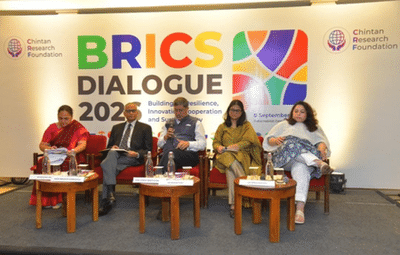 Analysts emphasized that India’s fourth presidency of BRICS comes at a crucial juncture, characterized by geopolitical competition, economic fragmentation, technological disruption, and increasing demands for reform in global governance institutions. They noted that India's leadership aims to strengthen BRICS as a platform for practical, inclusive, and sustainable cooperation under the theme of "building resilience, innovation, collaboration, and stability." Shishir Priyadarshi, president of CRF, highlighted the importance of economic cooperation, stating that trade is one of the strongest pillars of geoeconomic collaboration.Priyadarshi, a former director of the World Trade Organization (WTO), identified three other pillars: financial cooperation, technology, and geopolitical integration. He pointed out that the challenge lies in creating an effective group despite geopolitical differences. Since its emergence as an economic bloc, BRICS has evolved significantly. Its agenda now encompasses global governance and institutional reform, trade and investment, development finance, technology and artificial intelligence, energy and climate, digital transformation, and South-South cooperation.Following its recent expansion, BRICS now represents nearly 49.5% of the world’s population and about 40% of global GDP, greatly enhancing its potential impact on economic and political discussions worldwide. Focusing on India's BRICS presidency, Professor Srikanth Kondapalli noted the importance of recognizing the varying perspectives among key partners regarding a multipolar world order. He stated, "BRICS is significant because it enables a bottom-up approach to cooperation, allowing countries to build resilience and diversify risks while strengthening alternative economic and strategic partnerships instead of completely breaking away from existing systems." Heena Makhija highlighted that BRICS is not a charter-based organization and has experienced both vertical and horizontal expansion, resulting in power imbalances.Makhija cautioned that reaching a consensus on establishing a BRICS secretariat in New Delhi could be challenging given the emerging and diverse membership. Professor Harsh V. Pant from the Observer Research Foundation pointed out that BRICS was originally envisioned as a geoeconomic platform. However, differences among member countries on geopolitical fronts have made geopolitics an increasingly critical dimension of the group. He also questioned whether BRICS could effectively advance India's multilateral agenda.Subyasach Saha from the Research and Information System for Developing Countries (RIS) emphasized the need for BRICS to focus on providing concrete collective value beyond bilateral relations among its members, highlighting the idea of "Vasudhaiva Kutumbakam" promoted by India. Pritam Banerjee called for innovative financial instruments within the New Development Bank's mandate to enhance financial cooperation among BRICS members. The discussion also explored various areas of collaboration that could yield tangible results, including establishing a BRICS grain exchange, implementing interconnected paperless trade systems, reducing non-tariff barriers, and promoting trade in local currencies where commercially feasible.Such initiatives could not only strengthen economic resilience but also demonstrate the practical significance of BRICS cooperation. A key takeaway from the dialogue was that the future credibility of BRICS will depend on its ability to move from declarations to implementation. Its growing membership provides greater representation and collective weight but also makes consensus-building and institutional continuity more crucial.
Next Story