
Future military power will depend on speed, precision, information & integration; keen to explore research and co-development with like-minded countries: Rajnath


NEW DELHI: Defence minister Rajnath Singh on Saturday said that modern warfare is undergoing a profound transformation, extending beyond the traditional domains of land, sea and air to encompass space, cyber, the electromagnetic spectrum and the information domain. He highlighted the growing influence of unmanned systems, drones, AI, electronic warfare and long-range precision weapons in shaping contemporary military operations.
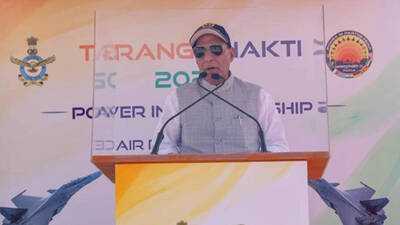
“Future military power will be defined less by the number of platforms we possess. It will be determined by the speed of sensing, understanding, deciding, and acting,” he said, underlining that speed, precision, information and integration had emerged as defining attributes of military capability.
The minister also referred to the Advanced Medium Combat Aircraft (AMCA) programme as an important step towards mastering fifth-generation stealth fighter technology and underscored the importance of advanced aero-engine development and co-production. He said that India is keen to explore cooperation with like-minded countries in research, co-development, co-production, maintenance, training and innovation. Emphasising the growing importance of trusted partnerships and resilient supply chains, he stated, “The defence relationships of the future will be about technology and trust, not just about platforms.”
Congratulating the IAF and all organisations involved in the successful conduct of multinational Tarang Shakti exercise, Rajnath welcomed the participating nations and appreciated their contribution to strengthening professional understanding and operational cooperation. He observed that building strong indigenous capabilities must go hand in hand with meaningful cooperation with trusted partners. India must be capable of acting independently when required while also operating effectively with other nations when their interests and responsibilities converge, he emphasised.
The minister said that the presence of participating air forces have added significant value to the exercise and expressed hope that the contingents would return with valuable professional insights and a deeper understanding of India's capabilities and perspectives. The multinational air exercise brought together air forces from seven friendly foreign countries, including Australia, Bangladesh, France, Germany, Sri Lanka, UAE and USA along with 32 observer nations.
Describing the spirit of the exercise, Rajnath said, “Different nations. Different aircraft. Different experiences. But one sky. That is the message of Tarang Shakti.” He emphasised that the value of the exercise extended beyond the sorties flown and scenarios practised, encompassing the ability to communicate, coordinate and operate effectively with partner forces. He called upon the Indian Air Force to incorporate the lessons of the exercise into its training, tactics, technology, doctrine and future capability development. He expressed confidence that the participating nations would carry forward the professional relationships and mutual understanding developed during the exercise to explore new avenues of aerospace and defence cooperation.
He highlighted the significance of Tarang Shakti in translating the principles of capability, technology, interoperability and trust into operational experience.
Rajnath said India, under the leadership of PM Modi, had recognised the importance of strengthening national resilience against emerging security challenges and had adopted Atmanirbharta in defence as a national policy. He stressed that a nation must possess the capability to produce its own weapons and critical technologies to sustain itself during prolonged conflicts and periods of uncertainty.
The minister said the IAF had evolved from a force operating with limited resources at the time of Independence into a modern aerospace power equipped with advanced aircraft, precision weapons, sophisticated sensors, integrated networks and increasingly advanced indigenous technologies. He emphasised that Atmanirbhar Bharat did not mean isolation from the world, but the development of domestic capabilities to design, develop, manufacture, maintain and upgrade critical defence technologies.
“Future military power will be defined less by the number of platforms we possess. It will be determined by the speed of sensing, understanding, deciding, and acting,” he said, underlining that speed, precision, information and integration had emerged as defining attributes of military capability.
The minister also referred to the Advanced Medium Combat Aircraft (AMCA) programme as an important step towards mastering fifth-generation stealth fighter technology and underscored the importance of advanced aero-engine development and co-production. He said that India is keen to explore cooperation with like-minded countries in research, co-development, co-production, maintenance, training and innovation. Emphasising the growing importance of trusted partnerships and resilient supply chains, he stated, “The defence relationships of the future will be about technology and trust, not just about platforms.”
Congratulating the IAF and all organisations involved in the successful conduct of multinational Tarang Shakti exercise, Rajnath welcomed the participating nations and appreciated their contribution to strengthening professional understanding and operational cooperation. He observed that building strong indigenous capabilities must go hand in hand with meaningful cooperation with trusted partners. India must be capable of acting independently when required while also operating effectively with other nations when their interests and responsibilities converge, he emphasised.
The minister said that the presence of participating air forces have added significant value to the exercise and expressed hope that the contingents would return with valuable professional insights and a deeper understanding of India's capabilities and perspectives. The multinational air exercise brought together air forces from seven friendly foreign countries, including Australia, Bangladesh, France, Germany, Sri Lanka, UAE and USA along with 32 observer nations.
Describing the spirit of the exercise, Rajnath said, “Different nations. Different aircraft. Different experiences. But one sky. That is the message of Tarang Shakti.” He emphasised that the value of the exercise extended beyond the sorties flown and scenarios practised, encompassing the ability to communicate, coordinate and operate effectively with partner forces. He called upon the Indian Air Force to incorporate the lessons of the exercise into its training, tactics, technology, doctrine and future capability development. He expressed confidence that the participating nations would carry forward the professional relationships and mutual understanding developed during the exercise to explore new avenues of aerospace and defence cooperation.
He highlighted the significance of Tarang Shakti in translating the principles of capability, technology, interoperability and trust into operational experience.
Rajnath said India, under the leadership of PM Modi, had recognised the importance of strengthening national resilience against emerging security challenges and had adopted Atmanirbharta in defence as a national policy. He stressed that a nation must possess the capability to produce its own weapons and critical technologies to sustain itself during prolonged conflicts and periods of uncertainty.
The minister said the IAF had evolved from a force operating with limited resources at the time of Independence into a modern aerospace power equipped with advanced aircraft, precision weapons, sophisticated sensors, integrated networks and increasingly advanced indigenous technologies. He emphasised that Atmanirbhar Bharat did not mean isolation from the world, but the development of domestic capabilities to design, develop, manufacture, maintain and upgrade critical defence technologies.
Next Story