
India tests 1,000-km-range KAL one-way attack drone at Pokhran


JAISALMER: India’s efforts to develop indigenous long-range unmanned strike capabilities received a major boost with the successful flight trial of KAL, a 1,000-km-range one-way attack drone , at the Pokhran Field Firing Range in Jaisalmer, Rajasthan, on Sunday.
Designed and developed by Noida-based defence technology company IG Defence , the drone was flight-tested from a vehicle-mounted launch platform.
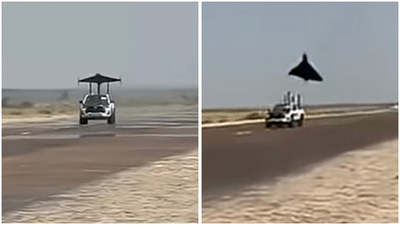
The trial marked a significant milestone in the company’s efforts to develop an indigenous long-range unmanned strike system.
According to the company, the Pokhran range trial successfully validated the drone’s integrated airframe, propulsion, avionics, navigation and mission architecture.
The successful flight test is being described as an important step towards developing advanced unmanned systems for long-range precision missions.
KAL has been designed as part of the emerging category of long-range one-way attack drones, commonly referred to as loitering-type or kamikaze platforms. These systems are designed for one-way missions against designated targets.
The drone has a reported range of up to 1,000 km, an endurance of seven to eight hours, a payload capacity of up to 50 kg and an operating altitude of up to 5,000 metres above mean sea level.
Official said The system incorporates a navigation architecture combining multi-band GNSS and inertial navigation systems (INS), allowing autonomous flight along its designated mission profile.
According to IG Defence, KAL can be configured for precision engagement of designated targets, including infrastructure, radar installations, air-defence systems and other strategic targets, subject to mission requirements and operational authorisations.
The use of a vehicle-mounted launch platform during the Pokhran trial is also significant from an operational perspective. According to the company, a road-mobile configuration could allow the system to be deployed from dispersed locations instead of depending exclusively on fixed launch infrastructure.
The development comes amid the growing use of long-range unmanned systems in contemporary conflicts. Recent conflicts, have demonstrated the increasing role of relatively low-cost unmanned platforms in long-range strike operations and in challenging air-defence networks.
An IG Defence official said the Pokhran trial represented an important milestone for both the company and India’s broader push for self-reliance in advanced defence technology.
“Recent conflicts have demonstrated the growing importance of long-range one-way attack drones in precision-strike and air-defence operations. KAL has been designed around emerging requirements, including long range, autonomous operation, payload capability and scalable indigenous production,” the official said.
KAL is part of IG Defence’s wider portfolio of indigenous defence technologies, which includes interceptor drones, FPV combat drones, autonomous UAVs, counter-UAS systems, electronic warfare, AI-enabled swarm technologies, tactical robotics and logistics drones.
The company said KAL can also be integrated with its GRID battle management system, an AI-enabled C5ISRT architecture designed to coordinate unmanned platforms and battlefield information.
Designed and developed by Noida-based defence technology company IG Defence , the drone was flight-tested from a vehicle-mounted launch platform.
The trial marked a significant milestone in the company’s efforts to develop an indigenous long-range unmanned strike system.
According to the company, the Pokhran range trial successfully validated the drone’s integrated airframe, propulsion, avionics, navigation and mission architecture.
The successful flight test is being described as an important step towards developing advanced unmanned systems for long-range precision missions.
KAL has been designed as part of the emerging category of long-range one-way attack drones, commonly referred to as loitering-type or kamikaze platforms. These systems are designed for one-way missions against designated targets.
The drone has a reported range of up to 1,000 km, an endurance of seven to eight hours, a payload capacity of up to 50 kg and an operating altitude of up to 5,000 metres above mean sea level.
Official said The system incorporates a navigation architecture combining multi-band GNSS and inertial navigation systems (INS), allowing autonomous flight along its designated mission profile.
According to IG Defence, KAL can be configured for precision engagement of designated targets, including infrastructure, radar installations, air-defence systems and other strategic targets, subject to mission requirements and operational authorisations.
The use of a vehicle-mounted launch platform during the Pokhran trial is also significant from an operational perspective. According to the company, a road-mobile configuration could allow the system to be deployed from dispersed locations instead of depending exclusively on fixed launch infrastructure.
The development comes amid the growing use of long-range unmanned systems in contemporary conflicts. Recent conflicts, have demonstrated the increasing role of relatively low-cost unmanned platforms in long-range strike operations and in challenging air-defence networks.
An IG Defence official said the Pokhran trial represented an important milestone for both the company and India’s broader push for self-reliance in advanced defence technology.
“Recent conflicts have demonstrated the growing importance of long-range one-way attack drones in precision-strike and air-defence operations. KAL has been designed around emerging requirements, including long range, autonomous operation, payload capability and scalable indigenous production,” the official said.
KAL is part of IG Defence’s wider portfolio of indigenous defence technologies, which includes interceptor drones, FPV combat drones, autonomous UAVs, counter-UAS systems, electronic warfare, AI-enabled swarm technologies, tactical robotics and logistics drones.
The company said KAL can also be integrated with its GRID battle management system, an AI-enabled C5ISRT architecture designed to coordinate unmanned platforms and battlefield information.
Next Story