
Launch of first privately-built PSLV rocket by first quarter of 2027: Isro chief, says govt fast-tracking sat launches with startups in a 'big way'


NEW DELHI: The first privately-built Polar Satellite Launch Vehicle ( PSLV-N1 ) is ready for a maiden launch in the “first quarter of next year”, Isro chairman V Narayanan said on Tuesday. He also said govt is fast-tracking satellite launches in collaboration with startups “in a big way” as currently Isro has only 56 space assets in orbit.
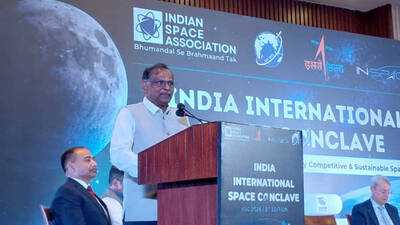
Talking about the first privately-built rocket, Narayanan, on the sidelines of 5th India International Space Conference, said, “Earlier, it was only Isro that built PSLV with the support of industry. Now, a Larsen & Toubro (L&T) and Hindustan Aeronautics Limited (HAL) consortium has been given five PSLVs (to build). So, the first rocket PSLV-N1 is getting ready and we are targeting to launch it by the first quarter of next year.”
Signed in Sept 2022 for Rs 860 crore, a contract by Isro’s commercial arm NewSpace India Ltd (NSIL) shifted the HAL-L&T consortium from component suppliers to end-to-end manufacturers of five PSLV rockets. The original agreement stipulated a 24-month rollout for the first rocket by 2024, followed by one every six months. However, the maiden flight launch was previously pushed to 2025, then to 2026 and now the new launch deadline is early 2027.
To speed up satellite launches, Narayanan said, “Right now. We have only 56 space assets, We need to build a lot of space assets (satellites) for communication, navigation and earth observation . This cannot be done only by the govt sector. So, it is in that direction that the govt, which has rolled out space sector reforms, is helping in a very big way... Isro and INSPACe are hand-holding the private sector and you will see its benefit five years from now. Everywhere, the space sector is doing extremely well. Today, from one startup, their number has come to 440 plus.”
On the Gaganyaan update, the Isro chairman said, “Gaganyaan is not delayed. It is a technology intensive activity. We are in the final phase. The rocket and all the items are ready. We are working on the orbital module. And at the earliest opportunity, it will be launched.”
Talking about foreign collaboration, the Isro chief said, “In the space area, we strongly believe international collaboration is a mandatory requirement. And India is collaborating with 64 countries... There was a time when we were looking for technology, but today we are also a technology provider. At least 434 satellites for 34 countries have lifted off from the Indian soil during the last 12 years. When you talk about international collaboration, it is a mutual benefit. India is getting benefits and in the same way, we are also supporting other countries.”
On dependence on imported semiconductor chips, Narayanan said, “When you talk about a satellite or launch vehicle, we need a lot of electronic components. For example, one of the things is a computer chip and computer processor. There was a time when everything was imported in India. Isro and Semiconductor Lab (SCL) in Chandigarh together have developed the Vikram processor. And already Vikram 16 series is in usage. Vikram-32 chip has come out and we are going to induct it into the programme.”
Talking about the first privately-built rocket, Narayanan, on the sidelines of 5th India International Space Conference, said, “Earlier, it was only Isro that built PSLV with the support of industry. Now, a Larsen & Toubro (L&T) and Hindustan Aeronautics Limited (HAL) consortium has been given five PSLVs (to build). So, the first rocket PSLV-N1 is getting ready and we are targeting to launch it by the first quarter of next year.”
Signed in Sept 2022 for Rs 860 crore, a contract by Isro’s commercial arm NewSpace India Ltd (NSIL) shifted the HAL-L&T consortium from component suppliers to end-to-end manufacturers of five PSLV rockets. The original agreement stipulated a 24-month rollout for the first rocket by 2024, followed by one every six months. However, the maiden flight launch was previously pushed to 2025, then to 2026 and now the new launch deadline is early 2027.
To speed up satellite launches, Narayanan said, “Right now. We have only 56 space assets, We need to build a lot of space assets (satellites) for communication, navigation and earth observation . This cannot be done only by the govt sector. So, it is in that direction that the govt, which has rolled out space sector reforms, is helping in a very big way... Isro and INSPACe are hand-holding the private sector and you will see its benefit five years from now. Everywhere, the space sector is doing extremely well. Today, from one startup, their number has come to 440 plus.”
On the Gaganyaan update, the Isro chairman said, “Gaganyaan is not delayed. It is a technology intensive activity. We are in the final phase. The rocket and all the items are ready. We are working on the orbital module. And at the earliest opportunity, it will be launched.”
Talking about foreign collaboration, the Isro chief said, “In the space area, we strongly believe international collaboration is a mandatory requirement. And India is collaborating with 64 countries... There was a time when we were looking for technology, but today we are also a technology provider. At least 434 satellites for 34 countries have lifted off from the Indian soil during the last 12 years. When you talk about international collaboration, it is a mutual benefit. India is getting benefits and in the same way, we are also supporting other countries.”
On dependence on imported semiconductor chips, Narayanan said, “When you talk about a satellite or launch vehicle, we need a lot of electronic components. For example, one of the things is a computer chip and computer processor. There was a time when everything was imported in India. Isro and Semiconductor Lab (SCL) in Chandigarh together have developed the Vikram processor. And already Vikram 16 series is in usage. Vikram-32 chip has come out and we are going to induct it into the programme.”
Next Story