
Putin, Saudi crown prince discuss safe passage through Hormuz, Bab el-Mandeb


Russian President Vladimir Putin and Saudi crown prince Mohammed bin Salman discussed the need to ensure safe passage through the Strait of Hormuz and Bab el-Mandeb during a phone call on Tuesday, the Kremlin said, as disruptions to the key waterways continue to affect regional oil flows and global trade.
The two leaders exchanged views on the situation in the Middle East and stressed that a political and diplomatic settlement remained the only viable path forward, according to the Kremlin.
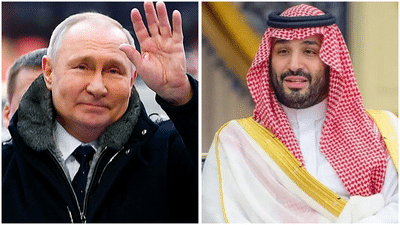
They also "underscored the need for a swift cessation of hostilities" in Yemen amid the deteriorating military and political situation there.
Kremlin stresses need to keep key waterways open
"The importance of ensuring the safe and unimpeded passage of vessels through the region's international waterways, including the Bab el-Mandeb and Strait of Hormuz, was emphasised," the Kremlin said, as quoted by Reuters.
The two waterways are important routes for global energy shipments. With the Hormuz and Bab el-Mandeb routes disrupted by Iran and Iran-allied Houthi militants, Saudi Arabia has been forced to use Egypt's Suez Canal to export oil.
The United States, which bombed the Houthis for two months last year, has so far rejected repeated requests from Mohammed bin Salman to rejoin the fight against the group.
The New York Times reported that US President Donald Trump called off US strikes against the Houthis on Sunday at the last minute, after troops had already begun loading bombs onto planes.
Saudi oil exports rise as Red Sea risks persist
Saudi Arabia's crude oil exports rose about 3.3% in July from the previous month to 4.125 million barrels per day, their highest level since March, according to Joint Organizations Data Initiative data reported by Reuters.
Saudi crude production also increased to 8.135 million barrels per day in July from 7.122 million bpd in June.
"Saudi crude and product exports increased in July as regional tensions moderated," UBS analyst Giovanni Staunovo said, while warning that exports could be weaker in August, particularly from Red Sea terminals, because of renewed tensions involving the Houthis.
Saudi refinery crude throughput fell slightly to 2.478 million bpd in July from 2.498 million bpd in June.
Saudi Arabia also resumed operations at its East-West Pipeline, with exports potentially following from the Red Sea port of Yanbu, according to three sources cited by Reuters. Drone attacks had forced the kingdom to shut the pipeline on September 13.
Iran says Hormuz could reopen within seven days
A senior Iranian official told Reuters on Tuesday that Iran could reopen the Strait of Hormuz within seven days if the United States eases military pressure and lifts its blockade on Iranian ports.
Meanwhile, Houthi fighters pushed to seize strategic heights in Yemen on Monday in an effort to cut off the Red Sea coast from areas held by Saudi-backed forces.
The developments come as the security situation around the region's key shipping routes remains closely linked to oil supply flows and refinery operations.
The two leaders exchanged views on the situation in the Middle East and stressed that a political and diplomatic settlement remained the only viable path forward, according to the Kremlin.
They also "underscored the need for a swift cessation of hostilities" in Yemen amid the deteriorating military and political situation there.
Kremlin stresses need to keep key waterways open
"The importance of ensuring the safe and unimpeded passage of vessels through the region's international waterways, including the Bab el-Mandeb and Strait of Hormuz, was emphasised," the Kremlin said, as quoted by Reuters.
The two waterways are important routes for global energy shipments. With the Hormuz and Bab el-Mandeb routes disrupted by Iran and Iran-allied Houthi militants, Saudi Arabia has been forced to use Egypt's Suez Canal to export oil.
The United States, which bombed the Houthis for two months last year, has so far rejected repeated requests from Mohammed bin Salman to rejoin the fight against the group.
The New York Times reported that US President Donald Trump called off US strikes against the Houthis on Sunday at the last minute, after troops had already begun loading bombs onto planes.
Saudi oil exports rise as Red Sea risks persist
Saudi Arabia's crude oil exports rose about 3.3% in July from the previous month to 4.125 million barrels per day, their highest level since March, according to Joint Organizations Data Initiative data reported by Reuters.
Saudi crude production also increased to 8.135 million barrels per day in July from 7.122 million bpd in June.
"Saudi crude and product exports increased in July as regional tensions moderated," UBS analyst Giovanni Staunovo said, while warning that exports could be weaker in August, particularly from Red Sea terminals, because of renewed tensions involving the Houthis.
Saudi refinery crude throughput fell slightly to 2.478 million bpd in July from 2.498 million bpd in June.
Saudi Arabia also resumed operations at its East-West Pipeline, with exports potentially following from the Red Sea port of Yanbu, according to three sources cited by Reuters. Drone attacks had forced the kingdom to shut the pipeline on September 13.
Iran says Hormuz could reopen within seven days
A senior Iranian official told Reuters on Tuesday that Iran could reopen the Strait of Hormuz within seven days if the United States eases military pressure and lifts its blockade on Iranian ports.
Meanwhile, Houthi fighters pushed to seize strategic heights in Yemen on Monday in an effort to cut off the Red Sea coast from areas held by Saudi-backed forces.
The developments come as the security situation around the region's key shipping routes remains closely linked to oil supply flows and refinery operations.
Next Story