
Saskatoon rebuilt 540 metres of road with recycled asphalt and concrete; laboratory tests found 47% less radial microstrain in the stabilised recycled base under high stress, and the project cost about $268,000 less than a conventional design


In 2009, the City of Saskatoon in Saskatchewan, Canada, created a 540-meter section of 8th Street East using recycled asphalt and concrete materials, according to a case study by the Transportation Association of Canada (TAC). The work was part of the city's Green Streets Infrastructure Program , which explored ways to reuse construction rubble in road building. As per the research published by TAC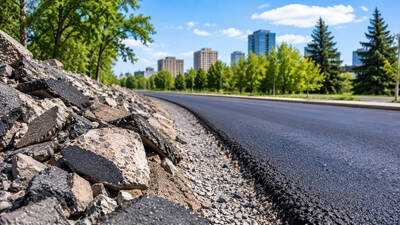 , the cost of the recycled design was around $268,000 cheaper than the traditional alternative. Further laboratory analysis proved that the stabilised recycled material exhibited 47% lower radial microstrain when subjected to high stress as compared to conventional granular base. There were huge amounts of reclaimed hot mix asphalt and Portland cement concrete left from previous road construction projects by the municipality. Initially, they were crushed and used as low-grade fill material. Green Streets Program was designed to evolve engineering specifications for their better utilisation in the road construction process.
How Saskatoon reused old road materials
The project known as 8th Street East was carried out on a particular segment of road. In the southeast of Saskatoon, this road suffered from fatigue cracks and moisture damage under the surface. The investigation focused on the use of recycled materials to improve the road. The project involved the pavement structure across the road. A separate study, "City of Saskatoon Mechanic Pavement Structure Modelling", explained that the right turn lane had suffered structural failure because of drainage problems and a wet subgrade. That lane received a recycled pavement design that included a 300 millimetre layer of crushed Portland cement concrete to improve drainage. The driving and median lanes were rehabilitated using other recycled pavement structures. The wider 540-metre rehabilitation project was examined in the 2011 TAC paper "Sustainability Case Study Review of Using Recycled Aggregate in Road Structure", written by Marlis Foth, Rielle Haichert, Duane Guenther and Curtis Berthelot. The researchers assessed the work across four areas: economic, environmental, social and technical sustainability.
Laboratory tests showed less strain under heavy loading
Comparison was made between the mechanical properties of the recycled and conventional road construction materials. Radial microstrain was one of the tests performed. It reflected the degree of deformation of a material exposed to stress. The stabilised recycled granular base exhibited 29% lower radial microstrain compared to the conventional granular base, according to their findings. Under laboratory conditions, under the impact of high stress, the result was even better. There was 47% less radial microstrain. In addition, the researchers found out that the stabilised material possessed 59% higher stiffness than the conventional granular base.
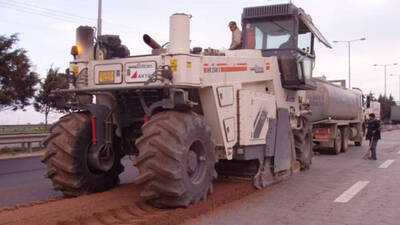 This finding demonstrated that the addition of cement and asphalt emulsion to recycled material could positively affect its performance, especially when there is heavy traffic. These were only laboratory findings and not proof of 47% less strain for the whole road under the usual traffic load. There was another comparison done in field testing. Researchers used the heavy weight deflectometer to measure the deflection response of the road under load. The recycled pavement section demonstrated deflection values equal to or even lower than those of the adjacent conventionally constructed pavement section.
The rehabilitation cost was about $268,000 less
Comparing the cost of construction for the recycled pavement design to a cost estimate for a conventional design, the TAC study found that the recycled construction cost $350,306 in 2009, while the conventional design cost an estimated $618,516. The difference between the two was approximately $268,000. Shorter transportation distance reduced utilisation of virgin aggregate and no landfill fees were cited by the researchers as factors contributing to the lower cost.
In addition, recycled construction required 215,649 megajoules of energy, whereas the conventional design needed 343,209 megajoules. It was estimated by the researchers that the amount of energy saved by using recycled construction materials was 127,560 megajoules. In addition, it was pointed out by the authors of the paper that local availability of recycled material could result in a reduction of emissions related to the transportation of construction material over long distances. The Saskatoon project was an example of how the reclaimed asphalt and concrete could be recycled and reused in road construction.
How Saskatoon reused old road materials
The project known as 8th Street East was carried out on a particular segment of road. In the southeast of Saskatoon, this road suffered from fatigue cracks and moisture damage under the surface. The investigation focused on the use of recycled materials to improve the road. The project involved the pavement structure across the road. A separate study, "City of Saskatoon Mechanic Pavement Structure Modelling
Laboratory tests showed less strain under heavy loading
Comparison was made between the mechanical properties of the recycled and conventional road construction materials. Radial microstrain was one of the tests performed. It reflected the degree of deformation of a material exposed to stress. The stabilised recycled granular base exhibited 29% lower radial microstrain compared to the conventional granular base, according to their findings. Under laboratory conditions, under the impact of high stress, the result was even better. There was 47% less radial microstrain. In addition, the researchers found out that the stabilised material possessed 59% higher stiffness than the conventional granular base.
The rehabilitation cost was about $268,000 less
Comparing the cost of construction for the recycled pavement design to a cost estimate for a conventional design, the TAC study found that the recycled construction cost $350,306 in 2009, while the conventional design cost an estimated $618,516. The difference between the two was approximately $268,000. Shorter transportation distance reduced utilisation of virgin aggregate and no landfill fees were cited by the researchers as factors contributing to the lower cost.
In addition, recycled construction required 215,649 megajoules of energy, whereas the conventional design needed 343,209 megajoules. It was estimated by the researchers that the amount of energy saved by using recycled construction materials was 127,560 megajoules. In addition, it was pointed out by the authors of the paper that local availability of recycled material could result in a reduction of emissions related to the transportation of construction material over long distances. The Saskatoon project was an example of how the reclaimed asphalt and concrete could be recycled and reused in road construction.
Next Story