
US Republicans may join Democrats to challenge Trump's sweeping tariff policies


Republican lawmakers are signalling a growing willingness to challenge President Donald Trump's sweeping tariff policies , with some open to rolling back individual levies and reconsidering the powers delegated to the White House on trade. The shift could offer Democrats an opportunity to build bipartisan support for reversing parts of Trump's tariff agenda when they take control of Congress .
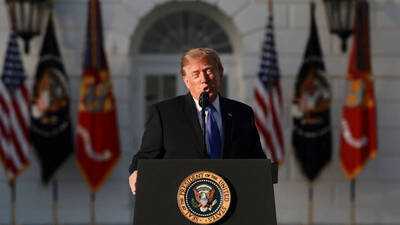
Several Republicans have said they would consider repealing tariffs on a case-by-case basis, particularly those that have raised costs for American businesses, farmers and consumers. Some have also suggested that Congress should re-examine the authority it has handed the executive branch to impose import duties, although there is little appetite for a blanket restriction on Trump's powers, reported Associated Press.
“A rethink is indeed in order,” Indiana Republican Senator Todd Young said, adding that he would push for “the most consumer friendly tariff approaches”.
Representative Michael Guest of Mississippi also indicated that he could find common ground with Democrats on some measures. “I would personally be opposed to just a blanket restriction on the president's ability to impose tariffs,” he said. “But I would be willing to look at it on a case-by-case basis based on what the Democrats may bring forward.”
The Republican reservations come as Trump continues to expand his trade offensive. The administration on Wednesday proposed fresh tariffs targeting China, the European Union, Japan, South Korea, Taiwan and nine other major trading partners, adding to the sweeping import duties that have become a defining feature of his second term.
Trump, who has called himself “Mr. Tariff”, has defended the levies as a way to revive American manufacturing, strengthen domestic industries and gain leverage over trading partners. However, the duties have also raised costs for businesses reliant on imported goods, with some of the burden being passed on to consumers.
The Republican shift marks a departure from the party's traditional support for free trade, particularly as concerns over affordability have emerged as a major political issue. Several lawmakers have acknowledged that tariffs could have contributed to the cost-of-living pressures that hurt Republicans in the recent midterm elections.
Canada tariffs could be an early test
One possible area of bipartisan agreement is Trump's tariffs on Canada. Democrats have already identified the levies as an early target, arguing that they have strained relations with a major trading partner and invited retaliatory measures.
Republican Senator John Kennedy of Louisiana, who supports tariffs on China but had not backed earlier efforts to repeal the Canadian levies, said: “Tariffs with respect to Canada don't make sense to me.”
Young also said he was open to different approaches to the Canadian tariffs , suggesting that Congress should have a greater role in trade negotiations, particularly as the US prepares to renew the US-Mexico-Canada Agreement (USMCA).
“The USMCA process seems to work if Congress is actively involved and not patted on the head,” he said.
Republican Senator Mike Rounds of South Dakota also backed a fresh examination of the powers Congress has delegated to the executive branch over tariffs.
“There's nothing wrong with Congress taking a second look at whether or not those authorities should be withdrawn, modified, at least reconsidered, or limited,” he said.
Republicans divided over how far to go
The growing willingness to question Trump's trade policies does not necessarily mean Republicans are ready to support a broad rollback. Some lawmakers have warned against abandoning tariffs altogether.
Senator Josh Hawley of Missouri said he was concerned that Republicans could overcorrect in response to the election results. “I bet a lot of my Republican colleagues will be happy to join Democrats and get rid of a bunch of them, which makes me just a little nervous that it's going to be a dramatic pendulum swing,” he said.
Others have pointed to the impact on businesses in their constituencies. Representative Steve Womack of Arkansas said tariffs had contributed to affordability concerns, particularly for producers dependent on imported materials and goods.
“I have producers in my district that lament the fact that they're paying higher for goods that can't be sourced domestically,” he said.
Republican voters are also divided over the impact of Trump's tariff policies. According to the AP Voter Poll, around half of voters who backed Republican candidates in their local House races said the tariffs had helped the national economy, while about three in 10 said they had hurt it. Around one-quarter said they had made no difference.
Democrats see an opening, but Trump's veto remains a hurdle
For Democrats, the growing reservations among some Republicans could provide an opportunity to secure bipartisan support for challenging Trump's trade agenda after they take control of Congress.
Incoming Senate Finance Committee Chairman Ron Wyden has identified the Canadian tariffs as a priority, but said a successful effort to repeal them could build momentum for challenging other levies.
“If we're successful in repealing the Canadian tariffs, we'll have some momentum for going after other tariffs,” Wyden said.
Incoming House Ways and Means Committee Chairman Richard Neal also described reversing the Canadian tariffs as a possible starting point, while arguing that Congress needed to examine Trump's broader use of tariffs.
However, any legislative effort faces a major obstacle: Trump's veto. Overriding it would require a two-thirds majority in both chambers, a difficult threshold even with Democrats set to hold a 56-seat majority in the Senate.
Republican Senator Rand Paul of Kentucky, who has consistently opposed tariffs, said repeal measures would have to be attached to must-pass legislation to have a realistic chance of becoming law.
“On its own, he'll just veto it,” Paul said.
Whether Republicans are willing to translate their criticism into legislative action could offer an early indication of how much the election losses and Trump's approaching lame-duck status have weakened his hold over the party.
Next Story