
Beyond the Clock: The Astronomy Behind the Panchangam and Traditional Time

Open any Vedic almanac (panchangam) and you will notice how closely traditional timekeeping stays tied to the sky and to celestial motion. While a new vara (weekday) in traditional Hindu convention begins at sunrise, a tithi follows its own lunar-solar rhythm shifting whenever the Moon pulls ahead of the Sun by another 12 degrees of longitude, day or night.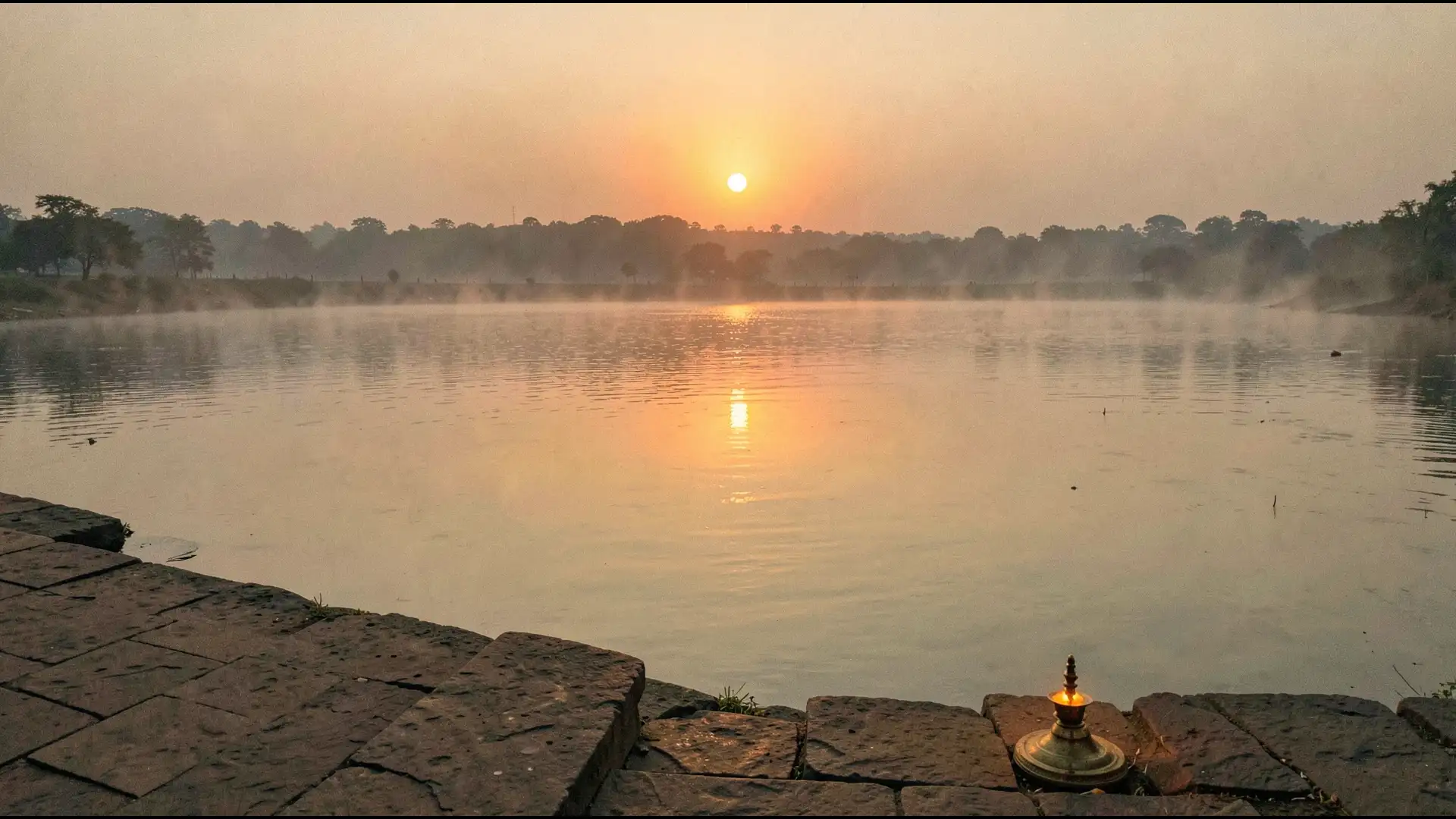
Midnight, by contrast, is an invisible threshold. No natural phenomenon announces it. It is a bureaucratic convenience, standardised in its current global form in the nineteenth and twentieth centuries when railways, telegraphs, and international time zones demanded synchronised clocks across long distances.
Traditional Indian astronomy (Jyotisha and the Siddhantas) predates modern clock standardisation by millennia. Its astronomers were not indifferent to precision; they were extraordinarily precise, pairing sky observation with mathematical astronomy, shadow gnomons (shanku), and water clocks (ghati yantra) to track time accurately across day and night.
A tithi, on the other hand, is a lunar day one-thirtieth of a synodic lunar month defined by every 12 increase in the longitudinal distance between the Moon and the Sun. Because the Moon and Sun move continuously at varying speeds, a tithi can start or end at any hour of the day or night, and its duration varies. A single tithi may even be current at two consecutive sunrises, or two tithis may begin and end within one day.
In panchangam tradition, the tithi prevailing at sunrise (Udaya Tithi) is commonly highlighted as the primary tithi associated with that day's observance, while the almanac also lists the exact start and end times of every tithi as the Sun and Moon move.
In Hindu tradition, sunrise holds special significance in ritual and panchangam reckoning as the transition from night into daylight. Noon and midnight serve as midpoints of the day and night cycles rather than the traditional vara boundary.
Temple priests, astrologers, and households that follow traditional customs consult the panchangam for their specific locality (desha). Because sunrise times depend on latitude and longitude, a panchangam for Varanasi differs from one for Chennai on the same date, reflecting local celestial timing rather than a single global clock.
Modern midnight-to-midnight timekeeping makes global coordination effortless across distant regions. Traditional panchangam timekeeping preserves local sky-and-cycle conventions alongside precise astronomical calculation.
A Day Defined by Light
Vedic timekeeping is deeply rooted in observable nature and astronomical cycles. Sunrise marks the return of daylight and a natural shift from night to day in everyday life. In traditional panchangam practice, the vara - the day of the week named after the ruling celestial body changes at sunrise rather than at midnight.Midnight, by contrast, is an invisible threshold. No natural phenomenon announces it. It is a bureaucratic convenience, standardised in its current global form in the nineteenth and twentieth centuries when railways, telegraphs, and international time zones demanded synchronised clocks across long distances.
Traditional Indian astronomy (Jyotisha and the Siddhantas) predates modern clock standardisation by millennia. Its astronomers were not indifferent to precision; they were extraordinarily precise, pairing sky observation with mathematical astronomy, shadow gnomons (shanku), and water clocks (ghati yantra) to track time accurately across day and night.
Savana Dina and Tithi
In Jyotisha and Siddhanta astronomy, the savana dina is the civil or mean solar day traditionally measured from one sunrise to the next (often treated as a standard unit of 60 ghatikas in siddhantic calculations). It anchors the vara (weekday) and everyday ritual counting.A tithi, on the other hand, is a lunar day one-thirtieth of a synodic lunar month defined by every 12 increase in the longitudinal distance between the Moon and the Sun. Because the Moon and Sun move continuously at varying speeds, a tithi can start or end at any hour of the day or night, and its duration varies. A single tithi may even be current at two consecutive sunrises, or two tithis may begin and end within one day.
In panchangam tradition, the tithi prevailing at sunrise (Udaya Tithi) is commonly highlighted as the primary tithi associated with that day's observance, while the almanac also lists the exact start and end times of every tithi as the Sun and Moon move.
Why Sunrise Matters in Tradition
Different cultures have chosen different reference points to mark the start of a day or observance. Some traditions associate the liturgical or ritual shift with evening or dusk, such as Shabbat beginning at sundown on Friday in Jewish tradition.In Hindu tradition, sunrise holds special significance in ritual and panchangam reckoning as the transition from night into daylight. Noon and midnight serve as midpoints of the day and night cycles rather than the traditional vara boundary.
What This Means for a Birth Chart
In Vedic astrology (Jyotisha), a birth chart (kundli) is cast for the exact moment and place of birth—not frozen at the previous morning's sunrise.- Planetary positions are calculated continuously for the exact time of birth. A child born at 12:30 AM has planets at their astronomical positions for 12:30 AM, not those from dawn.
- Lagna (Ascendant) is the degree of the zodiac rising on the eastern horizon at the exact moment and location of birth, shifting roughly every two hours. A 12:30 AM birth uses the ascendant rising around 12:30 AM.
- Day labeling (vara) vs. chart math: Two astrologers calculating a chart for 12:30 AM for the same location and ayanamsa will arrive at the same planetary degrees and lagna. However, in traditional panchangam convention, that 12:30 AM moment still falls under the previous sunrise-to-sunrise vara (for example, Monday rather than Tuesday), whereas a modern clock date treats 12:30 AM as the start of Tuesday.
The Living Logic of the Panchangam
The sunrise-anchored vara is not merely a historical curiosity. It remains part of how every panchangam which tracks the five limbs (anga): tithi, nakshatra, yoga, karana, and vara organises traditional dates, festivals, and observances.Temple priests, astrologers, and households that follow traditional customs consult the panchangam for their specific locality (desha). Because sunrise times depend on latitude and longitude, a panchangam for Varanasi differs from one for Chennai on the same date, reflecting local celestial timing rather than a single global clock.
Modern midnight-to-midnight timekeeping makes global coordination effortless across distant regions. Traditional panchangam timekeeping preserves local sky-and-cycle conventions alongside precise astronomical calculation.