
Vakri Graha: Why Planets Appear to Move Backwards in the Sky

On most nights, the planets drift slowly eastward against the backdrop of stars. Then, for weeks or months at a stretch, one of them appears to slow down, stop, and drift back the way it came.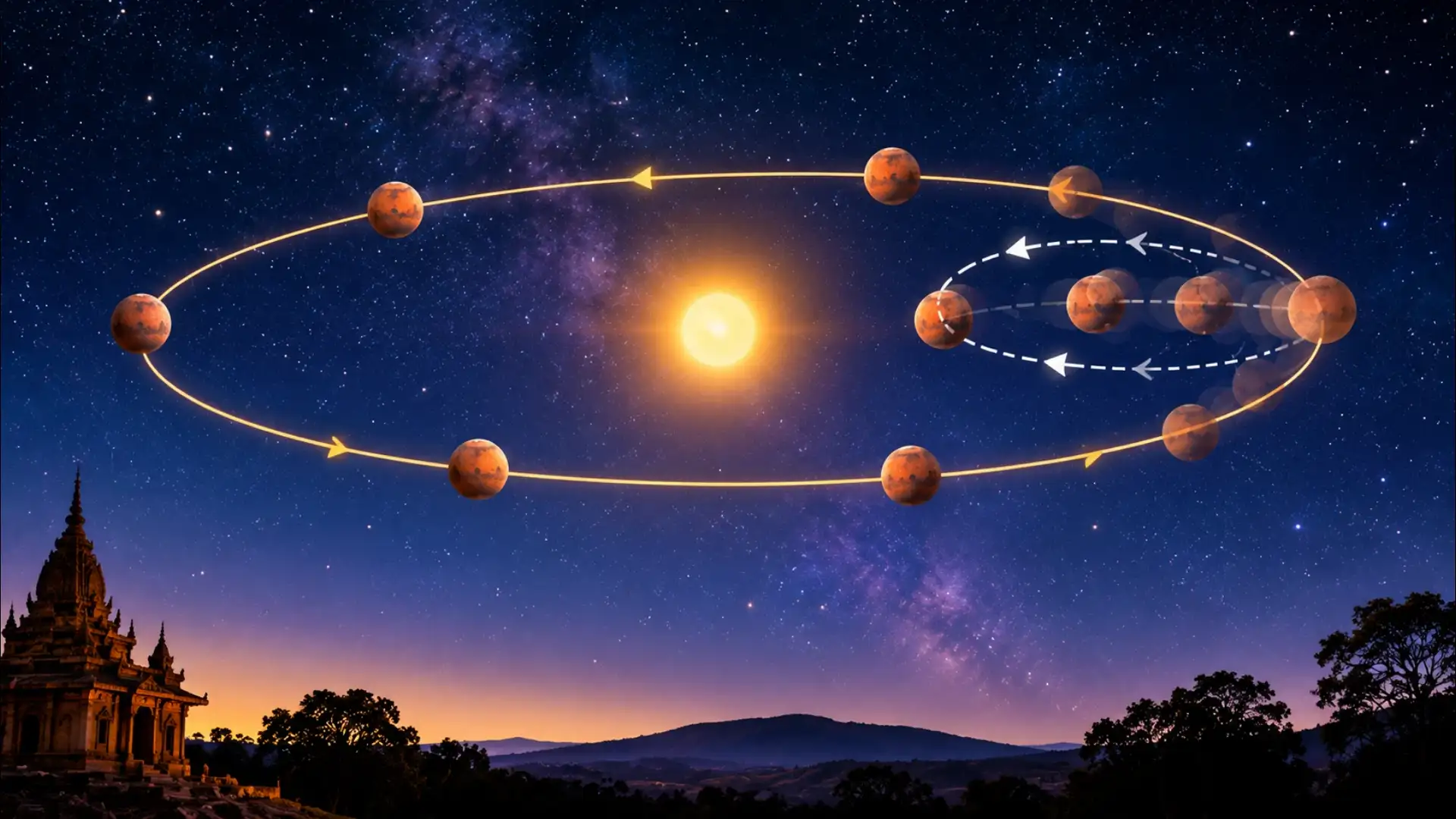
Ancient sky-watchers across every civilisation noticed this and found it deeply unsettling. In Vedic astrology, this apparent reversal is called vakri gati, and a planet in this state is a vakri graha .
The tradition treats it as one of the most significant conditions a planet can be in, a shift in how its energy expresses itself in a birth chart or in the world at large.
The clearest way to picture it: imagine two runners on a circular track, one on an inner lane and one on an outer lane. The inner runner moves faster. As she overtakes the outer runner, the outer runner appears, from her perspective, to drift backwards relative to the stands behind him, even though he is still moving forward.
Earth plays the role of the faster inner runner whenever it overtakes an outer planet like Mars, Jupiter, or Saturn. For inner planets like Mercury and Venus, the geometry is slightly different but the principle is the same: a change in relative position creates the illusion of backward motion.
Astronomers call this retrograde motion. The points where a planet appears to pause before reversing are called its stationary points. The phenomenon is entirely predictable and follows from the geometry of elliptical orbits.
The tradition holds that vakri planets are, in a sense, intensified, their significations become more pronounced, more inward-looking, or more complex to read. Kundali readings that include a vakri graha typically note it as a condition requiring more careful interpretation rather than a straightforward positive or negative marker.
Classical texts describe vakri planets as having a kind of heightened potency. Some traditions within Jyotish hold that a vakri planet in its own sign or exaltation sign becomes particularly strong. Others emphasise that the planet's themes, whatever the graha naturally governs, become subjects of deeper reflection or revisiting in a person's life.
The interpretation varies between schools, and experienced practitioners read the full chart rather than treating a single vakri placement in isolation.
It is worth knowing which planets can be vakri. The Sun and Moon never appear to go retrograde from Earth because of their orbital relationship with our planet. Among the others, Mercury goes vakri most frequently, several times a year, while Saturn's retrograde periods are the longest, sometimes stretching close to five months.
These stations were observed and recorded with considerable precision by ancient Indian astronomers, whose computational methods for predicting planetary positions were sophisticated enough to track these turning points across years and decades.
The Surya Siddhanta and other foundational texts of Indian astronomy treat retrograde motion as a natural feature of planetary movement, one that their mathematical models accounted for directly.
The astronomical and the astrological traditions in India developed together, and the concept of vakri gati sits at the boundary between them, a real observable phenomenon that the astrological tradition then interpreted for human significance.
The orbital explanation answers what is physically occurring between the planets and the Sun. The Jyotish framework answers a different question: given that this observable shift happens, what meaning does the tradition assign to it in the context of a birth chart or a moment in time.
Many readers find both layers genuinely interesting. The geometry of orbits is elegant on its own terms, the fact that an inner planet overtaking an outer one creates a predictable optical reversal is a beautiful consequence of how gravity shapes motion. The astrological layer adds a human dimension that has been part of Indian intellectual and cultural life for well over a thousand years.
Understanding the mechanics does not dissolve the tradition, and accepting the tradition does not require ignoring the mechanics. They describe different things, and knowing both gives a fuller picture of why this particular celestial event has held human attention for so long.
Every culture that watched the sky carefully enough eventually noticed that planets do not march steadily forward. The Indian tradition gave the phenomenon a name, a theory, and a place in one of the world's oldest continuous systems of sky interpretation.
The orbit that produces the illusion and the chart that reads its meaning are, in their own ways, both attempts to make sense of the same wandering light.
Disclaimer: Retrograde motion is an astronomical phenomenon explained by the relative movement of planets. Astrological interpretations of Vakri Graha are based on traditional Vedic astrology and are not scientifically proven. These interpretations should be viewed as cultural beliefs rather than factual predictions.
Ancient sky-watchers across every civilisation noticed this and found it deeply unsettling. In Vedic astrology, this apparent reversal is called vakri gati, and a planet in this state is a vakri graha .
The tradition treats it as one of the most significant conditions a planet can be in, a shift in how its energy expresses itself in a birth chart or in the world at large.
What Is Actually Happening in the Sky
No planet genuinely reverses course. Every planet in the solar system orbits the Sun in the same direction, and none of them stop or turn around. What changes is the angle from which we observe them from Earth, which is itself a moving platform.The clearest way to picture it: imagine two runners on a circular track, one on an inner lane and one on an outer lane. The inner runner moves faster. As she overtakes the outer runner, the outer runner appears, from her perspective, to drift backwards relative to the stands behind him, even though he is still moving forward.
Earth plays the role of the faster inner runner whenever it overtakes an outer planet like Mars, Jupiter, or Saturn. For inner planets like Mercury and Venus, the geometry is slightly different but the principle is the same: a change in relative position creates the illusion of backward motion.
Astronomers call this retrograde motion. The points where a planet appears to pause before reversing are called its stationary points. The phenomenon is entirely predictable and follows from the geometry of elliptical orbits.
How Vedic Astrology Reads a Vakri Graha
In Vedic astrology, a planet that is vakri is understood to carry a different quality of influence than one moving in its normal direct course.The tradition holds that vakri planets are, in a sense, intensified, their significations become more pronounced, more inward-looking, or more complex to read. Kundali readings that include a vakri graha typically note it as a condition requiring more careful interpretation rather than a straightforward positive or negative marker.
Classical texts describe vakri planets as having a kind of heightened potency. Some traditions within Jyotish hold that a vakri planet in its own sign or exaltation sign becomes particularly strong. Others emphasise that the planet's themes, whatever the graha naturally governs, become subjects of deeper reflection or revisiting in a person's life.
The interpretation varies between schools, and experienced practitioners read the full chart rather than treating a single vakri placement in isolation.
It is worth knowing which planets can be vakri. The Sun and Moon never appear to go retrograde from Earth because of their orbital relationship with our planet. Among the others, Mercury goes vakri most frequently, several times a year, while Saturn's retrograde periods are the longest, sometimes stretching close to five months.
The Stations: Marga and Vakra
In classical Jyotish literature, the moment a planet slows to apparent stillness before reversing is called its station. Sanskrit texts distinguish between the point of going vakri and the point of turning direct again.These stations were observed and recorded with considerable precision by ancient Indian astronomers, whose computational methods for predicting planetary positions were sophisticated enough to track these turning points across years and decades.
The Surya Siddhanta and other foundational texts of Indian astronomy treat retrograde motion as a natural feature of planetary movement, one that their mathematical models accounted for directly.
The astronomical and the astrological traditions in India developed together, and the concept of vakri gati sits at the boundary between them, a real observable phenomenon that the astrological tradition then interpreted for human significance.
Why the Same Phenomenon Has Two Explanations
It is tempting to treat the orbital-mechanics explanation and the Jyotish interpretation as competing answers to the same question. They are not quite that.The orbital explanation answers what is physically occurring between the planets and the Sun. The Jyotish framework answers a different question: given that this observable shift happens, what meaning does the tradition assign to it in the context of a birth chart or a moment in time.
Many readers find both layers genuinely interesting. The geometry of orbits is elegant on its own terms, the fact that an inner planet overtaking an outer one creates a predictable optical reversal is a beautiful consequence of how gravity shapes motion. The astrological layer adds a human dimension that has been part of Indian intellectual and cultural life for well over a thousand years.
Understanding the mechanics does not dissolve the tradition, and accepting the tradition does not require ignoring the mechanics. They describe different things, and knowing both gives a fuller picture of why this particular celestial event has held human attention for so long.
Every culture that watched the sky carefully enough eventually noticed that planets do not march steadily forward. The Indian tradition gave the phenomenon a name, a theory, and a place in one of the world's oldest continuous systems of sky interpretation.
The orbit that produces the illusion and the chart that reads its meaning are, in their own ways, both attempts to make sense of the same wandering light.
Disclaimer: Retrograde motion is an astronomical phenomenon explained by the relative movement of planets. Astrological interpretations of Vakri Graha are based on traditional Vedic astrology and are not scientifically proven. These interpretations should be viewed as cultural beliefs rather than factual predictions.
Next Story