
What Dreaming of Flowers Means in Indian Dream Belief

A garland of marigolds at a temple threshold, a lotus rising from still water, a jasmine strand woven into hair, flowers are woven into Indian life at every significant moment. It is no surprise, then, that Indian dream tradition pays close attention when flowers appear in sleep.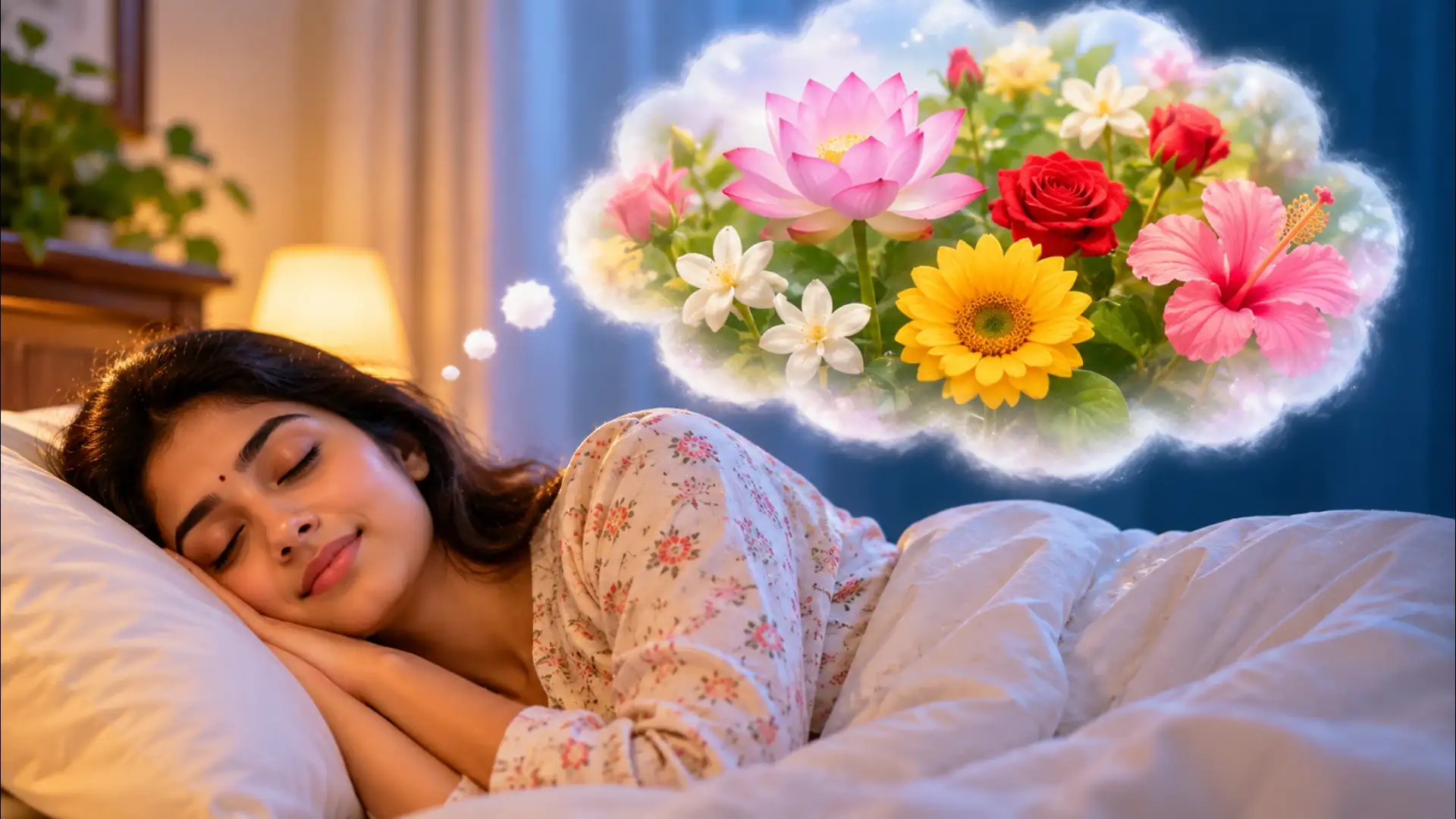
Sapno ka arth, the art of reading dream meaning, draws from Vedic astrology, folk belief, and texts like the Swapna Shastra, a body of traditional Indian knowledge concerned with what dreams reveal about the dreamer's inner world. The tradition does not claim certainty. It offers a framework through which people have long made sense of vivid or recurring dream images.
Dreaming of a lotus in full bloom is widely interpreted in this tradition as a sign of inner clarity emerging after a period of confusion or difficulty. The flower does not promise an outcome, it describes a state of mind the dreamer may be moving toward.
Jasmine carries a different register: its association with fragrance, with the unseen, with something that reaches you before you can see it. Dreams of jasmine are sometimes interpreted as a signal to pay attention to what is being felt rather than what is being seen.
A bouquet that crumbles in the hand is sometimes read as a symbol of something the dreamer is holding onto past its time. The tradition frames this as an invitation to let go, not a warning of loss.
A dream full of red blooms is read in this tradition as a reflection of something felt powerfully, something the waking mind may be keeping quiet.
Offering flowers, especially at a temple or a sacred space within the dream, is interpreted as the dreamer's own sense of gratitude or devotion finding expression. The tradition reads the gesture as meaningful in itself, independent of what follows from it.
What Indian dream tradition offers is not a prediction but a mirror. The flowers that appear in sleep reflect something the dreamer already carries, a feeling, a question, a readiness.
Whether one reads these symbols through Vedic astrology, Swapna Shastra, or the quieter current of folk belief passed down through families, the underlying idea is the same: the dreaming mind speaks in images, and flowers have always been among its oldest words.
Disclaimer: Dream interpretations mentioned in this article are based on traditional Indian beliefs, folk customs and astrological practices. They are not scientifically proven and should be viewed as cultural interpretations rather than predictions of future events.
Sapno ka arth, the art of reading dream meaning, draws from Vedic astrology, folk belief, and texts like the Swapna Shastra, a body of traditional Indian knowledge concerned with what dreams reveal about the dreamer's inner world. The tradition does not claim certainty. It offers a framework through which people have long made sense of vivid or recurring dream images.
The Lotus: Purity and Inner Clarity
In Indian dream tradition, the lotus is among the most auspicious flowers to see in sleep. Vastu and Vedic belief associate it with Lakshmi and Saraswati, and its symbolism rests on a familiar idea: something beautiful rising from muddy water without being touched by it.Dreaming of a lotus in full bloom is widely interpreted in this tradition as a sign of inner clarity emerging after a period of confusion or difficulty. The flower does not promise an outcome, it describes a state of mind the dreamer may be moving toward.
Marigolds and Jasmine: Devotion and Auspiciousness
Marigolds appear at every threshold, every puja, every wedding garland. In lok manyata, popular folk belief, dreaming of marigolds is read as a sign of devotion, of something sacred being honoured. Some regional traditions hold that seeing bright orange or yellow flowers in a dream signals a period of warmth and goodwill in one's relationships, though the tradition is careful to frame this as atmosphere rather than guarantee.Jasmine carries a different register: its association with fragrance, with the unseen, with something that reaches you before you can see it. Dreams of jasmine are sometimes interpreted as a signal to pay attention to what is being felt rather than what is being seen.
Withered or Fallen Flowers: A Prompt for Reflection
Not all flower dreams are read as auspicious. Swapna Shastra tradition holds that wilted, fallen, or scattered flowers are worth reflecting on, not as omens of doom, but as the tradition's way of nudging the dreamer toward something unresolved.A bouquet that crumbles in the hand is sometimes read as a symbol of something the dreamer is holding onto past its time. The tradition frames this as an invitation to let go, not a warning of loss.
Red Flowers and the Language of Emotion
Red flowers, roses, hibiscus, the red variety of the lotus, carry a strong emotional charge in Indian symbolic language. In dream belief, they are often associated with deep feeling: love, longing, or an intensity of emotion that has not yet been expressed. Ank jyotish and colour symbolism both assign red to passion and to the planet Mars, which governs energy and will.A dream full of red blooms is read in this tradition as a reflection of something felt powerfully, something the waking mind may be keeping quiet.
Receiving or Offering Flowers in a Dream
The action within the dream matters as much as the flower itself. Receiving flowers is generally read in lok manyata as a sign of goodwill coming toward the dreamer, affection, recognition, or care from someone in their life.Offering flowers, especially at a temple or a sacred space within the dream, is interpreted as the dreamer's own sense of gratitude or devotion finding expression. The tradition reads the gesture as meaningful in itself, independent of what follows from it.
What Indian dream tradition offers is not a prediction but a mirror. The flowers that appear in sleep reflect something the dreamer already carries, a feeling, a question, a readiness.
Whether one reads these symbols through Vedic astrology, Swapna Shastra, or the quieter current of folk belief passed down through families, the underlying idea is the same: the dreaming mind speaks in images, and flowers have always been among its oldest words.
Disclaimer: Dream interpretations mentioned in this article are based on traditional Indian beliefs, folk customs and astrological practices. They are not scientifically proven and should be viewed as cultural interpretations rather than predictions of future events.
Next Story