
What Is the Three-Second Rule in Driving? A Simple Way to Maintain a Safe Distance

Every driver knows they should leave a gap. Almost no driver knows how big that gap actually needs to be at highway speeds. A car length, two car lengths, a comfortable distance, these are impressions, and impressions shrink the moment attention drifts or speed climbs.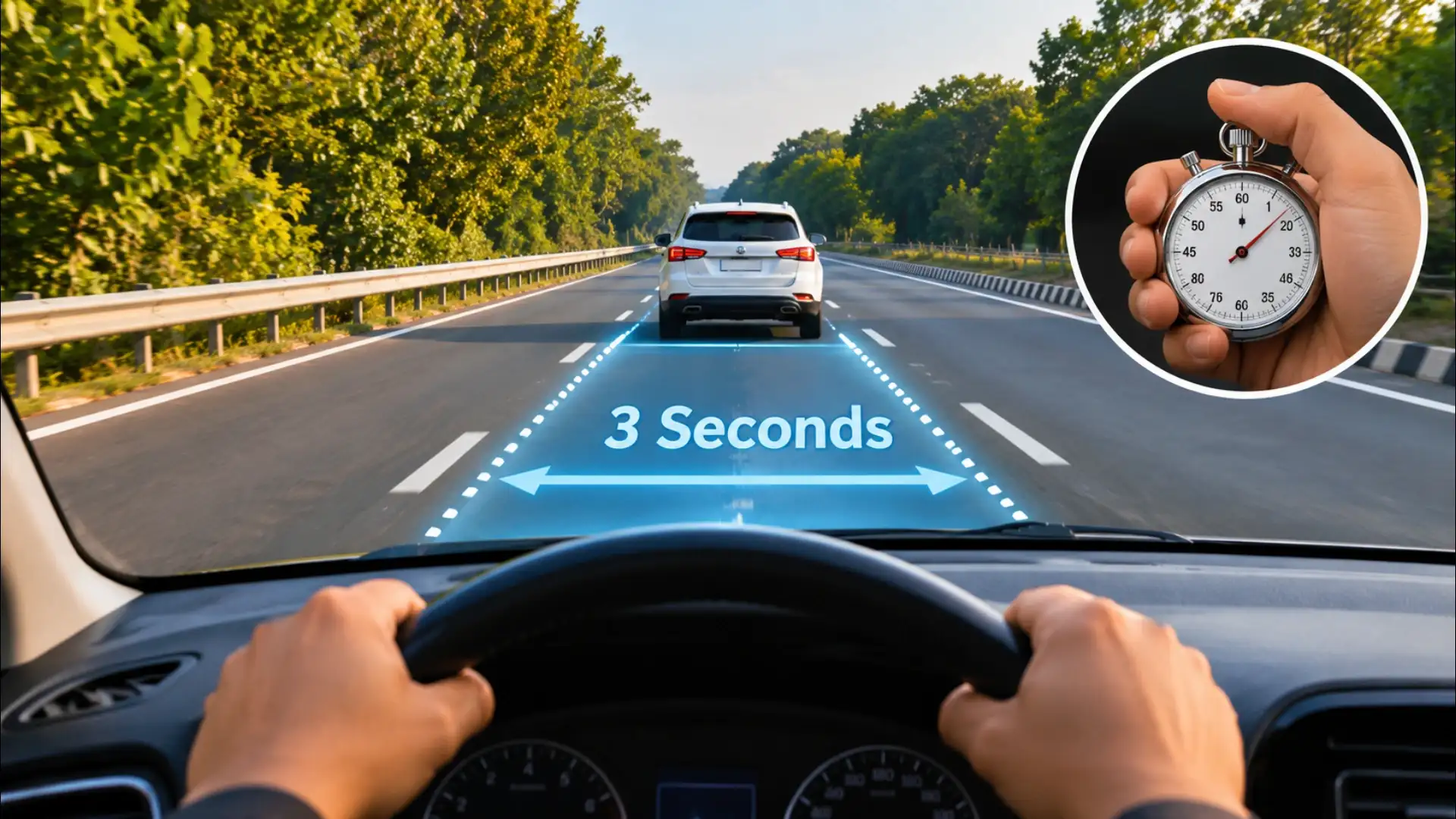
The three-second rule replaces guesswork with a method that scales automatically with speed. It asks for nothing more than a fixed point on the road and the ability to count.
That is the complete rule. No calculation, no conversion. At 80 km/h, three seconds gives roughly 67 metres. At 100 km/h, it gives roughly 83 metres. The count stays the same; the distance stretches automatically because you are covering more ground per second. This is precisely why a fixed number of car lengths fails on a highway, a car length at 60 km/h is very different from a car length at 120 km/h.
Perception and reaction together consume roughly 1.5 seconds for an alert driver. In that time alone, a vehicle at 100 km/h covers about 42 metres. The remaining 1.5 seconds covers the early phase of braking. Three seconds is therefore a floor, not a comfortable buffer.
In rain, the braking distance of a car on wet asphalt roughly doubles. In fog, the hazard appears later. On a gradient, stopping takes longer. In any of these conditions, four or five seconds is the appropriate count. The rule does not change; the count does.
The danger is not just the distance. It is what the short gap does to the driver's field of view. When a vehicle is close behind the one ahead, the driver can see only the back of that vehicle. Road surface, debris, animals, and the brake lights of vehicles two or three places ahead all disappear. The driver is reacting to the car directly in front rather than reading the road. By the time that car's brake lights come on, the gap is already gone.
A three-second gap restores the view. The driver can see past the vehicle ahead, spot brake lights two vehicles forward, and begin to ease off the accelerator before any emergency develops.
A vehicle that merges into your gap has, in most cases, created a new gap between itself and the vehicle ahead of it. Your effective following distance has changed in composition but not necessarily in total stopping time. If the merged vehicle is shorter than your previous gap, you may still have close to three seconds. If it is a truck or a bus, count again from the new fixed point and ease back if needed.
Closing the gap to punish a merge is the single most common way a three-second rule driver abandons the rule under social pressure. The gap is not a possession. It is time, and time is what keeps the vehicle and everyone in it intact.
The three-second rule replaces guesswork with a method that scales automatically with speed. It asks for nothing more than a fixed point on the road and the ability to count.
What the Rule Actually Says
Watch the vehicle ahead pass a fixed point on the road, a shadow line, a crack, a kilometre marker, a bridge pillar. Count to three at a steady pace. If your front bumper reaches that same point before you finish counting, you are too close.That is the complete rule. No calculation, no conversion. At 80 km/h, three seconds gives roughly 67 metres. At 100 km/h, it gives roughly 83 metres. The count stays the same; the distance stretches automatically because you are covering more ground per second. This is precisely why a fixed number of car lengths fails on a highway, a car length at 60 km/h is very different from a car length at 120 km/h.
Why Three Seconds Is the Minimum, Not the Target
The three-second gap covers the mechanical reality of stopping a vehicle in good conditions. It accounts for the distance your car travels during perception time, the moment between seeing a hazard and your foot reaching the brake, and the distance covered during actual braking.You may also like
- Maserati Grecale: 2026 facelift launches at Rs 1.14 crore, but will the new V6 variant impress?
- Can You Drive at 144 kmph Without Getting a Challan? Nitin Gadkari's Highway Speeding Remark Explained
- Has Your Car Crossed 2 Lakh Kilometres? Don't Sell It Just Yet! Here's What Actually Determines a Car's Life
- 100% Ethanol-Powered Cars Get Government Approval, But Where Will the Fuel Come From? Supreme Court Raises Big Questions
- Maruti Suzuki e-Vitara Creates History in Global Markets! Exports Cross 50,000 Units as Indian EV Demand Grows
Perception and reaction together consume roughly 1.5 seconds for an alert driver. In that time alone, a vehicle at 100 km/h covers about 42 metres. The remaining 1.5 seconds covers the early phase of braking. Three seconds is therefore a floor, not a comfortable buffer.
In rain, the braking distance of a car on wet asphalt roughly doubles. In fog, the hazard appears later. On a gradient, stopping takes longer. In any of these conditions, four or five seconds is the appropriate count. The rule does not change; the count does.
What Tailgating Actually Does to Your Stopping Distance
A driver following at one second, common in heavy highway traffic, has almost no stopping distance left after reaction time alone. At 80 km/h, one second is roughly 22 metres. A car in good condition needs more than that to stop from 80 km/h even after the brakes are already applied.The danger is not just the distance. It is what the short gap does to the driver's field of view. When a vehicle is close behind the one ahead, the driver can see only the back of that vehicle. Road surface, debris, animals, and the brake lights of vehicles two or three places ahead all disappear. The driver is reacting to the car directly in front rather than reading the road. By the time that car's brake lights come on, the gap is already gone.
A three-second gap restores the view. The driver can see past the vehicle ahead, spot brake lights two vehicles forward, and begin to ease off the accelerator before any emergency develops.
Keeping the Gap When Others Fill It
The most common frustration with the three-second rule on Indian highways is that other vehicles move into the gap. This is real, and the answer is to let them in and rebuild the gap rather than to close it again to prevent the merge.A vehicle that merges into your gap has, in most cases, created a new gap between itself and the vehicle ahead of it. Your effective following distance has changed in composition but not necessarily in total stopping time. If the merged vehicle is shorter than your previous gap, you may still have close to three seconds. If it is a truck or a bus, count again from the new fixed point and ease back if needed.
Closing the gap to punish a merge is the single most common way a three-second rule driver abandons the rule under social pressure. The gap is not a possession. It is time, and time is what keeps the vehicle and everyone in it intact.






Loving Newspoint? Download the app now
