
Adding gold to portfolio can boost returns without significantly increasing risk: WhiteOak study


Gold has traditionally been viewed as a safe-haven asset during periods of market uncertainty. While investors often use it as a hedge against inflation and geopolitical risks, a recent study suggests that gold can also play an important role in improving the risk-return profile of an investment portfolio when combined with equity and debt.
According to WhiteOak Capital's June 2026 edition of "Chemistry of Investing", adding gold to a portfolio alongside equity and debt has historically helped lower volatility while enhancing returns, highlighting the benefits of a diversified multi-asset allocation strategy.

Also Read | MF Tracker: How Edelweiss Large Cap Fund logged positive returns in the last 10 calendar years
The study challenges the common belief that adding equity to a debt portfolio automatically increases risk. Based on historical data from September 2001 to May 2026, a portfolio invested entirely in debt delivered an average annual return of 6.81% with a volatility of 6.38%.
Interestingly, adding a small equity allocation improved outcomes. A portfolio comprising 90% debt and 10% equity generated an average return of 8.02% while reducing volatility to 5.75%.
Similarly, a portfolio with 75% debt and 25% equity delivered an average annual return of 9.83%, significantly higher than the all-debt portfolio, while maintaining a similar level of volatility.
According to WhiteOak Capital, this demonstrates how a carefully balanced mix of asset classes can improve risk-adjusted returns rather than simply increasing risk.
The study found that portfolio outcomes improved further when gold was introduced as a third asset class. WhiteOak examined a portfolio consisting of 55% debt, 25% equity and 20% gold. The combination generated an average annual return of 11.61% with a volatility of 6.85%.
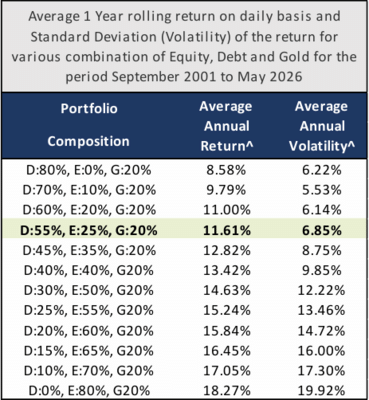
In comparison, the 75% debt and 25% equity portfolio delivered a return of 9.83% with volatility of 7.06%, while the 100% debt portfolio generated a return of 6.81% with volatility of 6.38%.
The report noted that the inclusion of gold shifted the return-volatility profile favourably, resulting in better risk-adjusted returns. According to the study, this highlights the benefits of combining low-correlated and negatively correlated asset classes within a portfolio.
The report pointed out that gold has historically exhibited a negative correlation with Indian equities. As a result, it has often acted as a cushion during periods when stock markets struggled.
The correlation analysis showed that Indian equities and gold correlated at -0.42 during the study period, indicating that the two asset classes frequently moved in opposite directions.
This diversification benefit becomes particularly valuable during periods of heightened market volatility, helping investors reduce portfolio fluctuations without sacrificing return potential.
To illustrate the concept, WhiteOak created a sample multi-asset portfolio with 25% domestic equity, 45% debt, 25% gold and 5% US equities, rebalanced annually.
Also Read | Planning a Rs 7 crore corpus in 12 years? Expert recommends active funds over index funds
The analysis showed that different asset classes outperformed in different market environments. For instance, gold delivered strong returns during periods when equities struggled, while equities led gains during market rallies.
According to the report, consistently predicting the best-performing asset class is extremely difficult. Therefore, maintaining exposure to multiple asset classes may help investors achieve a more balanced investment experience and improve long-term risk-adjusted returns.
According to WhiteOak Capital's June 2026 edition of "Chemistry of Investing", adding gold to a portfolio alongside equity and debt has historically helped lower volatility while enhancing returns, highlighting the benefits of a diversified multi-asset allocation strategy.
Also Read | MF Tracker: How Edelweiss Large Cap Fund logged positive returns in the last 10 calendar years
The study challenges the common belief that adding equity to a debt portfolio automatically increases risk. Based on historical data from September 2001 to May 2026, a portfolio invested entirely in debt delivered an average annual return of 6.81% with a volatility of 6.38%.
Interestingly, adding a small equity allocation improved outcomes. A portfolio comprising 90% debt and 10% equity generated an average return of 8.02% while reducing volatility to 5.75%.
Similarly, a portfolio with 75% debt and 25% equity delivered an average annual return of 9.83%, significantly higher than the all-debt portfolio, while maintaining a similar level of volatility.
According to WhiteOak Capital, this demonstrates how a carefully balanced mix of asset classes can improve risk-adjusted returns rather than simply increasing risk.
The study found that portfolio outcomes improved further when gold was introduced as a third asset class. WhiteOak examined a portfolio consisting of 55% debt, 25% equity and 20% gold. The combination generated an average annual return of 11.61% with a volatility of 6.85%.
In comparison, the 75% debt and 25% equity portfolio delivered a return of 9.83% with volatility of 7.06%, while the 100% debt portfolio generated a return of 6.81% with volatility of 6.38%.
The report noted that the inclusion of gold shifted the return-volatility profile favourably, resulting in better risk-adjusted returns. According to the study, this highlights the benefits of combining low-correlated and negatively correlated asset classes within a portfolio.
The report pointed out that gold has historically exhibited a negative correlation with Indian equities. As a result, it has often acted as a cushion during periods when stock markets struggled.
The correlation analysis showed that Indian equities and gold correlated at -0.42 during the study period, indicating that the two asset classes frequently moved in opposite directions.
This diversification benefit becomes particularly valuable during periods of heightened market volatility, helping investors reduce portfolio fluctuations without sacrificing return potential.
To illustrate the concept, WhiteOak created a sample multi-asset portfolio with 25% domestic equity, 45% debt, 25% gold and 5% US equities, rebalanced annually.
Also Read | Planning a Rs 7 crore corpus in 12 years? Expert recommends active funds over index funds
The analysis showed that different asset classes outperformed in different market environments. For instance, gold delivered strong returns during periods when equities struggled, while equities led gains during market rallies.
According to the report, consistently predicting the best-performing asset class is extremely difficult. Therefore, maintaining exposure to multiple asset classes may help investors achieve a more balanced investment experience and improve long-term risk-adjusted returns.
Next Story