
Elite form of coercion & extortion: Tenant fined Rs 5L


When a landlord decided to redevelop his property on L.B.S. Marg, Ghatkopar West, Mumbai, he faced resistance from over 60 tenants who were worried that he wouldn’t provide them with permanent residence or negotiate fairly.
That’s why the tenants took legal action, asking the court to enforce the rules outlined in Regulation 33(7)(A) of DCPR-2034 for reconstruction/development of the property. The tenant’s lawyer informed the court that their building measures 1498 sq. Yards,which is about 1,250.014 sq. meters.
The tenants’ advocate also mentioned that the landlord had supposedly hired a new builder who was actively involved in various redevelopment activities such as securing the IOD, obtaining the Fire NOC, executing plans, coordinating with tenants, and starting the groundwork for the project.
In court, the tenants argued that the landlord and the new builder held several meetings and discussions to reach a settlement, and during an inauguration ceremony, they allegedly signed a consent-cum-declarations in favour of the new builder, allowing it to construct a commercial building.
The tenants further claimed that these settlement discussions with the new builder went on for four to five months. However, during the negotiations between the landlord and the new builder, an extension was granted to the new builder as a gesture of support and cooperation for redevelopment of the landlord's property. This was done to ensure the financial and operational viability of the project.
The tenants also claimed the landlords haven’t kept the lines of communication open and haven’t provided any timeline for when the PAA agreements would be finalized. In these circumstances, the tenants decided to file yet another lawsuit to include the new builder in the ongoing redevelopment dispute.
Dr. Uday Warunjikar, the landlord’s advocate, told the court that he (the landlord) has not engaged or signed any contract with the new builder as claimed by the tenants. As such, the original builders continue. The landlord’s advocate told the court that adding the new builder as party to the redevelopment case would aggravate the dispute rather than resolving it.
When the Bombay High Court asked the tenants if the new builder had signed any agreement with the landlord and if they had proof, the tenants’ lawyer said no. The Bombay High Court said that prima facie it appears that the new builder has financed the present case filed by the tenants against the landlord to crystalise his unenforceable right against the landlord and the original builder.
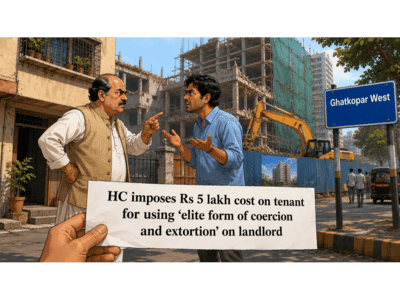
Thus on May 6, 2026, the Bombay High Court in an interim judgement, imposed Rs 5 lakh cost on tenants who had filed this case to make the new builder party to their pending redevelopment dispute case. The reason why the high court imposed this cost on tenants is because the tenants had failed to prove any privity of contract between the developer and the landlord.
The Bombay High Court observed that the tenant’s application was “nothing else but an elite form of coercion and extortion” and could be said to be an abuse of law.
The Bombay High Court also said that the new builder is using the tenants to put a pressure tactic on the landlord to compel him to acknowledge the new builder’s rights over redevelopment of this property, though they have no enforceable agreement either with the landlord or with the original builders.
It must be noted that the original redevelopment dispute case is still pending and this present article is not about that. The article is about the interim judgement where the tenants sought to add the new builder as a party to the pending redevelopment case.
The landlord was represented by Advocate Dr. Uday Warunjikar and Advocate Nitesh Bhutekar.
Bombay High Court discussion and order
The Bombay High Court (2026:BHC-OS:11633-DB) passed this order on May 6, 2026. A summary of the judgement is as follows:
Tenants have no right to implead new builder who did not sign a contract with landlord
After hearing both the tenants and landlord, the high court said that in their view, the tenants have no right to implead the new builder as a party to the redevelopment dispute case as the new builder has no privity of contract with the landlords in the present petition.
The high court said that doing so would only enlarge the issue and complicate it.
The high court said that it is settled law that the tenants’ rights are protected. In Chandralok People Welfare Association vs. State of Maharashtra & Ors. reported in 2023 SCC OnLine Bom 2300 and Anandrao G. Pawar vs. Municipal Corporation of Greater Mumbai and Ors. reported in 2023 SCC OnLine Bom 2534 , the Bombay High Court has elucidated the rights of the tenants.
In this background, the Bombay High Court asked the tenants’ advocate whether there was any binding contract between the new builder and the existing landlords. The tenants’ advocate answered in the negative and thus the high court said that the tenants’ present application would be a sheer abuse of process of law and nothing else but an “elite form of coercion and extortion”.
New Builder attempted to use pressure tactics on landlord
The Bombay High Court said that according to them, the present application is nothing else but a back-door entry attempted by the proposed respondent (new builder), through a seemingly innocuous application of being joined as a necessary party to the present petition.
The high court said that despite offering the new builder to consider withdrawing their application, the new builder insisted that the Bombay High Court should decide the Interim Application.
In these circumstances, the Bombay High Court said that they are compelled to draw an inference and record their observation that this application is nothing short of a pressure tactic employed by the proposed respondent (new builder) in the guise of an application by the petitioners (tenants) to compel the landlords to acknowledge the rights of the proposed respondent (new builder) though they have no enforceable agreement either with the landlord or with the original builders.
The Bombay High Court said that it is settled law that the courts are not meant to be tools in the hands of unscrupulous litigants to coerce or pressurize a party in any manner or form.
Order:
That’s why the tenants took legal action, asking the court to enforce the rules outlined in Regulation 33(7)(A) of DCPR-2034 for reconstruction/development of the property. The tenant’s lawyer informed the court that their building measures 1498 sq. Yards,which is about 1,250.014 sq. meters.
The tenants’ advocate also mentioned that the landlord had supposedly hired a new builder who was actively involved in various redevelopment activities such as securing the IOD, obtaining the Fire NOC, executing plans, coordinating with tenants, and starting the groundwork for the project.
In court, the tenants argued that the landlord and the new builder held several meetings and discussions to reach a settlement, and during an inauguration ceremony, they allegedly signed a consent-cum-declarations in favour of the new builder, allowing it to construct a commercial building.
The tenants further claimed that these settlement discussions with the new builder went on for four to five months. However, during the negotiations between the landlord and the new builder, an extension was granted to the new builder as a gesture of support and cooperation for redevelopment of the landlord's property. This was done to ensure the financial and operational viability of the project.
The tenants also claimed the landlords haven’t kept the lines of communication open and haven’t provided any timeline for when the PAA agreements would be finalized. In these circumstances, the tenants decided to file yet another lawsuit to include the new builder in the ongoing redevelopment dispute.
Dr. Uday Warunjikar, the landlord’s advocate, told the court that he (the landlord) has not engaged or signed any contract with the new builder as claimed by the tenants. As such, the original builders continue. The landlord’s advocate told the court that adding the new builder as party to the redevelopment case would aggravate the dispute rather than resolving it.
When the Bombay High Court asked the tenants if the new builder had signed any agreement with the landlord and if they had proof, the tenants’ lawyer said no. The Bombay High Court said that prima facie it appears that the new builder has financed the present case filed by the tenants against the landlord to crystalise his unenforceable right against the landlord and the original builder.
Thus on May 6, 2026, the Bombay High Court in an interim judgement, imposed Rs 5 lakh cost on tenants who had filed this case to make the new builder party to their pending redevelopment dispute case. The reason why the high court imposed this cost on tenants is because the tenants had failed to prove any privity of contract between the developer and the landlord.
The Bombay High Court observed that the tenant’s application was “nothing else but an elite form of coercion and extortion” and could be said to be an abuse of law.
The Bombay High Court also said that the new builder is using the tenants to put a pressure tactic on the landlord to compel him to acknowledge the new builder’s rights over redevelopment of this property, though they have no enforceable agreement either with the landlord or with the original builders.
It must be noted that the original redevelopment dispute case is still pending and this present article is not about that. The article is about the interim judgement where the tenants sought to add the new builder as a party to the pending redevelopment case.
The landlord was represented by Advocate Dr. Uday Warunjikar and Advocate Nitesh Bhutekar.
Bombay High Court discussion and order
Tenants have no right to implead new builder who did not sign a contract with landlord
After hearing both the tenants and landlord, the high court said that in their view, the tenants have no right to implead the new builder as a party to the redevelopment dispute case as the new builder has no privity of contract with the landlords in the present petition.
The high court said that doing so would only enlarge the issue and complicate it.
The high court said that it is settled law that the tenants’ rights are protected. In Chandralok People Welfare Association vs. State of Maharashtra & Ors. reported in 2023 SCC OnLine Bom 2300 and Anandrao G. Pawar vs. Municipal Corporation of Greater Mumbai and Ors. reported in 2023 SCC OnLine Bom 2534 , the Bombay High Court has elucidated the rights of the tenants.
In this background, the Bombay High Court asked the tenants’ advocate whether there was any binding contract between the new builder and the existing landlords. The tenants’ advocate answered in the negative and thus the high court said that the tenants’ present application would be a sheer abuse of process of law and nothing else but an “elite form of coercion and extortion”.
New Builder attempted to use pressure tactics on landlord
The Bombay High Court said that according to them, the present application is nothing else but a back-door entry attempted by the proposed respondent (new builder), through a seemingly innocuous application of being joined as a necessary party to the present petition.
The high court said that despite offering the new builder to consider withdrawing their application, the new builder insisted that the Bombay High Court should decide the Interim Application.
In these circumstances, the Bombay High Court said that they are compelled to draw an inference and record their observation that this application is nothing short of a pressure tactic employed by the proposed respondent (new builder) in the guise of an application by the petitioners (tenants) to compel the landlords to acknowledge the rights of the proposed respondent (new builder) though they have no enforceable agreement either with the landlord or with the original builders.
The Bombay High Court said that it is settled law that the courts are not meant to be tools in the hands of unscrupulous litigants to coerce or pressurize a party in any manner or form.
Order:
- It prima facie appears that the present application is moved and financed by the proposed respondent (new builder) to crystalize his unenforceable right against the respondents 3 to 5 and respondent 6 to 9. Such attempts to abuse the process of the court cannot be countenanced. The court therefore disallows the present application.
- Assuming that the new builder has some contractual obligations with the earlier developer, they have rights to sue them independently.
- The court accordingly dismissed the Application with costs of Rs 5 lakh to be paid to Bar Council of Maharashtra and Goa’s Advocate Academy and Research Center within a period of two weeks from the date of uploading of this Order on the official website of High Court, Bombay
- List the petition for reporting compliance on 15th June, 2026.
Next Story