
Employee wins 7.86L damages for lunch-break accident


When Mr Yashpal was working for a company in Bhalswa, Delhi he was assigned the work of a supervisor. On June 22, 2010 just as any other day, he completed his assigned work and was having his lunch in the work site. However, on this unfortunate day an iron rod carried by a mobile crane fell upon him resulting in grievous injuries. His colleagues immediately rushed him to hospital where he remained admitted for a considerable time period. Ultimately, the doctors had to amputate his left leg.
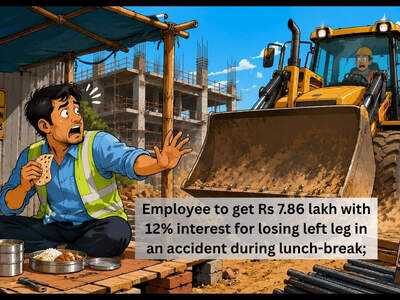
Mr Yashpal thus filed an application seeking compensation for his injuries since it arose during his employment and the injuries hinder his abilities. The Commissioner of Employees Compensation, Delhi heard his case (no. WC/113/NW/11/1175) and on April 28, 2016 ordered the insurance company to pay Rs 7.86 lakh with 12% interest per annum with effect from July 22, 2010 till it is paid under the Employee's Compensation Act, 1923.
The insurance company did not want to pay this compensation on the following grounds:
On July 23, 2026, Justice Manoj Kumar Ohri ruled that the insurance company has to pay the compensation to Yashpal as determined by the commissioner (Rs 7.86 lakh with 12% interest). The high court said that the accident suffered by Yashpal during his lunch break will be treated as arising out of and in the course of employment Employee's Compensation Act, 1923.
Why did the employee win the case
Advocate Mayank Parashar from Clasis Law says that the Delhi High Court ruled in favour of the employee getting compensation as the unfortunate accident happened to him during his lunch break. The high court clarified that the construction site where the employee was working and having his lunch does fall outside the scope of his course of employment.
Parashar also says that the Delhi High Court rejected the insurer’s argument about the injured employee being given the title of a supervisor. The high court said that in such cases what needs to be seen is the actual nature of work performed by the said employee rather than what is his designation.
Parashar also says that the high court accepted the Commissioner of Employees Compensation’s reliance placed on the medical evidence which says that the employee suffered 75% disability as his left leg had to be amputated.
Parashar says that under the new labor code (Occupational Safety, Health and Working Conditions Code, 2020) the law places a greater emphasis on preventive safety measures.
Delhi High Court order and discussion
A summary of the high court judgement (FAO 493/2016 and CM APPL. 37073/2016) is as follows:
Mere Supervisor designation is not conclusive to exclude Yashpal from employees
The high court observed that one of the grounds for rejection of compensation payment by the insurance company is that Yashpal is not an "employee" within the meaning of Section 2(dd).
The high court said that the mere designation assigned to a workman is not conclusive. What is relevant is the nature of duties actually discharged. Apart from the bald plea taken in the written statement, no material has been brought on record to establish that Yashpal was discharging managerial or administrative functions so as to exclude him from the purview of the Act.
Moreover, the Commissioner has accepted the evidence that Yashpal was engaged at the construction site and suffered injuries during the course of such employment. Thus the high court said that this finding being one of fact does not warrant interference in the present appeal.
Accident happened at worksite
A temporary break for taking meals doesn't sever the nexus between employment and the accident
The high court observed that the accident admittedly occurred at the work site while Yashpal was present there in connection with his employment.
The Delhi High Court said: "A temporary break for taking meals does not, by itself, sever the nexus between employment and the accident." Thus the high court said that the Commissioner rightly held the accident to have arisen out of and during the course of employment.
Other grounds of denial also rejected by high court
The high court also rejected the insurance company's contentions about Yashpal not being the employee of the crane operator. The high court said that the insurance company also did not establish any breach of the policy conditions nor showed any bar disentitling Yashpal from recovering compensation from them (insurer).
The high court also rejected the insurance company's objections about Yashpal's 75% disability claim as the disability certificate issued by the competent Medical Board assessed his permanent disability at 75% and the commissioner also accepted the medical evidence and assessed the loss of earning capacity accordingly.
Thus the high court held that the commissioner's order does not need any interference by the high court and ordered the insurance company to pay.
Mr Yashpal thus filed an application seeking compensation for his injuries since it arose during his employment and the injuries hinder his abilities. The Commissioner of Employees Compensation, Delhi heard his case (no. WC/113/NW/11/1175) and on April 28, 2016 ordered the insurance company to pay Rs 7.86 lakh with 12% interest per annum with effect from July 22, 2010 till it is paid under the Employee's Compensation Act, 1923.
The insurance company did not want to pay this compensation on the following grounds:
- Yashpal had no employee-employer relationship with the crane owner.
- The Commissioner of Employees Compensation, Delhi failed to return any finding relating to whether the accident arose out of and during the course of employment.
- Yaspal claimed 75% loss of earning capacity but produced no disability certificate.
- Yashpal was employed as a 'Supervisor' and was performing supervisory/managerial duties and, therefore, he did not fall within the definition of an "employee" under Section 2(dd).
- Lastly, the accident occurred during Yashpal's lunch break and had no nexus with his employment.
On July 23, 2026, Justice Manoj Kumar Ohri ruled that the insurance company has to pay the compensation to Yashpal as determined by the commissioner (Rs 7.86 lakh with 12% interest). The high court said that the accident suffered by Yashpal during his lunch break will be treated as arising out of and in the course of employment Employee's Compensation Act, 1923.
Why did the employee win the case
Advocate Mayank Parashar from Clasis Law says that the Delhi High Court ruled in favour of the employee getting compensation as the unfortunate accident happened to him during his lunch break. The high court clarified that the construction site where the employee was working and having his lunch does fall outside the scope of his course of employment.
Parashar also says that the Delhi High Court rejected the insurer’s argument about the injured employee being given the title of a supervisor. The high court said that in such cases what needs to be seen is the actual nature of work performed by the said employee rather than what is his designation.
Parashar also says that the high court accepted the Commissioner of Employees Compensation’s reliance placed on the medical evidence which says that the employee suffered 75% disability as his left leg had to be amputated.
Parashar says that under the new labor code (Occupational Safety, Health and Working Conditions Code, 2020) the law places a greater emphasis on preventive safety measures.
Delhi High Court order and discussion
A summary of the high court judgement (FAO 493/2016 and CM APPL. 37073/2016) is as follows:
Mere Supervisor designation is not conclusive to exclude Yashpal from employees
The high court observed that one of the grounds for rejection of compensation payment by the insurance company is that Yashpal is not an "employee" within the meaning of Section 2(dd).
The high court said that the mere designation assigned to a workman is not conclusive. What is relevant is the nature of duties actually discharged. Apart from the bald plea taken in the written statement, no material has been brought on record to establish that Yashpal was discharging managerial or administrative functions so as to exclude him from the purview of the Act.
Moreover, the Commissioner has accepted the evidence that Yashpal was engaged at the construction site and suffered injuries during the course of such employment. Thus the high court said that this finding being one of fact does not warrant interference in the present appeal.
Accident happened at worksite
A temporary break for taking meals doesn't sever the nexus between employment and the accident
The Delhi High Court said: "A temporary break for taking meals does not, by itself, sever the nexus between employment and the accident." Thus the high court said that the Commissioner rightly held the accident to have arisen out of and during the course of employment.
Other grounds of denial also rejected by high court
The high court also rejected the insurance company's contentions about Yashpal not being the employee of the crane operator. The high court said that the insurance company also did not establish any breach of the policy conditions nor showed any bar disentitling Yashpal from recovering compensation from them (insurer).
The high court also rejected the insurance company's objections about Yashpal's 75% disability claim as the disability certificate issued by the competent Medical Board assessed his permanent disability at 75% and the commissioner also accepted the medical evidence and assessed the loss of earning capacity accordingly.
Thus the high court held that the commissioner's order does not need any interference by the high court and ordered the insurance company to pay.
Next Story