
Fear of Unknown: Is $250 billion IT biz facing its Kodak moment?


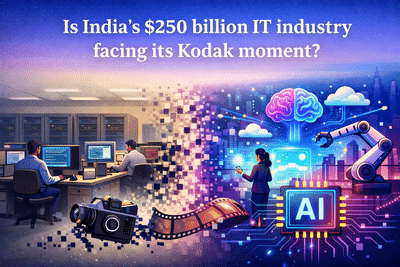
As Indian IT stocks bleed out, some down as much as one-third from their recent peaks, investors are asking something that would have seemed heretical just two years ago: can India's $250 billion technology services industry survive the AI revolution, or is it destined to become the next Kodak?
Wipro shares have shed 33% from its 52-week high. TCS, the sector's anchor, is down over 30%. Coforge has lost more than 30% of its value. Infosys is down 25%, LTIMindtree 21%, while HCL Tech and Tech Mahindra are nursing losses of 18-19%. In a single month, stocks across the sector have lost up to 21% of their value and the bear calls are growing louder.
Highly autonomous tools like Claude Cowork, Palantir's offerings, and a wave of similar platforms are threatening to disintermediate the IT services layer entirely. Bears argue that if AI enables enterprises to internally generate code, the foundational reason India's IT industry exists disappears.
How big is the AI risk?
Motilal Oswal's Abhishek Pathak has put a number on the immediate exposure. "We estimate that 12-15% of sector revenue faces direct exposure to AI-driven productivity and displacement risk, with incremental pressure from third-party software efficiencies and automation layers," he said. He is candid about the longer horizon: "In the long term, answers to whether the industry goes extinct, thrives, or just survives won't come by easily." For now, Pathak is holding his estimates steady, waiting for more evidence before updating the model to reflect the current narrative.
Self-built software, the kind that originally gave India's IT industry its reason to exist, has already shrunk from 35-40% of total software spend in the 1990s to just 14% today, as enterprises migrated to packaged software and vendor-led customisation. The fear is that AI violently reverses that trend, returning software creation to the enterprise and stranding Indian IT firms on the wrong side of history.
Also Read | Infosys-Anthropic deal sparks fresh debate: Is AI now an opportunity, not a threat, for Indian IT?
Nomura's Abhishek Bhandari, one of the more forceful voices pushing back against the bear case, argues the market is making a category error. "We believe these concerns are oversimplifying the role of IT services companies as they are the ones who reduce the friction between an enterprise and SaaS companies, and add services on top of that," he said.
The idea that a SaaS product and IT vendors can simply be replaced by vibe-coded apps, he contends, ignores a fundamental truth about how large enterprises make technology decisions. "Enterprise IT buyers optimise for career risk — reducing risks of failures — and not costs and innovations necessarily." Compliance, regulatory, business continuity are not problems that a nimble AI tool solves overnight.
"The current sell-off in IT services stocks appears to be a case of front-loading of pains — pricing in extinction of old business models before gains from new business models emerge,” Bhandari said.
Drawing historical analogies of application development and maintenance in the 2000s, remote infrastructure management in 2005 and cloud in 2015, the analyst argues that each of these previous events had triggered comparable fears of obsolescence but IT companies ultimately navigated. Revenue models, he acknowledges, will change significantly, shifting from traditional fixed-price and time-and-material structures toward outcome-driven contracts. But change in the business model is not the same as extinction.
Is AI a threat or opportunity?
The most striking counter-narrative to the Kodak thesis comes from Elara, which argues that AI paradoxically creates one of the largest services opportunities the industry has ever seen. There are more than 220 billion lines of COBOL code still running in production globally. Forty-five of the world's top 50 banks depend on it, as do insurance companies, telecoms, and airlines.
Also Read | Infosys' $400 billion AI dream fails to arrest stock slide, but target prices go up to Rs 2,050
Modernising that code from COBOL to AI-ready architecture costs between $3 and $7 per line. A standard 30-million-line modernisation project that previously cost around $210 million over seven years can now be completed in three years for under $90 million, thanks to AI acceleration. Elara analysts say COBOL modernisation alone represents a $600 billion-plus opportunity for IT companies. The very technology that the bears say will destroy Indian IT may, in fact, be the catalyst for its next phase of growth.
Infosys has already laid out a roadmap to capture a pie of the $300-400 billion AI services market opportunity.
Emkay frames the current dislocation as primarily psychological. "We believe the correction largely reflects fear of the unknown," it said. "With the impacts hard to quantify, investors have trimmed terminal growth assumptions."
At current valuations, large-cap IT services companies are trading at a free cash flow yield of 5-6%, with implied terminal growth of just 5-6%. The brokerage considers these levels as being excessively pessimistic for companies whose contextual understanding of enterprises' complex environments, domain knowledge, and client trust remain genuinely difficult to replicate. What will matter most going forward, Emkay argues, is management clarity on human-plus-agent offerings, business model transition toward outcome-based contracts, and consistent deal intake. A durable recovery, it cautions, will take time.
Tata Mutual Fund offers investors navigating the uncertainty a grounding thought. "The actual impact of disruption to IT companies is gradual, which will take time to build additional revenue sources coming out of AI transition — as happened in digital transformation," it said. The fund house notes that the market had already priced in a growth recovery in 2026 after two years of sluggish expansion; that recovery may now be delayed or shallower.
Are IT stocks cheap?
The saving grace is that valuations have corrected to absorb that disappointment. With earnings expectations stabilising and valuations within a reasonable band, it argues, the risk of further valuation-led downside looks limited.
Nomura's Bhandari also points to valuation support as a floor. Stocks are now trading below their 12-year historical averages and at a 12-39% discount to their 5-year averages. Free cash flow and dividend yields of 4-5% "will likely create a floor for stocks sooner than later." Guidance from Cognizant and Capgemini points to similar or improving organic growth in 2026 versus 2025, hardly the picture of an industry in terminal decline.
Unlike Kodak, which resisted adapting to the digital revolution till it was too late, Indian IT companies face no such psychological barrier and are already deploying AI aggressively, internally and externally, building platforms, forging partnerships, and reshaping their talent models. The question is whether the adaptation is fast and profitable enough to bridge the valley between the deflationary pressures of today and the growth opportunities of tomorrow.
(Disclaimer: Recommendations, suggestions, views, and opinions given by experts are their own. These do not represent the views of the Economic Times)
Wipro shares have shed 33% from its 52-week high. TCS, the sector's anchor, is down over 30%. Coforge has lost more than 30% of its value. Infosys is down 25%, LTIMindtree 21%, while HCL Tech and Tech Mahindra are nursing losses of 18-19%. In a single month, stocks across the sector have lost up to 21% of their value and the bear calls are growing louder.
Highly autonomous tools like Claude Cowork, Palantir's offerings, and a wave of similar platforms are threatening to disintermediate the IT services layer entirely. Bears argue that if AI enables enterprises to internally generate code, the foundational reason India's IT industry exists disappears.
How big is the AI risk?
Motilal Oswal's Abhishek Pathak has put a number on the immediate exposure. "We estimate that 12-15% of sector revenue faces direct exposure to AI-driven productivity and displacement risk, with incremental pressure from third-party software efficiencies and automation layers," he said. He is candid about the longer horizon: "In the long term, answers to whether the industry goes extinct, thrives, or just survives won't come by easily." For now, Pathak is holding his estimates steady, waiting for more evidence before updating the model to reflect the current narrative.
Self-built software, the kind that originally gave India's IT industry its reason to exist, has already shrunk from 35-40% of total software spend in the 1990s to just 14% today, as enterprises migrated to packaged software and vendor-led customisation. The fear is that AI violently reverses that trend, returning software creation to the enterprise and stranding Indian IT firms on the wrong side of history.
Also Read | Infosys-Anthropic deal sparks fresh debate: Is AI now an opportunity, not a threat, for Indian IT?
Nomura's Abhishek Bhandari, one of the more forceful voices pushing back against the bear case, argues the market is making a category error. "We believe these concerns are oversimplifying the role of IT services companies as they are the ones who reduce the friction between an enterprise and SaaS companies, and add services on top of that," he said.
The idea that a SaaS product and IT vendors can simply be replaced by vibe-coded apps, he contends, ignores a fundamental truth about how large enterprises make technology decisions. "Enterprise IT buyers optimise for career risk — reducing risks of failures — and not costs and innovations necessarily." Compliance, regulatory, business continuity are not problems that a nimble AI tool solves overnight.
"The current sell-off in IT services stocks appears to be a case of front-loading of pains — pricing in extinction of old business models before gains from new business models emerge,” Bhandari said.
Drawing historical analogies of application development and maintenance in the 2000s, remote infrastructure management in 2005 and cloud in 2015, the analyst argues that each of these previous events had triggered comparable fears of obsolescence but IT companies ultimately navigated. Revenue models, he acknowledges, will change significantly, shifting from traditional fixed-price and time-and-material structures toward outcome-driven contracts. But change in the business model is not the same as extinction.
Is AI a threat or opportunity?
The most striking counter-narrative to the Kodak thesis comes from Elara, which argues that AI paradoxically creates one of the largest services opportunities the industry has ever seen. There are more than 220 billion lines of COBOL code still running in production globally. Forty-five of the world's top 50 banks depend on it, as do insurance companies, telecoms, and airlines.
Also Read | Infosys' $400 billion AI dream fails to arrest stock slide, but target prices go up to Rs 2,050
Modernising that code from COBOL to AI-ready architecture costs between $3 and $7 per line. A standard 30-million-line modernisation project that previously cost around $210 million over seven years can now be completed in three years for under $90 million, thanks to AI acceleration. Elara analysts say COBOL modernisation alone represents a $600 billion-plus opportunity for IT companies. The very technology that the bears say will destroy Indian IT may, in fact, be the catalyst for its next phase of growth.
Infosys has already laid out a roadmap to capture a pie of the $300-400 billion AI services market opportunity.
Emkay frames the current dislocation as primarily psychological. "We believe the correction largely reflects fear of the unknown," it said. "With the impacts hard to quantify, investors have trimmed terminal growth assumptions."
At current valuations, large-cap IT services companies are trading at a free cash flow yield of 5-6%, with implied terminal growth of just 5-6%. The brokerage considers these levels as being excessively pessimistic for companies whose contextual understanding of enterprises' complex environments, domain knowledge, and client trust remain genuinely difficult to replicate. What will matter most going forward, Emkay argues, is management clarity on human-plus-agent offerings, business model transition toward outcome-based contracts, and consistent deal intake. A durable recovery, it cautions, will take time.
Tata Mutual Fund offers investors navigating the uncertainty a grounding thought. "The actual impact of disruption to IT companies is gradual, which will take time to build additional revenue sources coming out of AI transition — as happened in digital transformation," it said. The fund house notes that the market had already priced in a growth recovery in 2026 after two years of sluggish expansion; that recovery may now be delayed or shallower.
Are IT stocks cheap?
The saving grace is that valuations have corrected to absorb that disappointment. With earnings expectations stabilising and valuations within a reasonable band, it argues, the risk of further valuation-led downside looks limited.
Nomura's Bhandari also points to valuation support as a floor. Stocks are now trading below their 12-year historical averages and at a 12-39% discount to their 5-year averages. Free cash flow and dividend yields of 4-5% "will likely create a floor for stocks sooner than later." Guidance from Cognizant and Capgemini points to similar or improving organic growth in 2026 versus 2025, hardly the picture of an industry in terminal decline.
Unlike Kodak, which resisted adapting to the digital revolution till it was too late, Indian IT companies face no such psychological barrier and are already deploying AI aggressively, internally and externally, building platforms, forging partnerships, and reshaping their talent models. The question is whether the adaptation is fast and profitable enough to bridge the valley between the deflationary pressures of today and the growth opportunities of tomorrow.
(Disclaimer: Recommendations, suggestions, views, and opinions given by experts are their own. These do not represent the views of the Economic Times)
Next Story