
India in Flux: You earn well, so why does life still feel expensive? The new middle-class dilemma


A Rs 25 lakh annual package once symbolised stability, success and the promise of a comfortable life. Today, for many young professionals in India’s cities, it often feels like survival with better branding. The country’s new middle class is earning more than previous generations could have imagined, boosted by booming corporate salaries , startup culture , global opportunities and a rapidly expanding digital economy.

Yet beneath this prosperity lies a quieter reality shaped by anxiety and uncertainty. The same generation earning bigger paychecks is also grappling with rising rents, unaffordable housing, higher living costs and the fear of becoming professionally irrelevant in an AI-driven economy. Success itself has become challenging, constantly measured against curated online lives where achievement is displayed in real time.
To understand this complex world of middle-class earners, TOI spoke to professionals navigating these pressures firsthand.
Earning more than ever before
India’s urban middle class today lives in a dramatically different economy from the one their parents experienced. Liberalisation , technology and the startup boom have transformed career opportunities across sectors.
Bonuses, ESOPs, remote international work and freelance opportunities have further expanded earning potential.
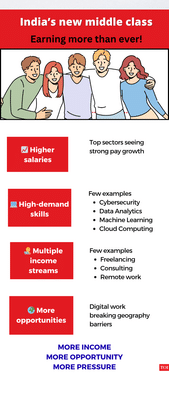
The shift is also visible in salary trends. According to EY’s Future of Pay 2026 report, companies in India are set to offer an average salary increase of 9.1 per cent in 2026, with Global Capability Centres, financial services and e-commerce among the top-paying sectors. Skills in AI, machine learning and cybersecurity are also commanding significant salary premiums.
Beyond salaries, access to opportunity itself has widened. Digital platforms, remote work and online learning have allowed professionals from smaller cities and middle-class backgrounds to enter industries that were once geographically or socially out of reach. Freelancing, consulting and creator-led work have also opened alternative income pathways beyond traditional corporate roles.
Rising cost of living
Higher incomes have not removed financial pressure; in many cases, they have simply reshaped it.
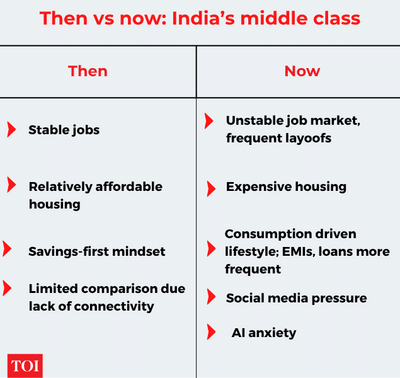
International travel, premium gadgets, fitness memberships, branded fashion and frequent dining out are now far more common in urban India. Social media has intensified this shift by turning everyday life into a constant benchmark of comparison.
At the same time, the cost of living in India’s major cities has increased sharply, particularly in housing, healthcare, education and transport. In many cases, expenses are rising at a pace that matches or even outstrips income growth, leaving limited real financial cushioning for young professionals.
Durgesh Kumar Jha, a public relations consultant, captures this internal tension. “I feel the biggest pressure comes from trying to balance everything together while still keeping yourself mentally stable,” he said. “People today are constantly thinking about the future, responsibilities, and expectations, and that pressure keeps building internally even if things look normal from the outside.”
He added that financial security is no longer just about income but also about having “peace of mind, discipline, and the ability to stay calm during uncertain situations.”
Meanwhile, for many in the new middle class, financial security remains a moving benchmark rather than a fixed state, shaped as much by rising obligations as by rising aspirations.
“I honestly feel more financially content than financially secure,” said Shristi Chaudhari, senior executive in regulatory intelligence and market research at a French MNC. She said that while she manages her finances responsibly and avoids stretching beyond her means, this sense of stability also comes from not yet having major responsibilities related to family and long-term commitments like many of her peers.
At the same time, Chaudhari noted that the pressure today is not always directly financial, but also tied to the pace and expectations of professional life. “The biggest pressure on me today is figuring out how to manage multitasking in my work while consistently meeting deadlines and delivering quality output at the same time,” she said, adding that what she seeks most now is “the resilience to balance all of this without compromise.”
Housing dream feels further away
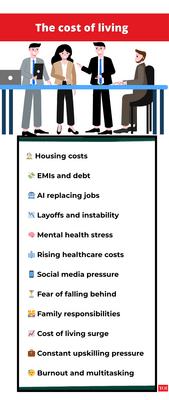
Rising salaries have not necessarily translated into long-term financial comfort. One of the biggest concerns for the middle class today is housing affordability, especially in metro cities.
According to Anarock Research’s 2025 housing market analysis, residential prices across major cities rose by around 8 per cent during the year, even as sales volumes declined by 14 per cent. Delhi-NCR recorded the sharpest increase among major metros, with prices rising by nearly 23 per cent.
Even professionals earning well above average often struggle to buy homes in the cities where they work. For many, rent itself has become a long-term financial burden. Salaries may have increased, but property prices and urban costs have risen faster, pushing homeownership further into the future.
Yash Sharma, a software engineer from Jaipur, said financial security today is “not a static feeling” and requires continuous adaptation as industries and careers evolve rapidly.
He agreed that “housing is another significant challenge, particularly in major metro cities where high rents and living costs can be difficult to manage, especially for fresh graduates and those in the early years of their careers.”
EMIs, dual incomes and new cost of milestones
Higher incomes have also reshaped how middle-class financial life is structured.
Dual-income households have become increasingly common in urban India, not only as a lifestyle choice but also as a financial necessity to manage rising living costs.
At the same time, EMIs and credit-based consumption have become central to financial planning. From housing loans to vehicle purchases and lifestyle spending, a significant share of monthly income is now committed to long-term repayments, reducing financial flexibility.
Together, these shifts have raised the threshold for financial readiness. Major life milestones such as buying a home, marriage or long-term financial planning are increasingly defined by affordability, job stability and sustained income potential rather than traditional timelines.
As Yash Sharma put it, “Rising expenses and balancing savings goals are also concerns that many people are navigating today,” adding his opinion on a solution for managing part of lifestyle. On managing lifestyle inflation, he added: “Living within one’s means, avoiding the tendency to increase expenses with every salary hike or promotion, building an emergency fund, and practising mindful personal finance can make a meaningful difference over the long term.”
AI and unstable careers beyond automation
Alongside financial pressure comes a growing fear around job security. Artificial intelligence has become one of the biggest concerns among white-collar professionals, but it is not the only factor reshaping anxiety.
Even beyond automation, unpredictability such as periodic layoffs have made long-term career stability increasingly uncertain in corporate life.
The India Economic Survey 2025–26 highlighted that generative AI could significantly disrupt white-collar employment, especially in sectors such as IT and outsourcing. Industry experts also warn that routine roles in marketing, accounting, legal services and project management are increasingly exposed to automation.
As a result, many professionals now feel constant pressure, not just for growth, but for survival in a rapidly shifting job market.
Health costs and silent stress
India is witnessing a rise in non-communicable diseases at younger ages. According to ICMR and NFHS-based health trend data, conditions such as diabetes, hypertension and obesity are increasingly being diagnosed in adults under 40, driven by sedentary lifestyles, long working hours and rising stress levels.
Mental health strain is also rising in urban populations. WHO has highlighted depression and anxiety as leading global health burdens, with workplace stress and fast-paced urban living contributing significantly to the problem, particularly among young professionals.
For many in the new middle class, health is no longer a later-life concern. It is becoming part of their present financial and emotional equation.
The pressure to keep up online
The growing uncertainty is not always visible externally. Many continue to appear financially successful online while internally dealing with burnout, fear and pressure.
The pressure to “keep up” has become one of the defining traits of the modern middle-class experience. Earlier generations compared themselves within neighbourhoods. Today, comparison happens constantly through screens, where curated lifestyles create unrealistic standards of success.
A promotion, a luxury vacation or even a new car has become part of a larger online performance of achievement. Increasing visibility of extreme wealth and success stories has also widened the perceived gap within the same generation.
Anyone who does not match these markers often feels they are falling behind or not doing enough.
Jolly Jain, founder of Amodini Designer Studio in Jaipur, said, “Social media has created lifestyle expectations that can sometimes make people feel they are behind in life, even when they are working extremely hard. For many entrepreneurs and young professionals, the challenge is not just earning money, but building something sustainable without burning out mentally and financially.”
She added, “I think financial security today is not only about income. It is also about having adaptability, multiple opportunities, strong relationships, and the confidence that you can rebuild even if challenges come.”
More than just money
Amid the anxiety, there is also resilience. India’s new middle class continues to adapt, learn new skills and chase opportunities in an increasingly competitive world.
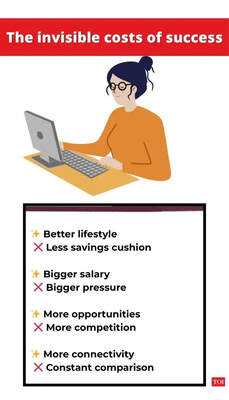
But the definition of success itself is shifting. It is no longer measured only by salary, assets or visible milestones, but also by stability, health, flexibility and the ability to stay mentally steady in an uncertain environment.
Because in today’s economy, the real question is not just how much people earn, but how much pressure that earning carries with it.
Yet beneath this prosperity lies a quieter reality shaped by anxiety and uncertainty. The same generation earning bigger paychecks is also grappling with rising rents, unaffordable housing, higher living costs and the fear of becoming professionally irrelevant in an AI-driven economy. Success itself has become challenging, constantly measured against curated online lives where achievement is displayed in real time.
To understand this complex world of middle-class earners, TOI spoke to professionals navigating these pressures firsthand.
Earning more than ever before
India’s urban middle class today lives in a dramatically different economy from the one their parents experienced. Liberalisation , technology and the startup boom have transformed career opportunities across sectors.
Bonuses, ESOPs, remote international work and freelance opportunities have further expanded earning potential.
The shift is also visible in salary trends. According to EY’s Future of Pay 2026 report, companies in India are set to offer an average salary increase of 9.1 per cent in 2026, with Global Capability Centres, financial services and e-commerce among the top-paying sectors. Skills in AI, machine learning and cybersecurity are also commanding significant salary premiums.
Beyond salaries, access to opportunity itself has widened. Digital platforms, remote work and online learning have allowed professionals from smaller cities and middle-class backgrounds to enter industries that were once geographically or socially out of reach. Freelancing, consulting and creator-led work have also opened alternative income pathways beyond traditional corporate roles.
Rising cost of living
Higher incomes have not removed financial pressure; in many cases, they have simply reshaped it.
International travel, premium gadgets, fitness memberships, branded fashion and frequent dining out are now far more common in urban India. Social media has intensified this shift by turning everyday life into a constant benchmark of comparison.
At the same time, the cost of living in India’s major cities has increased sharply, particularly in housing, healthcare, education and transport. In many cases, expenses are rising at a pace that matches or even outstrips income growth, leaving limited real financial cushioning for young professionals.
Durgesh Kumar Jha, a public relations consultant, captures this internal tension. “I feel the biggest pressure comes from trying to balance everything together while still keeping yourself mentally stable,” he said. “People today are constantly thinking about the future, responsibilities, and expectations, and that pressure keeps building internally even if things look normal from the outside.”
He added that financial security is no longer just about income but also about having “peace of mind, discipline, and the ability to stay calm during uncertain situations.”
Meanwhile, for many in the new middle class, financial security remains a moving benchmark rather than a fixed state, shaped as much by rising obligations as by rising aspirations.
“I honestly feel more financially content than financially secure,” said Shristi Chaudhari, senior executive in regulatory intelligence and market research at a French MNC. She said that while she manages her finances responsibly and avoids stretching beyond her means, this sense of stability also comes from not yet having major responsibilities related to family and long-term commitments like many of her peers.
At the same time, Chaudhari noted that the pressure today is not always directly financial, but also tied to the pace and expectations of professional life. “The biggest pressure on me today is figuring out how to manage multitasking in my work while consistently meeting deadlines and delivering quality output at the same time,” she said, adding that what she seeks most now is “the resilience to balance all of this without compromise.”
Housing dream feels further away
Rising salaries have not necessarily translated into long-term financial comfort. One of the biggest concerns for the middle class today is housing affordability, especially in metro cities.
According to Anarock Research’s 2025 housing market analysis, residential prices across major cities rose by around 8 per cent during the year, even as sales volumes declined by 14 per cent. Delhi-NCR recorded the sharpest increase among major metros, with prices rising by nearly 23 per cent.
Even professionals earning well above average often struggle to buy homes in the cities where they work. For many, rent itself has become a long-term financial burden. Salaries may have increased, but property prices and urban costs have risen faster, pushing homeownership further into the future.
Yash Sharma, a software engineer from Jaipur, said financial security today is “not a static feeling” and requires continuous adaptation as industries and careers evolve rapidly.
He agreed that “housing is another significant challenge, particularly in major metro cities where high rents and living costs can be difficult to manage, especially for fresh graduates and those in the early years of their careers.”
EMIs, dual incomes and new cost of milestones
Higher incomes have also reshaped how middle-class financial life is structured.
Dual-income households have become increasingly common in urban India, not only as a lifestyle choice but also as a financial necessity to manage rising living costs.
At the same time, EMIs and credit-based consumption have become central to financial planning. From housing loans to vehicle purchases and lifestyle spending, a significant share of monthly income is now committed to long-term repayments, reducing financial flexibility.
Together, these shifts have raised the threshold for financial readiness. Major life milestones such as buying a home, marriage or long-term financial planning are increasingly defined by affordability, job stability and sustained income potential rather than traditional timelines.
As Yash Sharma put it, “Rising expenses and balancing savings goals are also concerns that many people are navigating today,” adding his opinion on a solution for managing part of lifestyle. On managing lifestyle inflation, he added: “Living within one’s means, avoiding the tendency to increase expenses with every salary hike or promotion, building an emergency fund, and practising mindful personal finance can make a meaningful difference over the long term.”
AI and unstable careers beyond automation
Alongside financial pressure comes a growing fear around job security. Artificial intelligence has become one of the biggest concerns among white-collar professionals, but it is not the only factor reshaping anxiety.
Even beyond automation, unpredictability such as periodic layoffs have made long-term career stability increasingly uncertain in corporate life.
The India Economic Survey 2025–26 highlighted that generative AI could significantly disrupt white-collar employment, especially in sectors such as IT and outsourcing. Industry experts also warn that routine roles in marketing, accounting, legal services and project management are increasingly exposed to automation.
As a result, many professionals now feel constant pressure, not just for growth, but for survival in a rapidly shifting job market.
Health costs and silent stress
India is witnessing a rise in non-communicable diseases at younger ages. According to ICMR and NFHS-based health trend data, conditions such as diabetes, hypertension and obesity are increasingly being diagnosed in adults under 40, driven by sedentary lifestyles, long working hours and rising stress levels.
Mental health strain is also rising in urban populations. WHO has highlighted depression and anxiety as leading global health burdens, with workplace stress and fast-paced urban living contributing significantly to the problem, particularly among young professionals.
For many in the new middle class, health is no longer a later-life concern. It is becoming part of their present financial and emotional equation.
The pressure to keep up online
The growing uncertainty is not always visible externally. Many continue to appear financially successful online while internally dealing with burnout, fear and pressure.
The pressure to “keep up” has become one of the defining traits of the modern middle-class experience. Earlier generations compared themselves within neighbourhoods. Today, comparison happens constantly through screens, where curated lifestyles create unrealistic standards of success.
A promotion, a luxury vacation or even a new car has become part of a larger online performance of achievement. Increasing visibility of extreme wealth and success stories has also widened the perceived gap within the same generation.
Anyone who does not match these markers often feels they are falling behind or not doing enough.
Jolly Jain, founder of Amodini Designer Studio in Jaipur, said, “Social media has created lifestyle expectations that can sometimes make people feel they are behind in life, even when they are working extremely hard. For many entrepreneurs and young professionals, the challenge is not just earning money, but building something sustainable without burning out mentally and financially.”
She added, “I think financial security today is not only about income. It is also about having adaptability, multiple opportunities, strong relationships, and the confidence that you can rebuild even if challenges come.”
More than just money
Amid the anxiety, there is also resilience. India’s new middle class continues to adapt, learn new skills and chase opportunities in an increasingly competitive world.
But the definition of success itself is shifting. It is no longer measured only by salary, assets or visible milestones, but also by stability, health, flexibility and the ability to stay mentally steady in an uncertain environment.
Because in today’s economy, the real question is not just how much people earn, but how much pressure that earning carries with it.
Next Story