
Delhi Man’s SBI Account Debited by Rs 1.3 Lakh in 2018, Gets Rs 1.4 Lakh Refund After 8 Years

A major consumer court ruling has put the spotlight on banks' responsibility to investigate disputed transactions. The Delhi State Consumer Disputes Redressal Commission has upheld an order directing the State Bank of India (SBI) to pay ₹1.30 lakh to a customer after four ATM withdrawals and two account transfers were disputed as unauthorised.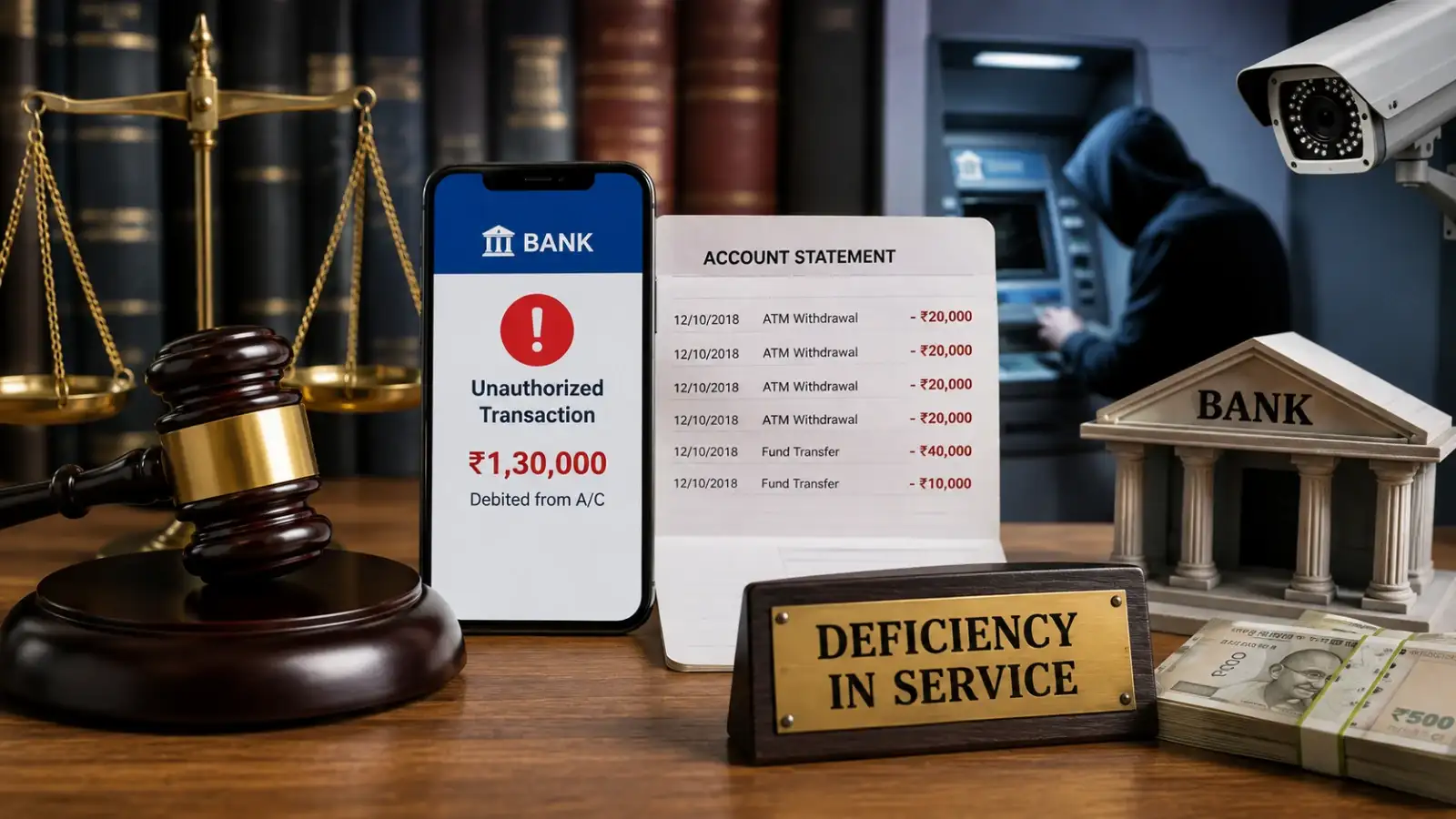
The bank has also been directed to pay ₹10,000 towards mental agony and litigation expenses, along with interest.
Four ATM Withdrawals, Two Transfers
The case concerns Amar Singh, whose account recorded four ATM withdrawals of ₹20,000 each on October 12, 2018. This amounted to ₹80,000.
On the same day, another ₹40,000 and ₹10,000 were transferred to an account belonging to a person identified as Sonu. Singh denied making or authorising these transactions.
On October 22, his ATM transaction failed because of insufficient balance. After updating his passbook, he discovered the disputed withdrawals and transfers. He immediately complained to SBI in writing and also filed an FIR at Mayur Vihar Phase-I police station.
When he received no response, Singh approached the bank again on March 6, 2019.
SBI Could Not Produce CCTV Footage
The Delhi District Consumer Commission had earlier found SBI deficient in service and ordered it to pay ₹1.30 lakh with 6% annual interest from October 12, 2018.
SBI challenged the decision, arguing that Singh had been negligent and had not reported the transactions within the required period. The bank also referred to RBI rules concerning customer liability in third-party fraud cases.
However, the state commission rejected SBI's defence.
“The District Commission has rightly held the Appellant Bank (SBI) guilty of deficiency in service as the Appellant failed to preserve and produce the CCTV footage of the disputed ATM transactions as well as failed to explain the processing of the unauthorised ATM withdrawals and amount transfers from bank account despite being in exclusive possession of the relevant electronic and documentary records,” the commission said.
Bank Had Records But Did Not Produce Them
Singh had specifically asked SBI to verify the disputed transactions and provide CCTV footage from the ATM. The bank failed to produce the footage before either consumer commission.
The commission also pointed to an NPCI circular dated March 26, 2013, concerning the availability of CCTV recordings for disputed ATM transactions when requested by customers.
Apart from CCTV footage, SBI had access to transaction logs, ATM journals, switch records and authentication details. Yet, these records were not produced to establish that the transactions had been properly authorised.
₹50,000 Transfers Also Remained Unexplained
The state commission concluded that SBI had failed to preserve evidence, explain the disputed transactions, establish that they were authorised and properly act on the customer's complaints.
It upheld the August 21, 2023 order of the Delhi District Consumer Commission and dismissed SBI's appeal on August 10, 2026. The original order included 6% annual interest on ₹1.30 lakh from October 12, 2018, along with ₹5,000 for mental agony and ₹5,000 towards litigation costs. If the amount was not paid within 30 days, the interest rate would rise to 8% per annum until payment.
What Should You Do After an Unauthorised Transaction?
If you notice an unfamiliar withdrawal or transfer in your bank account, report it to the bank immediately. Keep a written record of your complaint and preserve relevant statements, messages and transaction details.
Consumers facing similar complaints can seek help through their state consumer helpline. In Delhi, the helpline number is 011-23379146. The National Consumer Helpline can be reached at 1915.
The bank has also been directed to pay ₹10,000 towards mental agony and litigation expenses, along with interest.
Four ATM Withdrawals, Two Transfers
The case concerns Amar Singh, whose account recorded four ATM withdrawals of ₹20,000 each on October 12, 2018. This amounted to ₹80,000.
On the same day, another ₹40,000 and ₹10,000 were transferred to an account belonging to a person identified as Sonu. Singh denied making or authorising these transactions.
On October 22, his ATM transaction failed because of insufficient balance. After updating his passbook, he discovered the disputed withdrawals and transfers. He immediately complained to SBI in writing and also filed an FIR at Mayur Vihar Phase-I police station.
When he received no response, Singh approached the bank again on March 6, 2019.
SBI Could Not Produce CCTV Footage
The Delhi District Consumer Commission had earlier found SBI deficient in service and ordered it to pay ₹1.30 lakh with 6% annual interest from October 12, 2018.
SBI challenged the decision, arguing that Singh had been negligent and had not reported the transactions within the required period. The bank also referred to RBI rules concerning customer liability in third-party fraud cases.
However, the state commission rejected SBI's defence.
“The District Commission has rightly held the Appellant Bank (SBI) guilty of deficiency in service as the Appellant failed to preserve and produce the CCTV footage of the disputed ATM transactions as well as failed to explain the processing of the unauthorised ATM withdrawals and amount transfers from bank account despite being in exclusive possession of the relevant electronic and documentary records,” the commission said.
Bank Had Records But Did Not Produce Them
Singh had specifically asked SBI to verify the disputed transactions and provide CCTV footage from the ATM. The bank failed to produce the footage before either consumer commission.
You may also like
- US tariff threat on Russian oil: Bill a concern for India, but 'talks have been reassuring'
- Indraprastha Gas Profit Falls 44% To ₹237.9 Crore In Q1 FY27, Revenue Rises 17%
- Babus, mantris & buzz: Will the Delimitation Bill decide DMK-Congress relations?
- Ceylon Sapphires Open New Avenues to Strengthen India–Sri Lanka Partnership
- Crypto becomes Gen Z's gateway to investing in India: Report
The commission also pointed to an NPCI circular dated March 26, 2013, concerning the availability of CCTV recordings for disputed ATM transactions when requested by customers.
Apart from CCTV footage, SBI had access to transaction logs, ATM journals, switch records and authentication details. Yet, these records were not produced to establish that the transactions had been properly authorised.
₹50,000 Transfers Also Remained Unexplained
- Singh also denied visiting the bank branch or approving the ₹40,000 and ₹10,000 transfers.
- The commission said that once the customer disputed the transactions, SBI had to provide documents such as debit slips, transfer vouchers or transaction authorisation records to prove that they were genuine.
- The bank failed to produce these records or demonstrate that it had properly investigated how the transfers were made.
- These cumulative lapses completely undermine the defence set up by the Appellant and justify the findings returned by the district commission, the commission said.
The state commission concluded that SBI had failed to preserve evidence, explain the disputed transactions, establish that they were authorised and properly act on the customer's complaints.
It upheld the August 21, 2023 order of the Delhi District Consumer Commission and dismissed SBI's appeal on August 10, 2026. The original order included 6% annual interest on ₹1.30 lakh from October 12, 2018, along with ₹5,000 for mental agony and ₹5,000 towards litigation costs. If the amount was not paid within 30 days, the interest rate would rise to 8% per annum until payment.
What Should You Do After an Unauthorised Transaction?
If you notice an unfamiliar withdrawal or transfer in your bank account, report it to the bank immediately. Keep a written record of your complaint and preserve relevant statements, messages and transaction details.
Consumers facing similar complaints can seek help through their state consumer helpline. In Delhi, the helpline number is 011-23379146. The National Consumer Helpline can be reached at 1915.






Loving Newspoint? Download the app now
