
Sister got brother's property not wife; here's why


Recently, The Supreme Court ruled that merely because a husband's Will does not include his wife and children (legal heirs) for some of his properties, it cannot be termed as suspicious especially since the husband had written in his Will that his wife and children have sufficient properties given by him in his lifetime.
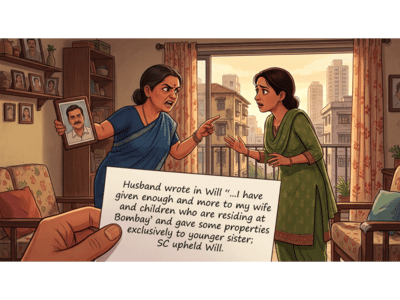
Before dying, the husband had written this in his last Will: "I am doing no injustice to my wife and children or other relatives…I have given enough and more to my wife and children who are residing at Bombay".
What had happened here
This judgement came against the background of a case filed by a wife and her five children as her husband in his last Will did not give her some properties and instead gave them exclusively to his sister.
To tell in a brief about her husband, B. Sheena Nairi, he was a permanent resident of Bombay and during his lifetime worked as a Chartered Accountant at five big reputed companies. Besides owning a residential flat in Bombay, he owned substantial other immovable properties situated at Brahmavar and Chanthar Village, Udupi Taluk, Karnataka, consisting primarily of agricultural lands and ancestral properties.
To tell you more about his (husband, B. Sheena Nairi) family, wife and kids, he was married to Parvathi Nairthi (Appellant No. 1), and they had five children. He also had had two sisters and two brothers:
However, the POA was only for management of the properties and ownership remained with him (B. Sheena Nairi) only. On May 15, 1983 he executed his last Will and gave some of the properties to his younger sister Laxmi Nairthy's (Plaintiff and Respondent No. 1), and cancelled the POA executed in favour of his brother-in-law.
However, on November 30, 1983 at 69 years of age, he died of a heart attack while in Delhi.
Also read: Hindu Succession Act: When a woman’s property may go to her husband's legal heirs before her own parents
This is where the dispute between his wife and his younger sister started. His wife argued that his alleged last Will is fraudulent as it excluded her and their five children (natural legal heirs) from inheriting the said properties which were given exclusively to his younger sister, Laxmi Nairthy.
Thus she (Parvathi Nairthi, wife) took matters into her own hands and on February 1, 1984 filed an application with the Tehsildar of Udupi for the transfer of her husband's properties in her favour (mutation).
The Tehsildar of Udupi, issued notice under the Karnataka Land Revenue Act, 1964 and called for the objections with respect to the said properties. When nobody objected, the Tehsildar of Udupi on April 6, 1984 passed a mutation order transferring the properties in her favour (wife, Parvathi Nairthi).
When she (younger sister Laxmi Nairthy) got to know about this mutation, she felt aggrieved and thus she filed a civil case against her (brother's wife) on November 22, 1990 (O.S. No. 186 of 1990).
Also read: Forged Will row: Buyer should not face criminal case for purchasing land on the basis of Will which police found to be forged; rules SC
This case was filed by her (younger sister) with the Court of the Additional Civil Judge (Senior Division), Udupi seeking a declaration that she is the absolute owner of the said properties under her brother's (B. Sheena Nairi) last Will.
To counter her claims, his wife (Parvathi Nairthi) and her five children, filed a written statement in court and contended that the Will is false and fabricated since he (husband) never executed any Will. She (wife) also contended that after his death, the said Will was created by his brothers, B. Jagannatha Nairi (elder brother) and Lakshmana Nairi (younger brother), in collusion with each other.
She (wife) also argued in court that the said properties were never in possession of Laxmi Nairthy (younger sister) as he had never revoked the POA executed in favour of Krishnayya Nairi.
The Trial Court, on December 16, 2008 allowed Laxmi Nairthy (younger sister)’s case and declared that she is the owner of these properties and also opened an enquiry for mense profits which is payable to her.
The trial court observed that his elder brother B. Jagannatha Nairi (PW2), who was one of the attesting witnesses to the Will categorically deposed that his brother (B. Sheena Nairi) had executed the Will in his presence and that the signature appearing on the Will belonged to him (B. Sheena Nairi).
However, the wife and children of the testator, except filing the written statement, had not produced any witness and had not appeared for cross-examination in order to prove their allegations.
The trial court said that on their (wife and children) behalf, only the POA holder appeared and had given his evidence which was doubtful. Also, the wife and the children had not specifically crossexamined Laxmi Nairthy (younger sister) and B. Jagannatha Nairi-PW2 to prove the Will as fraudulent.
Feeling aggrieved, she (wife) filed an appeal in the first appellate court. On August 6, 2012, the first appellate court dismissed the appeal and affirmed the findings of the Trial Court. Still aggrieved, she filed a second appeal (R.S.A No. 1970 of 2012) before the High Court of Karnataka. On November 15, 2012, the Karnataka High Court dismissed her second appeal.
She filed an appeal in the Supreme Court after losing the appeal in Karnataka High Court. On May 21, 2026, she lost the case in Supreme Court.
The wife and her children had contended that the action of her husband whereby he allegedly cut them off from the said properties in itself constitutes a suspicious circumstance surrounding the execution of the said Will.
The Supreme Court said that another bench of the court in another judgement (Ram Piari v. Bhagwant and Ors.(1990) 3 SCC 364) held that in the absence of an explanation as to why natural legal heirs are excluded from the Will it does not automatically make the Will invalid, but it can make the Court more cautious and suspicious while checking whether the Will was genuinely voluntary.
The Supreme Court said: “Mere exclusion of the natural heirs from the property of the testator (husband, B. Sheena Nairi), by itself, cannot be construed as a suspicious circumstance so as to invalidate a Will outrightly.”
Thus, the Supreme Court said that they are are of the view that the exclusion of the natural heirs cannot be sufficient to vitiate the Will in question, particularly when the Will clearly specifies that he (husband, B. Sheena Nairi) has not done any injustice to his wife, children, or other relatives, and that he has given enough to his wife and children who are residing at Bombay.
Keep reading to know why she lost the case in the Supreme Court.
Why did she lose the case?
Sadia Khan, Partner at Shardul Amarchand Mangaldas & Co, says that this decision is significant as it reinforces a fundamental and well-established principle of testamentary succession that the mere exclusion of natural heirs does not, by itself, render a Will invalid, as the very purpose of executing a Will is to depart from the natural course of succession that would otherwise apply under the Hindu Succession Act.
According to Khan, for estate planners, testators and beneficiaries alike, the judgment underscores a simple but critical principle: the most effective safeguard against future succession disputes is not merely a well-drafted Will, but one that is properly executed with attestation by two or more witnesses in accordance with law.
Khan says: "Where it can be established that a Will was duly executed by the testator voluntarily out of their free will while in a sound state of mind, and the same is proved through the testimony of one of the attesting witnesses, the mere exclusion of natural heirs cannot constitute a ground for invalidating such a Will."
Acording to Khan, even though registration of a Will is not mandatory under Indian law, the validity of an unregistered Will cannot be questioned solely on account of its non-registration, registration of a Will provides an additional layer of safeguard and evidentiary assurance.
Khan says: "The registration of a Will creates an independent record of the execution of the Will, thereby reducing the scope for subsequent allegations of fraud, coercion or fabrication."
Do individuals still need to register their Wills since the law does not mandate them?
Keshav Singhania, Head – Private Client, Singhania& Co. said to ET Wealth Online that a registered Will is presented before the Sub-Registrar office of the concerned district and recorded in the official registration records. Registration of Will is not compulsory under the law. Non-registration of Will(s) does not, by itself, lead to any adverse inference against its and remains a personal choice of the Testator.
Singhania says that once a Will is registered, it is kept in the safe custody of the Registrar reducing the risk of it being tampered with, destroyed, mutilated, misplaced or stolen. Registration is advisable for the following additional reasons:
Supreme Court order and analysis
A summary of the Supreme Court judgement (2026 INSC 521) is below:
Principles for the validity and execution of a Will
The Supreme Court reproduced Section 68 of the Indian Evidence Act, 1872, and said:
“Section 68—Proof of Execution of Document Required by Law to be Attested—If a document is required by law to be attested, it shall not be used as evidence until one attesting witness at least has been called for the purpose of proving its execution, if there be an attesting witness alive and subject to the process of the court and capable of giving evidence: xxx”
Case law cited: Meena Pradhan and Others v. Kamla Pradhan and Another (2023 SCC OnLine SC 1198)
The Supreme Court also referred to other cases and explained how the validity and execution of a Will can be seen, and after a careful perusal of the relevant material on record and applying the settled proposition of law, said that it is evident that the Will was duly executed by the husband (B. Sheena Nairi) voluntarily out of his free will in a sound state of mind.
The Supreme Court said that this is proved through the testimony of one of the attesting witnesses, B. Jagannatha Nairi (his elder brother), who was examined by the Trial Court.
This witness B. Jagannatha Nairi (his elder brother) categorically stated that B. Sheena Nairi (his brother, husband) executed the Will in question in his presence and that both he and B. Sheena Nairi signed the Will in the presence of each other.
Claim of title based on a Will
The Supreme Court also rejected the wife (Parvathi Nairthi’s) and her five children’s argument where they said that the Will first became common knowledge after seven years of his (B. Sheena Nairi, husband) death and thus must be rejected.
The Supreme Court said that their (wife’s and her five children’s) contention has been considered by all the courts, which concurrently held that his younger sister Laxmi Nairthy on February 10, 1984, had already given a representation notice to the Tehsildar of Udupi to mutate her name, and the said notice was received by the concerned authorities as evidenced by the postal certificate.
The Supreme Court also observed that although there was no material which disclosed that Laxmi Nairthy (younger sister) had produced the copy of the Will before the concerned authority but the said notice to the Tehsildar of Udupi itself disclosed all relevant facts, including the execution of the Will in favour of the Plaintiff, without any delay.
All the courts have duly examined the said issue thoroughly and have recorded concurrent findings, and thus, we are also in conformity with the same.
Mutation records do not give ownership of property
Parvathi Nairthi (wife) also argued before the court that they got the mutation in their name in 1984 itself, so by this logic, they own the properties.
The Supreme Court said that it is well settled that such mutation entries do not confer title and it is effected merely for fiscal purposes, namely, to enable the state to realise tax from the person whose name is recorded in the revenue records.
Case law cited: Balwant Singh And Another v. Daulat Singh (Dead) By LRs. And Others (1997) 7 SCC 137).
Non-registration of Will has no bearing on its validity
The Supreme Court said that Parvathi Nairthi’s (the wife’s) contention that the Will is unregistered has no significant bearing on its validity, as this court in the case of Ishwardeo Narain Singh v. Kamta Devi And Others ((1953) 1 SCC 295) has clearly held that:
“There is nothing in law which requires the registration of a Will and Wills are in a majority of cases not registered at all. To draw any inference against the genuineness of the will on the ground of its non-registration appears to us to be wholly unwarranted.”
Scope of suspicious circumstances to vitiate a Will
The wife (Parvathi Nairthi) and her children had contended that they are the natural heirs and thus should get those properties given exclusively to her husband’s younger sister. The wife also argued that this action in itself constitutes a suspicious circumstance surrounding the execution of the Will.
The Supreme Court said that this contention is legally untenable.
The Supreme Court said: “It is well-established that mere deprivation of natural heirs, by itself, may not amount to a suspicious circumstance because the whole idea behind the execution of a Will is to interfere with the normal line of succession.”
Case law cited: Rabindra Nath Mukherjee and Another v. Panchanan Banerjee (Dead) by LRs and Others (1995) 4 SCC 459)
In the case of Ram Piari v. Bhagwant and Ors. (1990) 3 SCC 364, the Supreme Court had held that prudence requires a reason for denying the benefit of inheritance to natural heirs and an absence of it, though not invalidating the Will in all cases, shrouds the disposition with suspicion as it does not give inking to the mind of the testator to enable the court to judge that the disposition was a voluntary act.
The Supreme Court said that another bench of their court in the case of Indu Bala Bose & Ors. v. Manindra Chandra Bose & Anr. (1982) 1 SCC 20, held that-
“Needless to say, any and every circumstance is not a “suspicious” circumstance. A circumstance would be “suspicious” when it is not normal or is not normally expected in a normal situation or is not expected of a normal person.”
The Supreme Court said that with regard to the prudence to be drawn while determining the suspicious circumstances, all the courts have unambiguously opined that the Will in question was validly executed.
The Supreme Court said: “It is trite to state that when the validity of a Will is to be determined, the overall terms of a Will, the intention of the testator, and the surrounding circumstances have also to be seen.”
Evidentiary Value of Affidavits
The wife (Parvathi Nairthi) and children also contended that the affidavits of both the attesting witnesses to the Will, denying that they had signed the same, render the Will invalid. The Supreme Court said that this contention is unsustainable.
The Supreme Court said that another bench of their court in the case of Ayaaubkhan Noorkhan Pathan v. State of Maharashtra and Others (2013) 4 SCC 465 has categorically held that an affidavit is not an “evidence” within the meaning of Section 3 of the Indian Evidence Act, 1872.
In that case, the court also said that an affidavit can be used as “evidence” only if, for sufficient reasons, the court passes an order under Order XIX of CPC.
Thus, the Supreme Court in this present case said that the filing of an affidavit cannot be regarded as sufficient evidence for any court or tribunal, on the basis of which it can come to a conclusion as regards a particular fact situation.
The Supreme Court said: “However, in a case where the deponent is available for cross-examination and an opportunity is given to the other side to cross-examine him, the same can be relied upon.”
In the present case, it is also important to note that those affidavits were filed even prior to the filing of the written statement, and the same has been rightly dealt with by all the courts, which questioned as to how the witnesses came to know about the enquiry regarding the validity of the Will despite no notice having been issued by the court calling upon them to submit such affidavits.
Before dying, the husband had written this in his last Will: "I am doing no injustice to my wife and children or other relatives…I have given enough and more to my wife and children who are residing at Bombay".
What had happened here
This judgement came against the background of a case filed by a wife and her five children as her husband in his last Will did not give her some properties and instead gave them exclusively to his sister.
To tell in a brief about her husband, B. Sheena Nairi, he was a permanent resident of Bombay and during his lifetime worked as a Chartered Accountant at five big reputed companies. Besides owning a residential flat in Bombay, he owned substantial other immovable properties situated at Brahmavar and Chanthar Village, Udupi Taluk, Karnataka, consisting primarily of agricultural lands and ancestral properties.
To tell you more about his (husband, B. Sheena Nairi) family, wife and kids, he was married to Parvathi Nairthi (Appellant No. 1), and they had five children. He also had had two sisters and two brothers:
- Akkanni Nairi (elder sister),
- Laxmi Nairthy (younger sister),
- B. Jagannatha Nairi (elder brother), and
- B. Lakshmana Nairi (younger brother).
However, the POA was only for management of the properties and ownership remained with him (B. Sheena Nairi) only. On May 15, 1983 he executed his last Will and gave some of the properties to his younger sister Laxmi Nairthy's (Plaintiff and Respondent No. 1), and cancelled the POA executed in favour of his brother-in-law.
However, on November 30, 1983 at 69 years of age, he died of a heart attack while in Delhi.
Also read: Hindu Succession Act: When a woman’s property may go to her husband's legal heirs before her own parents
This is where the dispute between his wife and his younger sister started. His wife argued that his alleged last Will is fraudulent as it excluded her and their five children (natural legal heirs) from inheriting the said properties which were given exclusively to his younger sister, Laxmi Nairthy.
Thus she (Parvathi Nairthi, wife) took matters into her own hands and on February 1, 1984 filed an application with the Tehsildar of Udupi for the transfer of her husband's properties in her favour (mutation).
The Tehsildar of Udupi, issued notice under the Karnataka Land Revenue Act, 1964 and called for the objections with respect to the said properties. When nobody objected, the Tehsildar of Udupi on April 6, 1984 passed a mutation order transferring the properties in her favour (wife, Parvathi Nairthi).
When she (younger sister Laxmi Nairthy) got to know about this mutation, she felt aggrieved and thus she filed a civil case against her (brother's wife) on November 22, 1990 (O.S. No. 186 of 1990).
Also read: Forged Will row: Buyer should not face criminal case for purchasing land on the basis of Will which police found to be forged; rules SC
This case was filed by her (younger sister) with the Court of the Additional Civil Judge (Senior Division), Udupi seeking a declaration that she is the absolute owner of the said properties under her brother's (B. Sheena Nairi) last Will.
To counter her claims, his wife (Parvathi Nairthi) and her five children, filed a written statement in court and contended that the Will is false and fabricated since he (husband) never executed any Will. She (wife) also contended that after his death, the said Will was created by his brothers, B. Jagannatha Nairi (elder brother) and Lakshmana Nairi (younger brother), in collusion with each other.
She (wife) also argued in court that the said properties were never in possession of Laxmi Nairthy (younger sister) as he had never revoked the POA executed in favour of Krishnayya Nairi.
The Trial Court, on December 16, 2008 allowed Laxmi Nairthy (younger sister)’s case and declared that she is the owner of these properties and also opened an enquiry for mense profits which is payable to her.
The trial court observed that his elder brother B. Jagannatha Nairi (PW2), who was one of the attesting witnesses to the Will categorically deposed that his brother (B. Sheena Nairi) had executed the Will in his presence and that the signature appearing on the Will belonged to him (B. Sheena Nairi).
However, the wife and children of the testator, except filing the written statement, had not produced any witness and had not appeared for cross-examination in order to prove their allegations.
The trial court said that on their (wife and children) behalf, only the POA holder appeared and had given his evidence which was doubtful. Also, the wife and the children had not specifically crossexamined Laxmi Nairthy (younger sister) and B. Jagannatha Nairi-PW2 to prove the Will as fraudulent.
Feeling aggrieved, she (wife) filed an appeal in the first appellate court. On August 6, 2012, the first appellate court dismissed the appeal and affirmed the findings of the Trial Court. Still aggrieved, she filed a second appeal (R.S.A No. 1970 of 2012) before the High Court of Karnataka. On November 15, 2012, the Karnataka High Court dismissed her second appeal.
She filed an appeal in the Supreme Court after losing the appeal in Karnataka High Court. On May 21, 2026, she lost the case in Supreme Court.
The wife and her children had contended that the action of her husband whereby he allegedly cut them off from the said properties in itself constitutes a suspicious circumstance surrounding the execution of the said Will.
The Supreme Court said that another bench of the court in another judgement (Ram Piari v. Bhagwant and Ors.(1990) 3 SCC 364) held that in the absence of an explanation as to why natural legal heirs are excluded from the Will it does not automatically make the Will invalid, but it can make the Court more cautious and suspicious while checking whether the Will was genuinely voluntary.
The Supreme Court said: “Mere exclusion of the natural heirs from the property of the testator (husband, B. Sheena Nairi), by itself, cannot be construed as a suspicious circumstance so as to invalidate a Will outrightly.”
Thus, the Supreme Court said that they are are of the view that the exclusion of the natural heirs cannot be sufficient to vitiate the Will in question, particularly when the Will clearly specifies that he (husband, B. Sheena Nairi) has not done any injustice to his wife, children, or other relatives, and that he has given enough to his wife and children who are residing at Bombay.
Keep reading to know why she lost the case in the Supreme Court.
Why did she lose the case?
Sadia Khan, Partner at Shardul Amarchand Mangaldas & Co, says that this decision is significant as it reinforces a fundamental and well-established principle of testamentary succession that the mere exclusion of natural heirs does not, by itself, render a Will invalid, as the very purpose of executing a Will is to depart from the natural course of succession that would otherwise apply under the Hindu Succession Act.
According to Khan, for estate planners, testators and beneficiaries alike, the judgment underscores a simple but critical principle: the most effective safeguard against future succession disputes is not merely a well-drafted Will, but one that is properly executed with attestation by two or more witnesses in accordance with law.
Khan says: "Where it can be established that a Will was duly executed by the testator voluntarily out of their free will while in a sound state of mind, and the same is proved through the testimony of one of the attesting witnesses, the mere exclusion of natural heirs cannot constitute a ground for invalidating such a Will."
Acording to Khan, even though registration of a Will is not mandatory under Indian law, the validity of an unregistered Will cannot be questioned solely on account of its non-registration, registration of a Will provides an additional layer of safeguard and evidentiary assurance.
Khan says: "The registration of a Will creates an independent record of the execution of the Will, thereby reducing the scope for subsequent allegations of fraud, coercion or fabrication."
Do individuals still need to register their Wills since the law does not mandate them?
Keshav Singhania, Head – Private Client, Singhania& Co. said to ET Wealth Online that a registered Will is presented before the Sub-Registrar office of the concerned district and recorded in the official registration records. Registration of Will is not compulsory under the law. Non-registration of Will(s) does not, by itself, lead to any adverse inference against its and remains a personal choice of the Testator.
Singhania says that once a Will is registered, it is kept in the safe custody of the Registrar reducing the risk of it being tampered with, destroyed, mutilated, misplaced or stolen. Registration is advisable for the following additional reasons:
- Provides proof that proper parties (Testator and Independent Witnesses) appeared before the Registering Officer and that their identities were verified before registration.
- Provides additional supporting evidence, thereby reducing the possibility of dispute regarding the validity of the Will.
Supreme Court order and analysis
A summary of the Supreme Court judgement (2026 INSC 521) is below:
Principles for the validity and execution of a Will
The Supreme Court reproduced Section 68 of the Indian Evidence Act, 1872, and said:
“Section 68—Proof of Execution of Document Required by Law to be Attested—If a document is required by law to be attested, it shall not be used as evidence until one attesting witness at least has been called for the purpose of proving its execution, if there be an attesting witness alive and subject to the process of the court and capable of giving evidence: xxx”
Case law cited: Meena Pradhan and Others v. Kamla Pradhan and Another (2023 SCC OnLine SC 1198)
The Supreme Court also referred to other cases and explained how the validity and execution of a Will can be seen, and after a careful perusal of the relevant material on record and applying the settled proposition of law, said that it is evident that the Will was duly executed by the husband (B. Sheena Nairi) voluntarily out of his free will in a sound state of mind.
The Supreme Court said that this is proved through the testimony of one of the attesting witnesses, B. Jagannatha Nairi (his elder brother), who was examined by the Trial Court.
This witness B. Jagannatha Nairi (his elder brother) categorically stated that B. Sheena Nairi (his brother, husband) executed the Will in question in his presence and that both he and B. Sheena Nairi signed the Will in the presence of each other.
Claim of title based on a Will
The Supreme Court also rejected the wife (Parvathi Nairthi’s) and her five children’s argument where they said that the Will first became common knowledge after seven years of his (B. Sheena Nairi, husband) death and thus must be rejected.
The Supreme Court said that their (wife’s and her five children’s) contention has been considered by all the courts, which concurrently held that his younger sister Laxmi Nairthy on February 10, 1984, had already given a representation notice to the Tehsildar of Udupi to mutate her name, and the said notice was received by the concerned authorities as evidenced by the postal certificate.
The Supreme Court also observed that although there was no material which disclosed that Laxmi Nairthy (younger sister) had produced the copy of the Will before the concerned authority but the said notice to the Tehsildar of Udupi itself disclosed all relevant facts, including the execution of the Will in favour of the Plaintiff, without any delay.
All the courts have duly examined the said issue thoroughly and have recorded concurrent findings, and thus, we are also in conformity with the same.
Mutation records do not give ownership of property
Parvathi Nairthi (wife) also argued before the court that they got the mutation in their name in 1984 itself, so by this logic, they own the properties.
The Supreme Court said that it is well settled that such mutation entries do not confer title and it is effected merely for fiscal purposes, namely, to enable the state to realise tax from the person whose name is recorded in the revenue records.
Case law cited: Balwant Singh And Another v. Daulat Singh (Dead) By LRs. And Others (1997) 7 SCC 137).
Non-registration of Will has no bearing on its validity
The Supreme Court said that Parvathi Nairthi’s (the wife’s) contention that the Will is unregistered has no significant bearing on its validity, as this court in the case of Ishwardeo Narain Singh v. Kamta Devi And Others ((1953) 1 SCC 295) has clearly held that:
“There is nothing in law which requires the registration of a Will and Wills are in a majority of cases not registered at all. To draw any inference against the genuineness of the will on the ground of its non-registration appears to us to be wholly unwarranted.”
Scope of suspicious circumstances to vitiate a Will
The wife (Parvathi Nairthi) and her children had contended that they are the natural heirs and thus should get those properties given exclusively to her husband’s younger sister. The wife also argued that this action in itself constitutes a suspicious circumstance surrounding the execution of the Will.
The Supreme Court said that this contention is legally untenable.
The Supreme Court said: “It is well-established that mere deprivation of natural heirs, by itself, may not amount to a suspicious circumstance because the whole idea behind the execution of a Will is to interfere with the normal line of succession.”
Case law cited: Rabindra Nath Mukherjee and Another v. Panchanan Banerjee (Dead) by LRs and Others (1995) 4 SCC 459)
In the case of Ram Piari v. Bhagwant and Ors. (1990) 3 SCC 364, the Supreme Court had held that prudence requires a reason for denying the benefit of inheritance to natural heirs and an absence of it, though not invalidating the Will in all cases, shrouds the disposition with suspicion as it does not give inking to the mind of the testator to enable the court to judge that the disposition was a voluntary act.
The Supreme Court said that another bench of their court in the case of Indu Bala Bose & Ors. v. Manindra Chandra Bose & Anr. (1982) 1 SCC 20, held that-
“Needless to say, any and every circumstance is not a “suspicious” circumstance. A circumstance would be “suspicious” when it is not normal or is not normally expected in a normal situation or is not expected of a normal person.”
The Supreme Court said that with regard to the prudence to be drawn while determining the suspicious circumstances, all the courts have unambiguously opined that the Will in question was validly executed.
The Supreme Court said: “It is trite to state that when the validity of a Will is to be determined, the overall terms of a Will, the intention of the testator, and the surrounding circumstances have also to be seen.”
Evidentiary Value of Affidavits
The wife (Parvathi Nairthi) and children also contended that the affidavits of both the attesting witnesses to the Will, denying that they had signed the same, render the Will invalid. The Supreme Court said that this contention is unsustainable.
The Supreme Court said that another bench of their court in the case of Ayaaubkhan Noorkhan Pathan v. State of Maharashtra and Others (2013) 4 SCC 465 has categorically held that an affidavit is not an “evidence” within the meaning of Section 3 of the Indian Evidence Act, 1872.
In that case, the court also said that an affidavit can be used as “evidence” only if, for sufficient reasons, the court passes an order under Order XIX of CPC.
Thus, the Supreme Court in this present case said that the filing of an affidavit cannot be regarded as sufficient evidence for any court or tribunal, on the basis of which it can come to a conclusion as regards a particular fact situation.
The Supreme Court said: “However, in a case where the deponent is available for cross-examination and an opportunity is given to the other side to cross-examine him, the same can be relied upon.”
In the present case, it is also important to note that those affidavits were filed even prior to the filing of the written statement, and the same has been rightly dealt with by all the courts, which questioned as to how the witnesses came to know about the enquiry regarding the validity of the Will despite no notice having been issued by the court calling upon them to submit such affidavits.
Next Story