
Campuses train new-age fraud hunters in Gujarat


Ahmedabad: When National Forensic Sciences University (NFSU) in Gandhinagar opened applications for two new MBA programmes — one in forensic accounting and fraud investigation , the other in fintech forensics — it received over 1,000 applications for 80 seats combined. That is roughly 13 applicants for every place. For a non-technical postgraduate course, NFSU officials say it is among the highest application rates recorded this year.
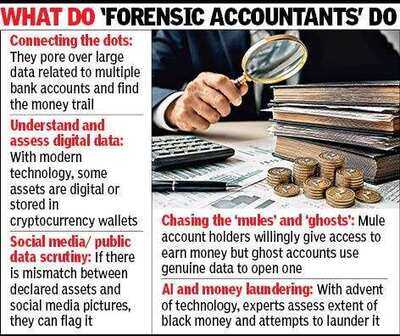
As financial crimes grow in scale and sophistication, forensic accounting classrooms in Gujarat are filling up fast. It is not just NFSU, Parul University in Vadodara has started offering MBA in forensic accounting and corporate fraud investigation from this year. For the past few years, it has also been mandatory for the chartered accountancy students to undergo module to understand the forensic accounting.
Prof Haresh Barot, dean of the School of Management Studies at NFSU, linked it directly to the evolving fraud landscape. “We see it in close association with incremental rise in financial crimes and frauds using technology,” he said. “In addition to conventional accounting, the investigators are now trained in use of AI tools for fraud detection and financial discrepancies.”
The past couple of years have also seen a spike in short-term training courses for the state police and central agencies, he added. “The tools of the trade have changed, and academia must keep up with the evolving technology.”
The numbers underpinning the momentum are stark. The Reserve Bank of India (RBI) has put the figure of financial frauds in the year 2025-26 at Rs 48,000 crore, up from Rs 32,800 crore in 2024-25. Cyber fraud losses are also mounting – Indians lost more than Rs 22,000 crore to scams involving interstate and international gangs in 2025, according to the Indian Cyber Crime Coordination Centre (I4C) under the Ministry of Home Affairs.
For universities, the spike is translating into new courses and closer industry engagement, especially as Gujarat pushes to expand its fintech footprint with initiatives such as GIFT City . The students, said experts, are frequently working with the Big Four of consulting along with several MNCs.
“We also offer courses in forensic accounting, fraud investigations, and cybersecurity as part of BSc and MSc programmes. The future of fraud investigation is not about human versus machine. It is about the seamless integration of computational intelligence for anomaly detection and human forensic expertise,” said Dr Amit Chauhan, head of the Department of Forensic Science at Parul University.
Police officials see the marked shift in crime patterns – while the last year was abuzz with digital arrest incidents, a year before saw a slew of investment and identity frauds in the state. While AI is used for committing crime, sleuths are using the similar tools to thwart it and solve it.
Some MBA (finance) programmes in the state have begun offering forensic accounting as an elective or minor, but full-fledged degrees remain limited, they said.
The discipline is also entering conventional professional pipelines. CA Aniket Talati, who served as national president of the Institute of Chartered Accountants of India in 2023-24, points to forensic audit’s presence in the CA Final syllabus. “The CA Final course has paper 3 covering forensic audit,” he said. “The students are expected to learn about various methods through which the financial crimes take place and how to investigate them with the aim to expose financial irregularities and systematic data collection that can be used as evidence. It is need of the hour with the crimes getting more and more sophisticated over the years with use of technology.”
As financial crimes grow in scale and sophistication, forensic accounting classrooms in Gujarat are filling up fast. It is not just NFSU, Parul University in Vadodara has started offering MBA in forensic accounting and corporate fraud investigation from this year. For the past few years, it has also been mandatory for the chartered accountancy students to undergo module to understand the forensic accounting.
Prof Haresh Barot, dean of the School of Management Studies at NFSU, linked it directly to the evolving fraud landscape. “We see it in close association with incremental rise in financial crimes and frauds using technology,” he said. “In addition to conventional accounting, the investigators are now trained in use of AI tools for fraud detection and financial discrepancies.”
The past couple of years have also seen a spike in short-term training courses for the state police and central agencies, he added. “The tools of the trade have changed, and academia must keep up with the evolving technology.”
The numbers underpinning the momentum are stark. The Reserve Bank of India (RBI) has put the figure of financial frauds in the year 2025-26 at Rs 48,000 crore, up from Rs 32,800 crore in 2024-25. Cyber fraud losses are also mounting – Indians lost more than Rs 22,000 crore to scams involving interstate and international gangs in 2025, according to the Indian Cyber Crime Coordination Centre (I4C) under the Ministry of Home Affairs.
For universities, the spike is translating into new courses and closer industry engagement, especially as Gujarat pushes to expand its fintech footprint with initiatives such as GIFT City . The students, said experts, are frequently working with the Big Four of consulting along with several MNCs.
“We also offer courses in forensic accounting, fraud investigations, and cybersecurity as part of BSc and MSc programmes. The future of fraud investigation is not about human versus machine. It is about the seamless integration of computational intelligence for anomaly detection and human forensic expertise,” said Dr Amit Chauhan, head of the Department of Forensic Science at Parul University.
Police officials see the marked shift in crime patterns – while the last year was abuzz with digital arrest incidents, a year before saw a slew of investment and identity frauds in the state. While AI is used for committing crime, sleuths are using the similar tools to thwart it and solve it.
Some MBA (finance) programmes in the state have begun offering forensic accounting as an elective or minor, but full-fledged degrees remain limited, they said.
The discipline is also entering conventional professional pipelines. CA Aniket Talati, who served as national president of the Institute of Chartered Accountants of India in 2023-24, points to forensic audit’s presence in the CA Final syllabus. “The CA Final course has paper 3 covering forensic audit,” he said. “The students are expected to learn about various methods through which the financial crimes take place and how to investigate them with the aim to expose financial irregularities and systematic data collection that can be used as evidence. It is need of the hour with the crimes getting more and more sophisticated over the years with use of technology.”
Next Story