
Kochi's Chinese Fishing Nets: How They Work and Where They Came From

Kochi's Chinese Fishing Nets are among the most recognisable sights along Kerala's coastline, attracting visitors with their unusual design and traditional fishing technique. These massive shore-operated fishing structures use a system of bamboo poles, ropes and counterweights to lower large nets into the water and lift them back with the catch. Popularly seen along the waterfront of Fort Kochi, these centuries-old nets have a fascinating history, with their origins linked to Chinese maritime influences. But how do they actually work, and how did they become part of Kochi's coastal heritage?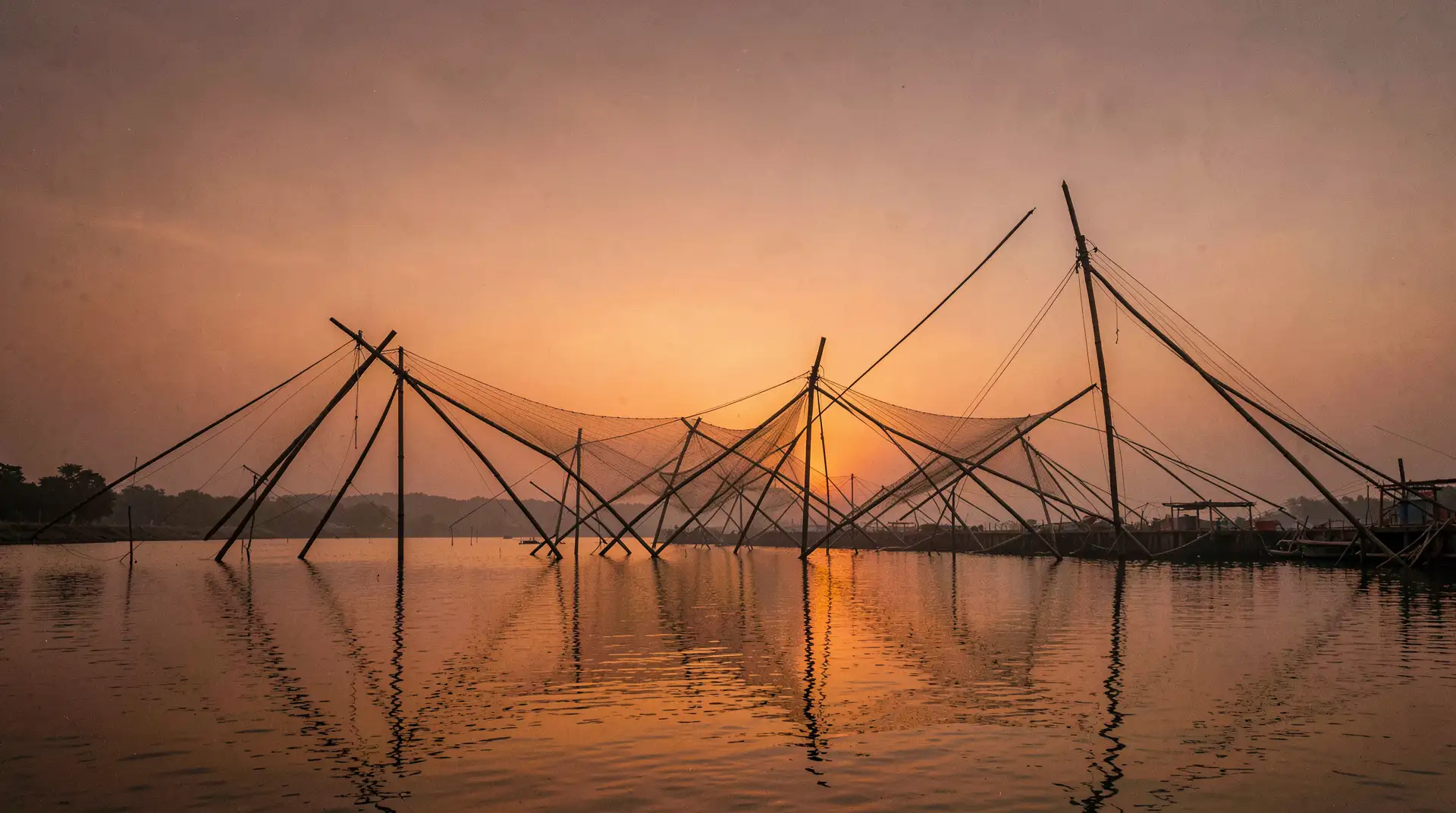
To fish, the crew hauls the landward end down by hand, pulling ropes. This drives the net end up and swings the whole arm out over the water. They let the net drop into the shallows, wait a few minutes for fish to drift over it, then release the ropes. The counterweights do the lifting, pulling the landward end back down and raising the net smoothly out of the water. The catch is small by trawler standards, a few kilograms at a time, but the method costs almost nothing to run and leaves the sea floor undisturbed.
The technology is almost certainly older than Zheng He's voyages. Fixed-counterweight dip nets of the same basic design appear in Chinese records and in paintings from the Song dynasty, centuries earlier. What the Malabar connection gave them was a new home. Local fishermen adopted the design, built their own versions from local timber, and worked them into the rhythms of the Kochi waterfront so completely that the nets outlasted every other trace of the Chinese trading presence.
Similar nets survive in scattered locations across South and Southeast Asia, parts of Vietnam, Sri Lanka, and the Konkan coast, wherever Chinese maritime trade routes touched a sheltered shoreline with the right depth of water. Kochi's are the most intact concentration, and the only ones still used commercially on a daily basis.
There are roughly two dozen working installations left. Each belongs to a family or a small cooperative. The work is passed down, though fewer young people are learning it. The nets are not profitable enough on their own to sustain a household in the way they once did; most operators now earn as much from tourists who pay to pull the ropes as from the fish they land. That shift has changed the waterfront's character without erasing it. The nets still go out at dawn and at dusk, the counterweights still do their quiet work, and the catch still moves to the stone slab and then to a pan a street away.
The counterweight principle is the same one a child discovers on a seesaw. The arm, the pivot, the weight on one end balancing the load on the other, it is not complicated. What is remarkable is that a solution this simple, carried from one coast to another across the fifteenth-century maritime world, found exactly the right shoreline and stayed there.
The Mechanism Behind the Nets
Each installation is a lever, nothing more. A tall wooden mast is planted in the shore. A long horizontal arm, traditionally teak or bamboo, now sometimes a mix of both, is lashed to the mast at a pivot point roughly a third of the way from the landward end. From the seaward end hangs the net, spread wide by a frame of poles. From the landward end hang the counterweights: river stones, sometimes concrete blocks, heavy enough that the net end of the arm wants to rise when unloaded.To fish, the crew hauls the landward end down by hand, pulling ropes. This drives the net end up and swings the whole arm out over the water. They let the net drop into the shallows, wait a few minutes for fish to drift over it, then release the ropes. The counterweights do the lifting, pulling the landward end back down and raising the net smoothly out of the water. The catch is small by trawler standards, a few kilograms at a time, but the method costs almost nothing to run and leaves the sea floor undisturbed.
Where They Came From
The nets are called cheena vala in Malayalam, cheena meaning China. The name is the oldest record of their origin. The most widely held account traces them to the court of the Chinese explorer Zheng He, whose fleet made several voyages to the Malabar Coast in the early fifteenth century. Kochi was a significant stop on that route: a deep natural harbour at the mouth of a backwater system, well placed for trade between the Arabian Sea and the interior of Kerala.The technology is almost certainly older than Zheng He's voyages. Fixed-counterweight dip nets of the same basic design appear in Chinese records and in paintings from the Song dynasty, centuries earlier. What the Malabar connection gave them was a new home. Local fishermen adopted the design, built their own versions from local timber, and worked them into the rhythms of the Kochi waterfront so completely that the nets outlasted every other trace of the Chinese trading presence.
Similar nets survive in scattered locations across South and Southeast Asia, parts of Vietnam, Sri Lanka, and the Konkan coast, wherever Chinese maritime trade routes touched a sheltered shoreline with the right depth of water. Kochi's are the most intact concentration, and the only ones still used commercially on a daily basis.
Fort Kochi and the Waterfront They Define
The nets stand along the tip of Fort Kochi, the narrow peninsula that separates the Arabian Sea from the backwaters behind it. This was the first European municipal town in India, established by the Portuguese in the early sixteenth century, later held by the Dutch and then the British. The waterfront carries all of that layering: a Portuguese church, Dutch-era warehouses, British bungalows, and at the very edge of the water, Chinese nets that predate all of them.There are roughly two dozen working installations left. Each belongs to a family or a small cooperative. The work is passed down, though fewer young people are learning it. The nets are not profitable enough on their own to sustain a household in the way they once did; most operators now earn as much from tourists who pay to pull the ropes as from the fish they land. That shift has changed the waterfront's character without erasing it. The nets still go out at dawn and at dusk, the counterweights still do their quiet work, and the catch still moves to the stone slab and then to a pan a street away.
What Makes Them Stay
A simpler technology would have been replaced by now. Trawlers, ring nets, and mechanised boats work the same waters and bring in far more fish per hour. The Chinese nets survive because they are fixed to the shore, because they require no fuel, because they fish a specific zone, the shallow tidal channel just off the tip of the peninsula, that other gear does not work well in, and because the families who own them have no reason to dismantle something that still functions and now draws visitors from every part of the world.The counterweight principle is the same one a child discovers on a seesaw. The arm, the pivot, the weight on one end balancing the load on the other, it is not complicated. What is remarkable is that a solution this simple, carried from one coast to another across the fifteenth-century maritime world, found exactly the right shoreline and stayed there.
Next Story